
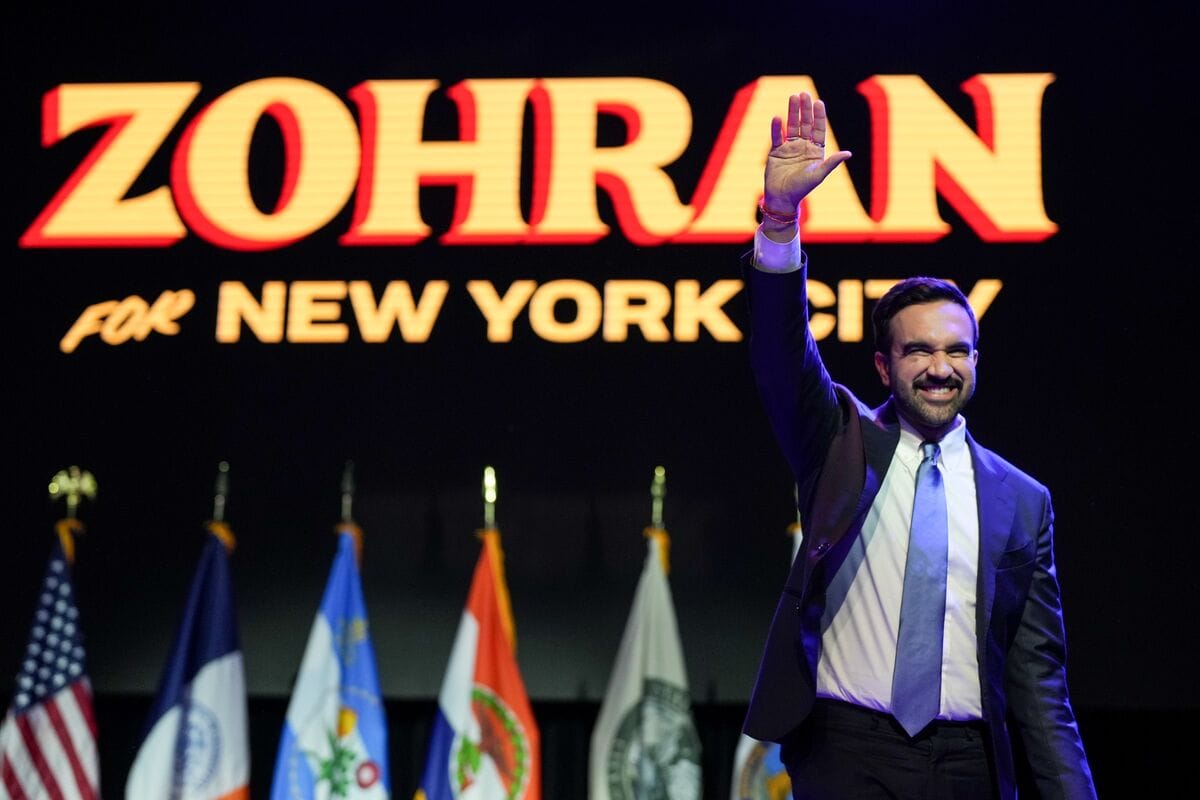
Democratic socialist Zohran Mamdani has been elected mayor of New York City, defeating former governor Andrew Cuomo in a closely watched race that highlighted a growing divide within the Democratic Party over technology and innovation policy.
According to the Associated Press, Mamdani captured 50.6% of the vote, ahead of Cuomo’s 41.2%, while Republican candidate Curtis Sliwa trailed behind. The victory cements Mamdani’s status as a rising progressive voice in New York politics and signals a shift in priorities for the city’s leadership.
 NELL CLARK
Cuomo’s Late Push for Crypto Innovation
In the final weeks of his campaign, Cuomo attempted to rebrand himself as a champion of emerging technologies, unveiling a plan to establish a chief innovation officer role to guide blockchain and cryptocurrency initiatives in the city. The position, Cuomo said, would focus on fostering collaboration between the public and private sectors while helping New York stay competitive in the fast-evolving tech economy.
Cuomo’s proposal, however, did not appear to sway voters. Political observers suggested that while the former governor’s ties to the tech industry were well-established, his message struggled to resonate beyond those circles.
“Establishment Democrats have traditionally had a strong relationship with the tech sector,” said Rebecca Liao, co-founder and CEO of the Web3 and AI startup Saga.
Liao, who also served on President Joe Biden’s 2020 campaign, noted that Mamdani’s base is less focused on crypto than on economic and social issues such as housing, healthcare, and workers’ rights.
A Reshaped Democratic Landscape
Cuomo, who lost the Democratic primary to Mamdani earlier this year, continued his campaign as an independent—a move that fractured the city’s centrist vote. Meanwhile, outgoing mayor Eric Adams, known for his strong crypto advocacy, exited the race in September amid financial and media pressures.
During his term, Adams had embraced digital assets, taking his first three paychecks in bitcoin and launching the Office of Blockchain and Digital Assets in October 2024—hailed as the first of its kind by a U.S. mayor. Mamdani, by contrast, has not made cryptocurrency a major part of his platform, focusing instead on affordability, public housing, and community investment.
Crypto Influence Extends Beyond New York
The conversation around crypto in politics extended across the Hudson River, where New Jersey’s gubernatorial race also drew attention. Democrat Mikie Sherrill defeated Republican Jack Ciattarelli, winning 57% to 42.4%, according to multiple outlets.
MIKE CATALINICrypto advocacy group Stand with Crypto claimed it played a significant role in mobilizing voters, noting that New Jersey is home to more than 80,000 crypto advocates—a number nearly matching the margin of victory in the state’s previous governor’s race.
CRYPTO! The best way to protect investors and users of cryptocurrency is to make it more mainstream. That’s exactly what the President did when he signed the first major cryptocurrency bill into federal law. In so doing, he also made cryptocurrency a more viable economic… pic.twitter.com/GyR8gtRvsM
— Jack Ciattarelli (@Jack4NJ) July 18, 2025
The group praised Sherrill for her pro-crypto stance, giving her an “A” rating on its policy scorecard and crediting her consistent support for legislation favorable to digital assets.
The Bigger Picture
While Mamdani’s victory in New York marks a turn away from crypto-driven politics, it underscores the growing influence of digital asset debates in American elections. As cities and states experiment with ways to integrate blockchain technology into public life, the divide between progressive priorities and tech-focused innovation is likely to remain a central theme in upcoming political cycles.



