

Decentralized lending protocol ZeroLend is winding down operations after its total value locked (TVL) plunged 98% from its peak, underscoring the challenges facing parts of the decentralized finance sector.
The project’s founder, known publicly as “Ryker,” announced the shutdown in a post on X, citing sustained operational losses and what he described as a weakening ecosystem that made the platform no longer viable.
— ZeroLend (@zerolendxyz) February 16, 2026
At its height in November 2024, ZeroLend held nearly $359 million in user deposits. As of this week, that figure has fallen to approximately $6.6 million, according to data from DefiLlama.
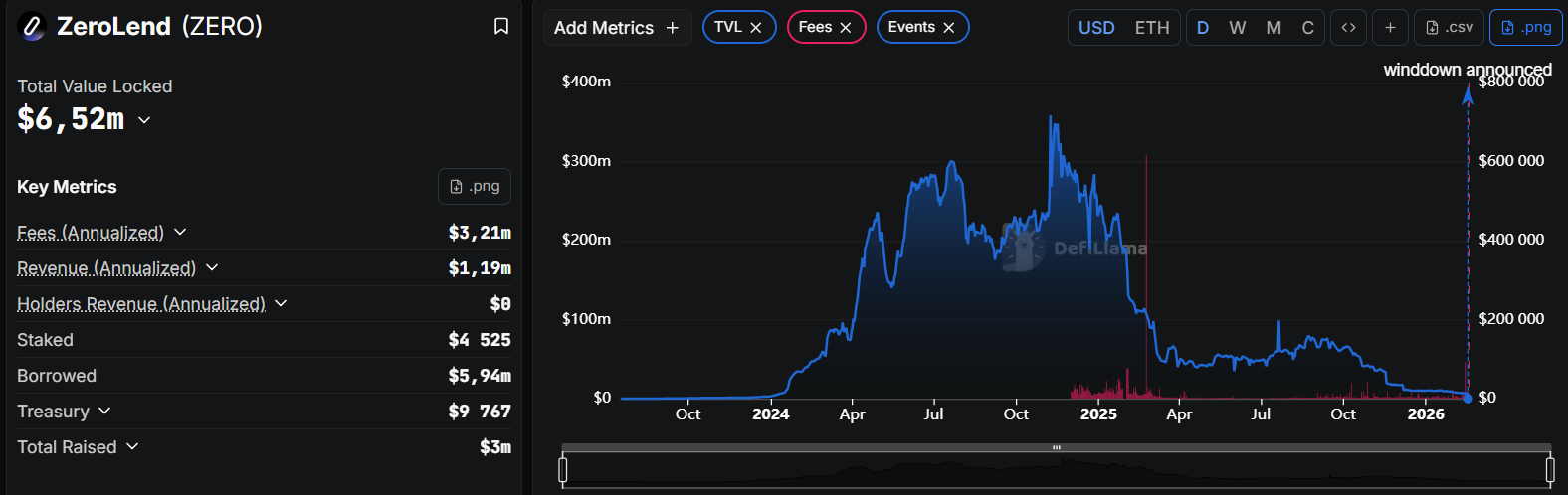
A Sharp Decline in Locked Assets
The remaining funds are spread across several blockchain networks. Around $2.75 million sits on Linea, $1.97 million on Ethereum, and roughly $933,000 on ZKsync Era. Smaller balances remain on networks such as Blast, Sonic, and Base.
The drop marks a dramatic reversal for a protocol that once positioned itself as a growing multi-chain lending platform. According to the founder, several issues compounded over time: early-stage chains that became inactive or illiquid, oracle providers discontinuing support, and increased attention from hackers and scammers as the protocol expanded.
Revenue Rise and Fall
Financial data shows that while ZeroLend experienced periods of revenue growth, it was unable to achieve long-term sustainability.
The protocol generated about $205,990 in earnings during 2024. That figure climbed to $1.17 million in 2025 before falling sharply to roughly $132,290 so far this year. Gross protocol revenue followed a similar path, peaking at $3.11 million in 2025 before dropping to around $355,000 in 2026.
Despite these revenue figures, the project never distributed income to ZERO token holders, leaving investors without yield or revenue-sharing benefits during its lifespan.
Withdrawal Process and Recovery Plans
For now, the team’s stated priority is helping users retrieve their remaining funds.
“Most markets have already been set to 0% loan-to-value,” Ryker wrote, urging users to withdraw assets as soon as possible.
Some pools present additional complications. Assets on Manta, Zircuit, and xLayer — where balances are comparatively small — are subject to a proposed “timelock upgrade” to the protocol’s smart contracts. The upgrade is intended to help redistribute funds currently locked in illiquid or inactive environments.
Ryker also addressed a separate incident involving LBTC users on Base dating back to February 2024. The team says it has been working to trace and recover those funds and plans to issue partial refunds using LINEA airdrop allocations received by the team. Affected users have been directed to contact support channels.
For ZERO token holders, however, there is no recovery plan. “For token holders, this marks the conclusion of the ZeroLend journey,” Ryker stated.
Token Price Reaction
The shutdown announcement triggered a sharp market reaction. The ZERO token fell 34% within 24 hours and has declined nearly entirely from its all-time high of $0.001 in May 2024, according to data from CoinGecko.
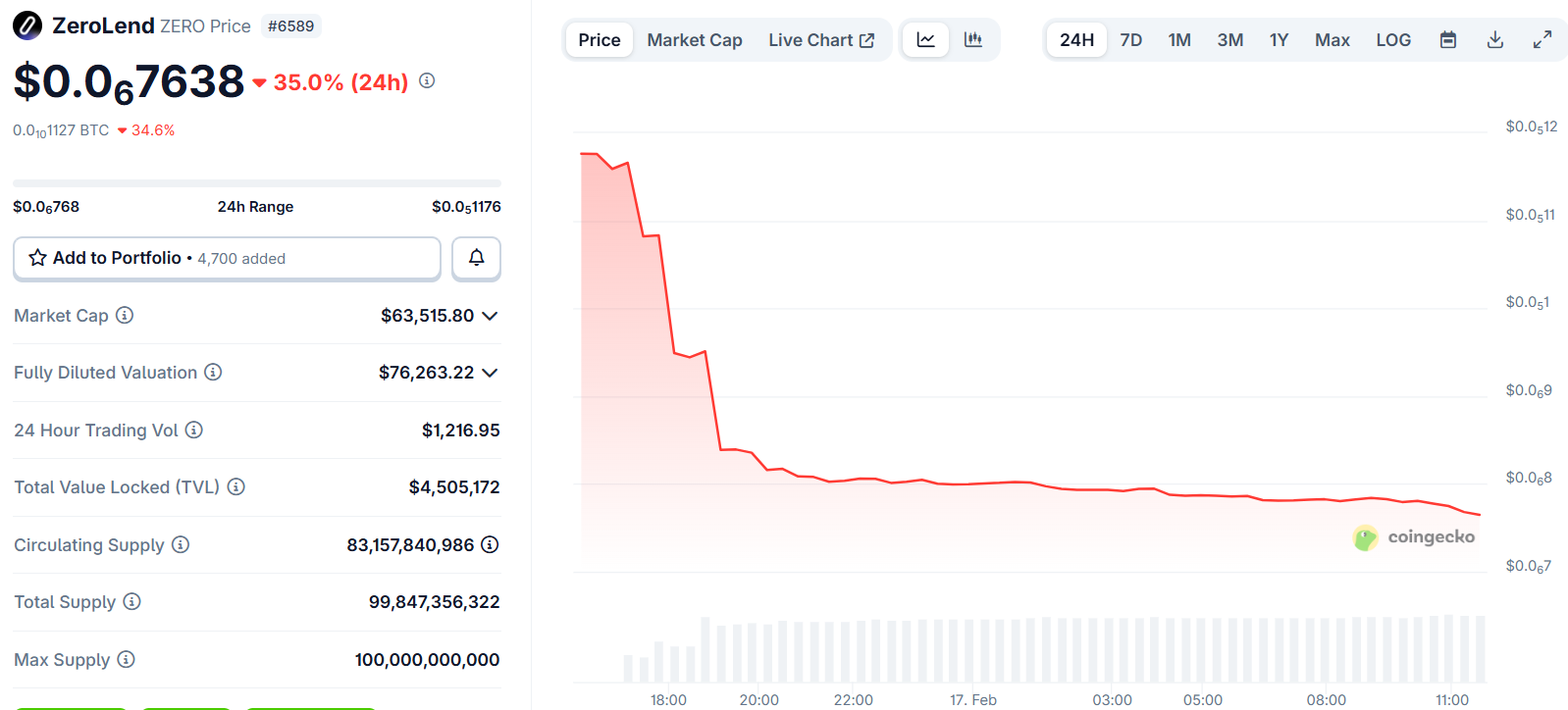
A Broader DeFi Reality Check
ZeroLend’s closure adds to a growing list of decentralized finance platforms struggling to maintain traction after rapid early growth. While multi-chain expansion and innovative lending models helped fuel initial adoption, long-term sustainability remains a challenge in a sector still shaped by liquidity cycles, security risks, and evolving infrastructure.
For users, the immediate focus is on withdrawing funds safely. For the wider DeFi community, the episode serves as a reminder that growth alone does not guarantee durability. As the industry matures, resilience and sound economics may prove just as important as innovation.



