

Generative AI fraud losses in the United States could reach $40 billion by 2027, according to Deloitte Center for Financial Services estimates. That projection is driving demand for verifiable media tools that can prove authenticity at the point of creation.
 Satish Lalchand
Succinct Labs, backed by Paradigm, has launched ZCAM, an iPhone application designed to cryptographically sign photos and videos at capture. The app generates a tamper-resistant record tied to the device, allowing users to confirm whether content is original or altered.
Can Cryptographic Proof Replace AI Detection Tools?
The product enters a market where AI-generated media is increasingly difficult to distinguish from real footage. Succinct’s approach differs from traditional detection systems by focusing on origin verification, using cryptographic hashes as digital fingerprints rather than relying on probabilistic analysis.
The company said ZCAM “signs photos and videos at the moment of capture, producing a tamper-proof record that links content to the device that captured it.” It added that the method enables independent verification of whether files were modified or synthetically generated.
Succinct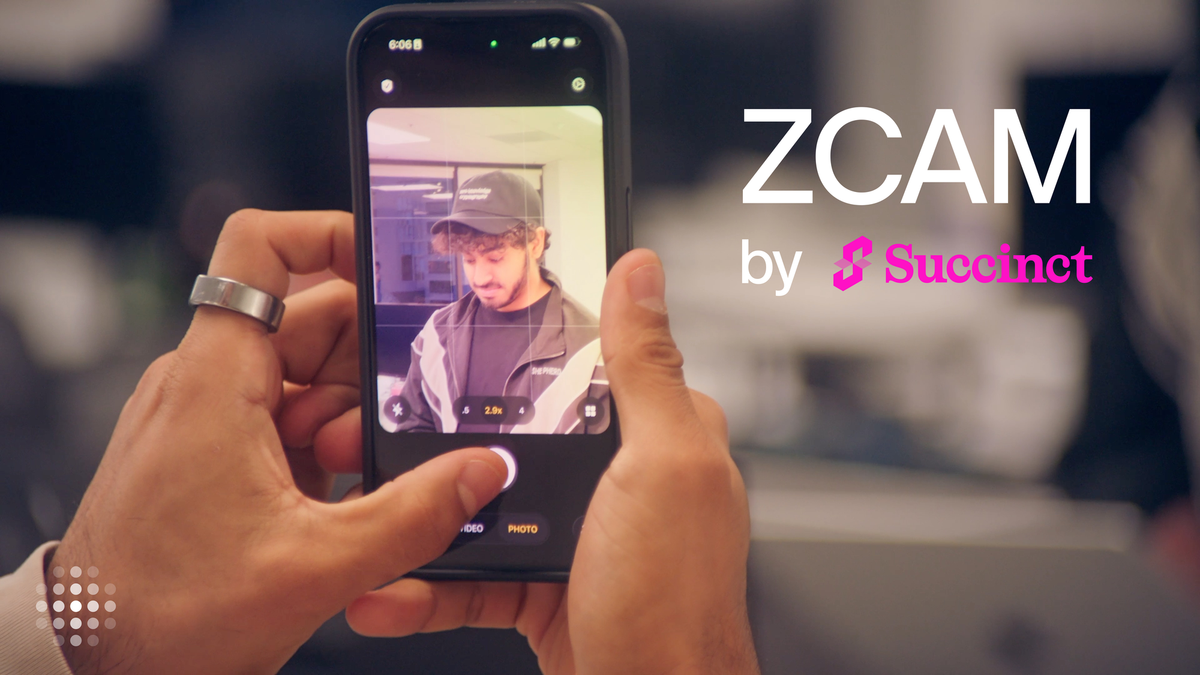
Adoption remains uncertain despite rising demand for trusted media workflows. The app requires users to capture content directly within ZCAM, which could limit uptake compared with default smartphone cameras, especially among casual users and social media creators.
Still, interest in cryptographic identity and verification systems is expanding across the sector. Projects like World, backed by Sam Altman, are exploring parallel approaches to distinguish human-generated activity from AI-driven outputs.
Succinct’s broader infrastructure push supports the launch. The firm’s zero-knowledge systems secure over $4 billion in digital assets, and its decentralized prover network on Ethereum enables applications to request and verify proofs across a distributed marketplace.
Will enterprises and media organizations shift workflows to prioritize verifiable capture over post-production validation? The next catalyst will be whether major platforms or publishers integrate ZCAM-style signing into standard content pipelines.



