Coinbase-backed x402 is transitioning to Linux Foundation governance, expanding oversight to a consortium of global tech and payments firms. The shift formalizes a neutral structure for an internet-native payments protocol targeting both crypto and traditional rails.
The move brings contributors including Amazon Web Services, American Express, Google, Mastercard, Microsoft, Visa, and Shopify, alongside crypto-native groups such as Polygon Labs and the Solana Foundation. Coinbase incubated the protocol with support from Cloudflare and Stripe, both of which will remain active under the new foundation structure announced Thursday.
Can Open Governance Unlock Agentic Payments Adoption?
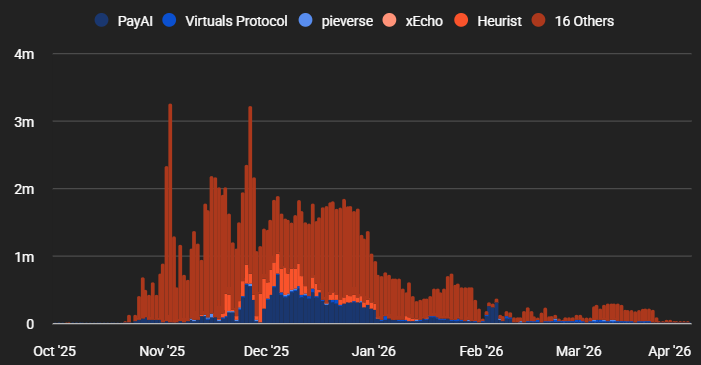
The transition reflects a broader push toward open standards in digital payments infrastructure. The Linux Foundation model, which also underpins projects like Kubernetes and Hyperledger Fabric, allows independent governance while encouraging enterprise participation. By comparison, x402 currently processes daily transaction volumes in the tens of thousands, according to data, indicating early-stage adoption relative to global payment networks.
“The internet was built on open protocols,” said Jim Zemlin, CEO of the Linux Foundation.
He added that the x402 Foundation will operate as a community-governed environment to ensure interoperability and transparency across contributors. Stripe Business Lead Kevin Miller said the firm is preparing infrastructure for “agentic commerce,” highlighting demand for systems that enable autonomous software agents to transact at scale.
The protocol revives the unused HTTP 402 “Payment Required” status code, positioning itself as a native payments layer for the internet. Recent development has focused on making x402 compatible with artificial intelligence agents, including tools for wallet creation and multi-rail support spanning Base, Polygon, Solana, credit cards, and bank transfers.
Competing efforts are emerging in parallel. Stripe and Tempo recently introduced a Machine Payments Protocol, while Visa launched a command-line payments tool aimed at automated systems. Still, fragmentation across standards remains a constraint for adoption in the agentic economy.
Governance under the Linux Foundation may accelerate coordination across these efforts as institutional contributors align on shared infrastructure. The next catalyst will depend on whether enterprise adoption translates into sustained transaction growth beyond experimental volumes.