
Wrapped Bitcoin (WBTC), the largest tokenized version of Bitcoin, is set to expand its reach to Solana through a new integration with interoperability protocol Hyperlane. The move introduces a direct, canonical bridge that allows users to transfer native WBTC between Ethereum and Solana, opening the door for Bitcoin-backed liquidity to flow more freely across ecosystems.
The integration will be powered by Hyperlane’s Nexus Bridge, an open-source interoperability solution designed to connect different blockchains without centralized gatekeepers. According to the announcement, the bridge enables holders to move WBTC seamlessly between Ethereum, where it was first launched, and the increasingly active Solana network.
“As demand grows for Bitcoin liquidity across high-throughput networks, it’s critical that interoperability is secure, reliable, and permissionless,” the WBTC team said in a statement. “Hyperlane enables us to extend WBTC to Solana in a way that aligns with those standards, giving developers and users seamless access to Bitcoin-backed liquidity.”
Expanding Bitcoin’s Utility Beyond Its Native Chain
Launched in January 2019, Wrapped Bitcoin was among the first ERC-20 tokens backed 1:1 by Bitcoin. The product allows Bitcoin holders to use their BTC value on blockchains that do not natively support it, such as Ethereum and TRON. By tokenizing Bitcoin, WBTC made it possible for BTC holders to participate in decentralized finance applications, lending protocols, and trading platforms outside the Bitcoin network.
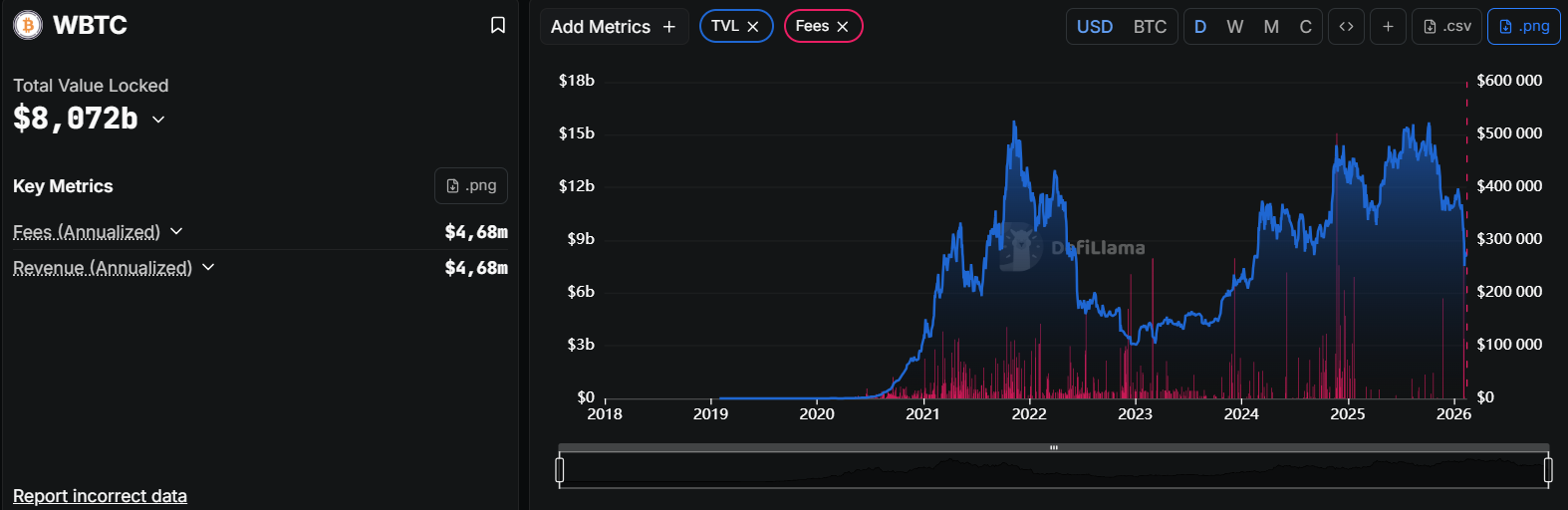
Today, WBTC has a market capitalization of roughly $8 billion, according to data. It remains the largest tokenized Bitcoin product on the market, based on figures from DefiLlama.
Each WBTC token is backed by an equivalent amount of Bitcoin held in custody. Initially, digital asset custodian BitGo served as the sole custodian. In 2024, however, BitGo shifted to what it described as a “multi-jurisdictional, multi-institutional” custody model in partnership with BiT Global, a regulated Hong Kong-based custody platform with ties to entrepreneur Justin Sun.
That transition sparked debate within parts of the crypto industry. Some projects, including MakerDAO and Coinbase, moved to distance themselves from WBTC following the custody update. Coinbase later introduced its own competing tokenized Bitcoin product, cbBTC. Sun publicly threatened legal action over Coinbase’s delisting of WBTC but ultimately withdrew the case.
A New Liquidity Path for Solana
The expansion to Solana comes as developers and investors seek faster and lower-cost environments for decentralized applications. Solana has positioned itself as a high-throughput blockchain capable of handling large transaction volumes, making it an attractive destination for cross-chain liquidity.
By establishing a native bridge rather than relying on synthetic or wrapped derivatives created independently on Solana, the WBTC team aims to provide what it describes as a canonical and secure transfer mechanism. For users, this means the ability to move existing WBTC directly between Ethereum and Solana without converting into alternative versions.
For the broader market, the integration reflects a continued push toward interoperability, as major digital assets increasingly operate across multiple networks rather than remaining confined to a single chain.
As blockchain ecosystems grow more interconnected, the ability to move value efficiently and securely between them is becoming essential. With this latest step, WBTC is positioning itself to remain central to Bitcoin’s role in decentralized finance, now extending its footprint into one of crypto’s fastest-moving networks.



