

The launch of World Liberty Financial’s (WLFI) token has turned into a flashpoint for controversy, as developers froze wallets linked to prominent investor Justin Sun, sending shockwaves through the crypto market. The move triggered a sharp sell-off, with WLFI’s price briefly dropping by half before regaining some ground.
What Happened to Justin Sun’s WLFI Stake?
WLFI debuted with heavy trading activity and initial excitement, but within days, the project’s team blacklisted wallets tied to Sun, rendering billions of tokens inaccessible. Records show Sun had acquired roughly 3 billion WLFI—worth $75 million at the time—but more than 2.9 billion of those tokens are now frozen.
The decision followed suspicions that Sun, or an exchange associated with him, shifted large amounts of WLFI in ways that may have influenced early price action. Trading data revealed that at least 50 million WLFI tokens—valued near $9 million—moved from Sun’s wallet shortly before the blacklist was enacted. Sun dismissed the transactions as “minor deposit tests,” though blockchain analysis suggested the activity was significant enough to impact liquidity.
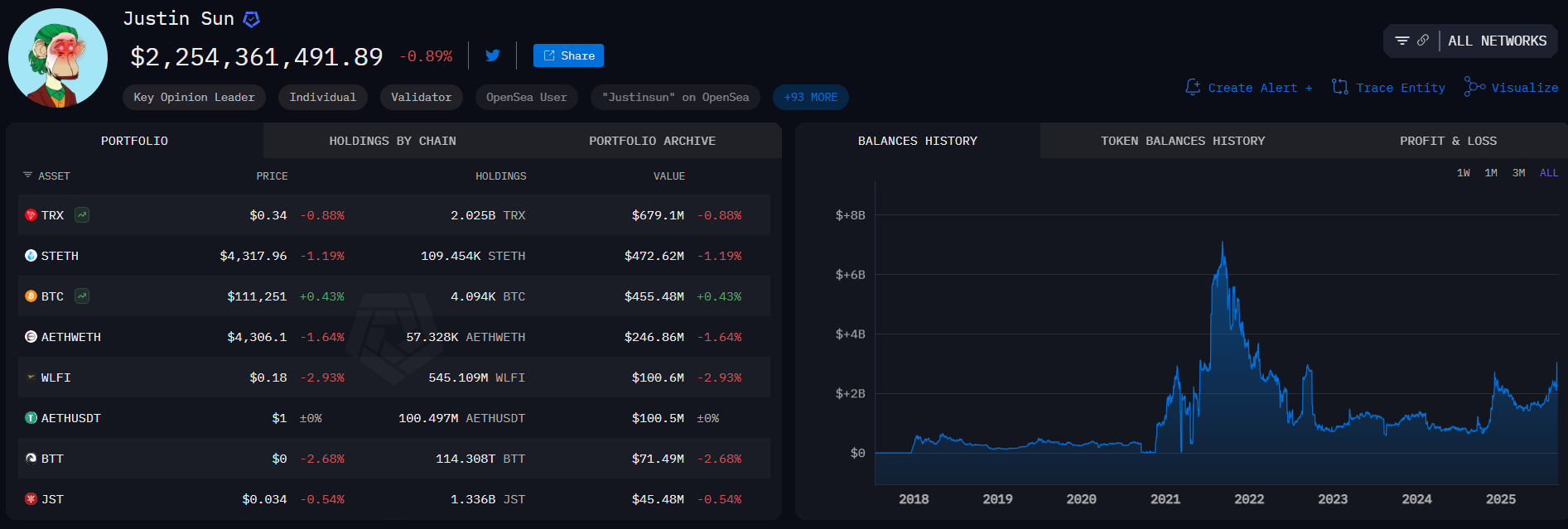
WLFI’s price, which opened around $0.40, tumbled to below $0.20 in its first hours of trading. The market turbulence, combined with Sun’s frozen stake, deepened skepticism about the project’s governance and transparency. As of early September 2025, Sun still holds about 545 million WLFI—worth more than $100 million at recent market prices—though questions remain over how those holdings were managed.
Our address only carried out a few general exchange deposit tests with very small amounts, followed by an address dispersion. No buying or selling was involved, so it could not possibly have any impact on the market.
— H.E. Justin Sun 👨🚀 (Astronaut Version) (@justinsuntron) September 4, 2025
Community Divided Over Centralization and Control
The wallet freeze has sparked heated debate among WLFI supporters and critics alike. Opponents argue that the move highlights a core risk of centralization, where developers can unilaterally target major stakeholders, undermining claims of decentralized governance. Some community members fear that this sets a precedent that could erode trust in the project.
Others see the intervention as necessary, pointing to possible manipulation attempts by large investors. The controversy intensified when HTX, an exchange linked to Sun, began offering unusually high returns—20% APY—on WLFI deposits. Analysts questioned whether user funds were being leveraged to manage withdrawals or influence market prices.
Justin filled u all lol 🤣 He said he won’t sell his $WLFI but he sold all his users $wlfi by trap them with 20% apr in HTX then dump them from okx and Binance . @EricTrump U guys can’t beat Justin, he’s the smartest scammer and you are just apprentices. pic.twitter.com/s4ddy5SLNt
— Dr.Hash“Wesley” (@CryptoApprenti1) September 4, 2025
Industry observers also note that WLFI’s token distribution model left insiders and exchanges with disproportionate control. While only 6.8% of tokens were officially unlocked at launch, trading volumes suggested far greater liquidity, hinting at significant selling pressure from concentrated holders.
Just think about it: the only $WLFI tokens that should have been in circulation was the 5B from the community, right? That’s 5% of the total supply. Add to that 1.6% of the total supply that the WLFI team gave to exchanges ‘for liquidity and marketing’. That’s 6.8% that was…
— Quinten | 048.eth (@QuintenFrancois) September 4, 2025
A Test Case for Governance in Crypto
Instead of marking a successful debut, WLFI’s launch has become a cautionary tale about ownership concentration, power struggles, and the delicate balance between decentralization and oversight. Regulators, already wary of high-profile token launches, are watching closely as questions about governance and transparency gain urgency.
At press time, WLFI was trading near $0.18, recovering slightly from its steep drop but still down more than 15% on the day. Whether the project can rebuild confidence—or whether it remains a case study in the risks of centralized control—remains to be seen.



