World Liberty Financial’s new governance proposal would require holders to stake unlocked WLFI tokens for 180 days to vote.
The shift ties voting rights to capital lockups, potentially tightening token supply while formalizing incentives funded by the protocol treasury.
The proposal was published Wednesday on the WLFI governance forum.
It outlines a multi-tiered staking framework where unlocked WLFI must be staked to gain voting rights, while locked tokens retain voting eligibility without additional requirements.
A new governance proposal is now live on the WLFI forum.
— WLFI (@worldlibertyfi) February 25, 2026
The community is being asked to vote on enabling Staking for $WLFI token holders to incentivize participation in governance— one of the most significant steps forward in the evolution of $WLFI.
Read the proposal. Make…
Will Staking-Based Voting Reshape WLFI Control?
Voting power would follow a square-root weighting model that factors in staked balances and remaining lock-up duration.
The structure is designed to limit concentration among large holders, a common criticism of token-weighted governance across decentralized finance (DeFi) protocols.
Governance participation would also carry financial incentives.
Stakers who vote in at least two governance proposals during their lock period would earn a base reward targeting 2% annualized yield, funded from the WLFI treasury.
The framework introduces participation tiers tied to staking size.
Wallets staking at least 10 million WLFI, valued near $1 million based on a $0.11 token price, would qualify as “Nodes” and gain access to licensed market makers for 1:1 stablecoin conversion into USD1.
Those staking more than 50 million WLFI would earn “Super Node” status.
Benefits include priority partnership opportunities and potential eligibility for economic incentives on approved integrations, according to the governance text.
The team estimates arbitrage profits during recent USD1 mint-sell cycles at roughly 15 basis points per cycle.
It argues the Node mechanism redirects that value from market makers to long-term token holders, while creating structural demand pressure on competing stablecoins.
“The Node mechanism redirects this value from a small number of intermediaries to long-term ecosystem participants,” the team wrote in the proposal.
The measure requires a quorum of 1 billion eligible WLFI voting tokens and a simple majority in a seven-day snapshot vote.
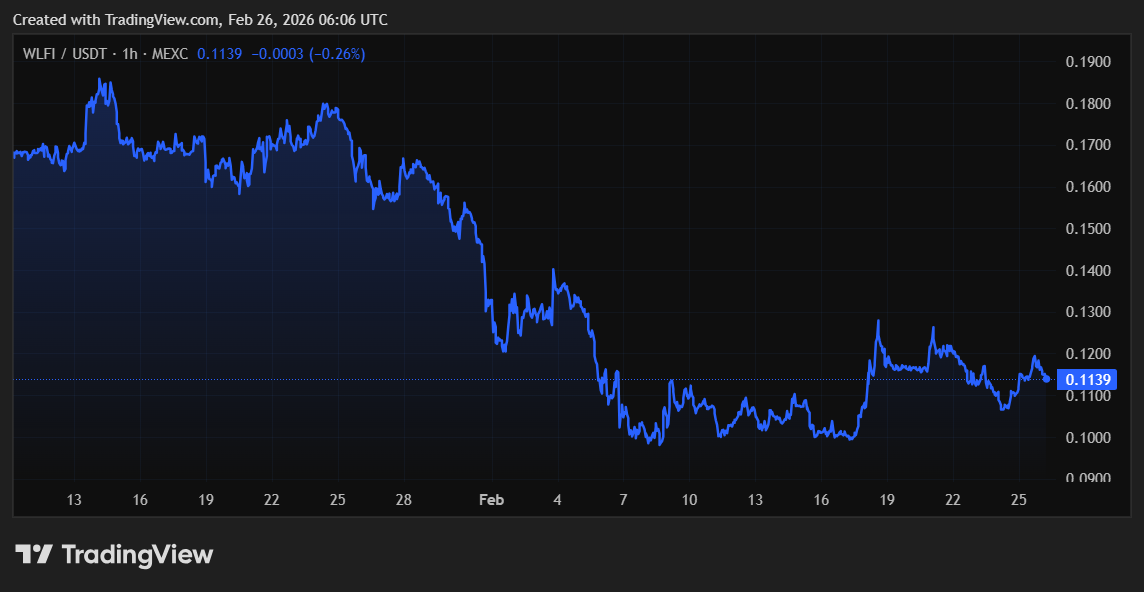
WLFI rose 0.16% over the past 24 hours to $0.11, with a market capitalization of $3.2 billion, according to price page.
Yet the more immediate catalyst is whether token holders deliver quorum, a threshold that will test both participation depth and conviction in the USD1-linked governance redesign.