

WisdomTree has taken a notable lead in the race to bring decentralized finance into traditional markets, rolling out the first exchange-traded product that uses Lido’s stETH rather than a centralized provider to earn Ethereum staking rewards.
 Lido
Lido
A New Type of Ethereum Staking Fund
The new product, called the WisdomTree Physical Lido Staked Ether ETP and trading under the ticker LIST, debuted in Europe on Thursday. It holds only stETH, the liquid staking token minted by Lido. WisdomTree says this design removes the need for the unstaked liquidity buffers that many ETH funds use for creations and redemptions. In short, LIST is fully staked at all times.
The ETP is now live on several major European exchanges, including Deutsche Börse Xetra, SIX Swiss Exchange, and Euronext in Paris and Amsterdam.
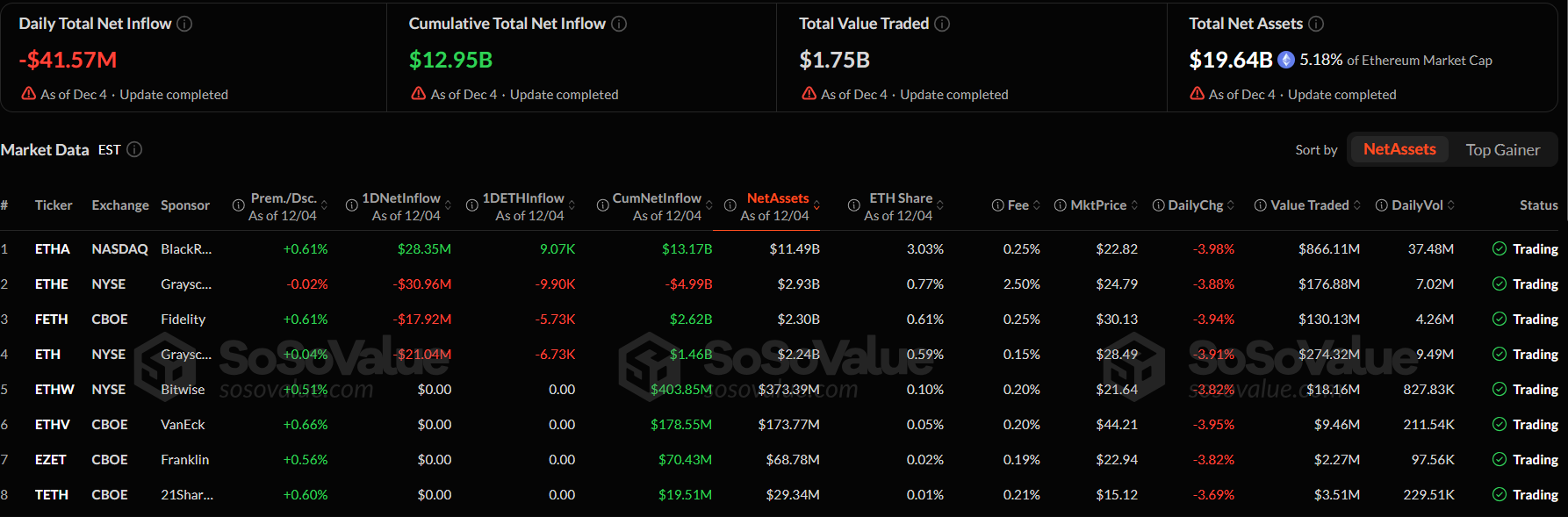
WisdomTree launched LIST with $50 million in committed assets, making it larger than several established Ethereum funds. For comparison, Invesco’s QETH sits at around $27 million, while 21Shares’ TETH fund holds about $29 million, according to data from SoSoValue.
Traditional Finance Edges Toward Decentralized Staking
The launch marks an important moment for the relationship between asset managers and decentralized staking protocols. Historically, firms have relied on centralized custodians such as Coinbase or internal systems to stake assets. By leaning on Lido instead, WisdomTree is signaling that decentralized infrastructure is mature enough to be integrated into regulated investment products.
The trend is growing. VanEck filed for a Staked Ethereum ETF in October, while U.S. issuers have been slower to adopt staking because of regulatory uncertainty. That picture has begun to shift. REX-Osprey introduced the first U.S. ETF offering native SOL staking rewards in July, and in October, Grayscale won approval to stake assets across its ETH products.
Even BlackRock is reportedly exploring staking options for ETHA, its $11.5 billion Ethereum trust.
WisdomTree notes that Europe’s clearer rules for physically backed crypto ETPs made LIST possible, calling the product proof that stETH can fit into traditional market infrastructure without compromising regulatory standards.
Why Lido’s stETH Matters
Lido remains the largest player in liquid staking, holding just under 25% of Ethereum’s liquid staking token market, according to Dune Analytics. Users deposit ETH to Lido, which stakes the tokens across a distributed network of node operators while issuing stETH, a token that continues to earn rewards and remains fully usable across DeFi.
This structure helps solve a long-standing challenge for institutions: Ethereum’s staking mechanism involves bonding and unbonding queues, making capital less flexible. stETH removes that friction by staying liquid.
djrtwoStill, Lido isn’t without debate. Its rapid early growth raised concerns about centralization within the Ethereum community, though its share of the market has since moderated. WisdomTree points out that Lido now delegates more than 8.5 million ETH across 650+ node operators, while about $10 billion in stETH is used as collateral in DeFi platforms.
“Lido Staked Ether sits at the centre of Ethereum’s transition to a yield-bearing network,” said Dovile Silenskyte, WisdomTree’s Director of Digital Asset Research.
She added that stETH reflects the increasing maturity of digital assets and their shift toward long-term, functional use.
WisdomTree oversees roughly $139.5 billion in global assets, and LIST marks its latest push into regulated digital asset products.



