
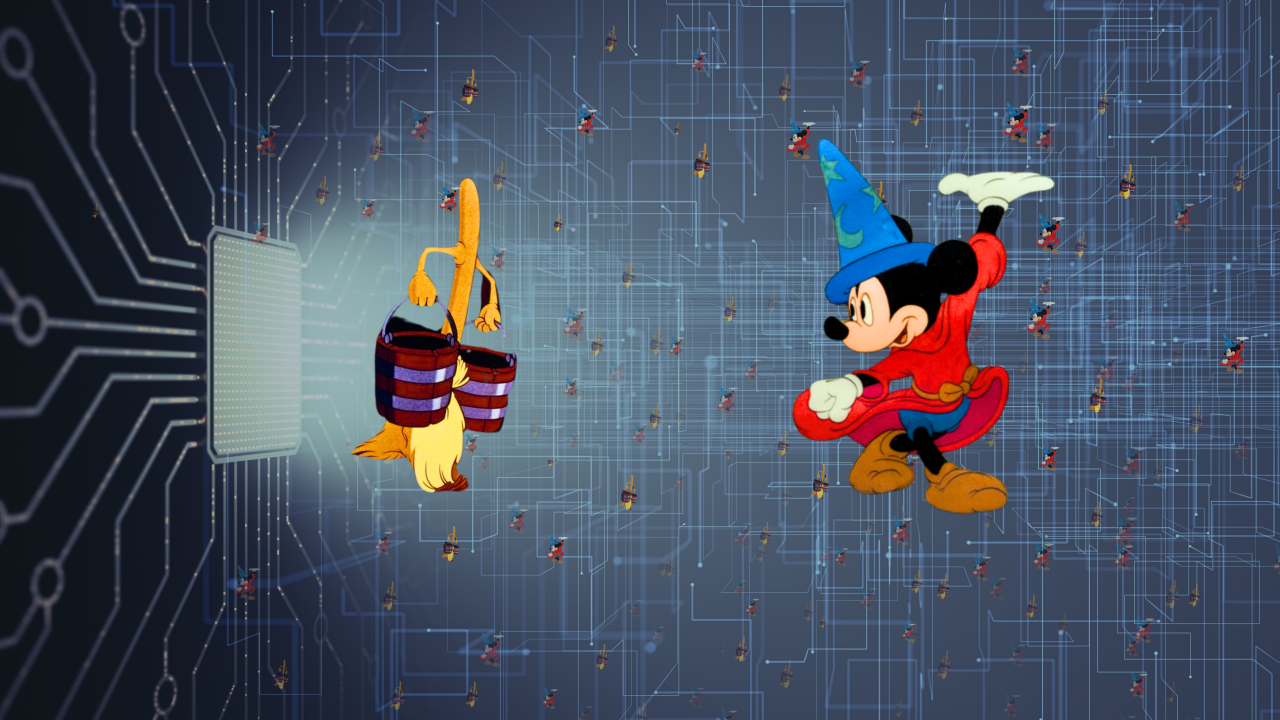
For a company built on world-famous characters and tightly managed intellectual property, Disney has always faced a careful balancing act. It needs to create and distribute content at massive scale while protecting its brands, its creative standards, and the legal rights tied to its assets. Generative AI offers speed and flexibility, but without structure, it can also introduce risk.
Disney’s recent agreement with OpenAI shows how the company is trying to resolve that tension by making AI part of its core operating model rather than treating it as a side experiment.
Under the deal, Disney becomes both a licensing partner and a major enterprise customer of OpenAI. The video generation model Sora will be able to create short, user-prompted videos using a limited set of Disney-owned characters and environments. At the same time, Disney will use OpenAI’s APIs to develop internal tools and new consumer features, including experiences linked to Disney+. Employees across the company will also gain access to ChatGPT for internal use.
What stands out is not the novelty of AI-generated Disney content, but the structure around it. Disney is not opening its full catalogue to unrestricted generation. The licence excludes actor likenesses and voices, restricts which assets can be used, and includes safety and age-appropriate controls. In practice, this positions generative AI as a governed production layer: flexible enough to generate variation, but firmly bounded by rules.
AI embedded in real workflows
Many enterprise AI initiatives struggle because they live outside everyday systems. Tools sit in separate dashboards, adding steps instead of removing them. Disney’s approach follows a more practical path by placing AI where work already happens.
For consumers, AI-driven features will appear inside Disney+, not as a standalone experiment. For employees, AI access comes through standardised tools and APIs, rather than a patchwork of unofficial solutions. This reduces friction, makes usage visible, and allows the company to apply consistent oversight.
Organisationally, Disney is treating AI as a shared capability, closer to a platform service than a creative novelty. That framing makes it easier to scale adoption across teams without multiplying legal or operational risk.
Scaling variation without adding headcount
The Sora licence focuses on short-form content generated from pre-approved assets, and that limitation is intentional. In large production environments, much of the cost comes from creating usable variations, reviewing them, and moving them through distribution channels.
Prompt-driven generation within a controlled asset set allows Disney to experiment and engage fans at a lower marginal cost, without increasing manual production or review workloads. The output is not a finished movie, but a controlled input into marketing, social media, and engagement pipelines.
This reflects a broader pattern in enterprise AI: the technology proves its value when it shortens the path from intent to usable output, rather than producing standalone artefacts.
APIs instead of point solutions
Beyond content generation, the agreement positions OpenAI’s models as building blocks. Disney plans to use APIs to create its own tools and experiences, rather than relying solely on off-the-shelf interfaces.
This matters because integration is often where AI programmes stall. API-level access allows Disney to embed AI directly into existing systems, product logic, and workflows. AI becomes part of the connective tissue between tools, not another layer employees have to work around.
Aligning AI with business incentives
Disney’s reported $1 billion equity investment in OpenAI is notable less for its size than for what it signals operationally. It suggests the company expects AI to be central and persistent, not optional or experimental.
AI touches revenue-facing surfaces such as Disney+ engagement, cost structures related to content variation and internal productivity, and long-term platform strategy. That alignment increases the chances that AI becomes part of standard planning cycles rather than a discretionary innovation project.
Making scale less fragile
At high volume, small AI failures can quickly become big problems. Disney and OpenAI have emphasised safeguards around intellectual property, harmful content, and misuse not as a branding exercise, but as a requirement for scale.
Automated controls around safety and rights management reduce the need for constant manual intervention and support consistent enforcement. When these systems work, they are largely invisible, but they make growth more resilient.
What other enterprises can learn
Disney’s assets are unique, but its operating approach offers broader lessons. Embed AI where work already happens. Constrain systems before scaling them. Prioritise integration over novelty. Tie AI investments to clear economic outcomes. Treat safety and governance as infrastructure, not afterthoughts.
Generative AI delivers lasting value when it becomes part of an organisation’s core machinery, governed, integrated, and measured. Disney’s strategy shows how that can work in practice, even in a business where creative control and intellectual property are everything.



