

A Turning Point for U.S. Crypto Regulation
Washington’s long-awaited “Crypto Week” is making waves across the digital asset world—and at the center of it all is the CLARITY Act.
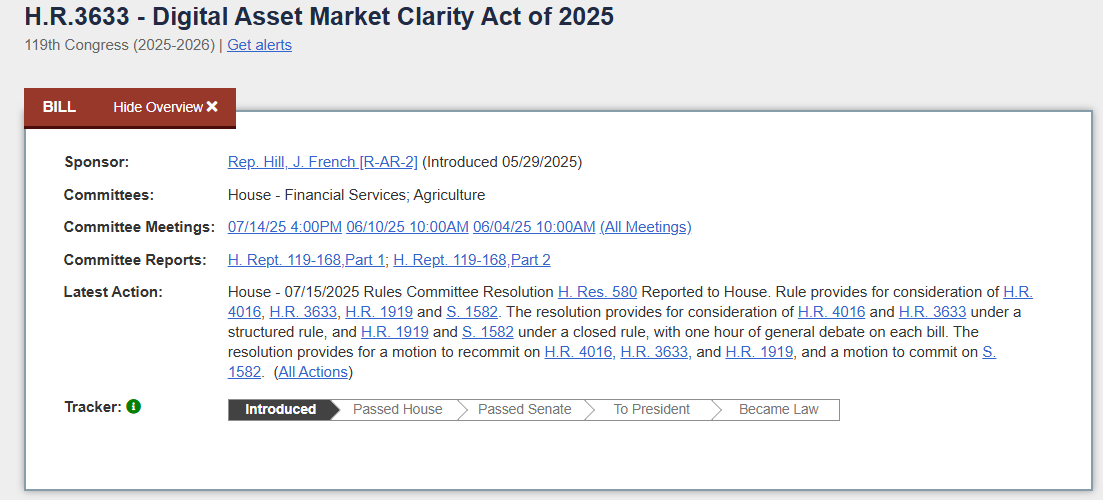
Short for the Digital Asset Market Structure Clarity Act, the bill aims to bring long-overdue order to the chaotic regulatory landscape surrounding crypto in the United States. Introduced on May 29, 2025, by Representative French Hill (R-AR), the proposal seeks to end a decade-long tug-of-war over who governs the crypto space: the SEC or the CFTC.
Instead of choosing one agency, the CLARITY Act outlines a power-sharing arrangement that defines who handles what, based on how digital assets are used. Securities would fall under the SEC’s jurisdiction, while commodities—especially decentralized, utility-focused tokens—would be overseen by the CFTC.
Key Provisions: What the Bill Actually Does
Here’s what the CLARITY Act is trying to accomplish:
- Clear legal definitions for terms like “blockchain,” “digital asset,” and “digital commodity”
- Jurisdiction split between the SEC and CFTC, based on asset function and decentralization
- “Investment contract assets” category allowing some tokens to evolve from securities to commodities over time
- Mandatory registration for crypto exchanges and brokers with the CFTC
- Fundraising flexibility—up to $75 million per year without SEC registration, under specific disclosure and decentralization benchmarks
- Self-custody rights protected by law, letting users hold crypto in personal wallets
- Ongoing project disclosures, including token supply, development updates, and financial risks
- Delisting protocols for unsafe tokens, jointly managed by SEC and CFTC
- Global coordination and AML compliance, including tighter rules for crypto entities
In short, the bill aims to give developers, investors, and regulators a playbook—so everyone knows the rules and responsibilities from the start.
Why It Matters
For years, crypto in the U.S. has been stuck in a gray zone. One agency treats tokens like securities; another sees them as commodities. The result? Confusion, lawsuits, and stalled innovation.
The CLARITY Act tries to fix that by offering structured, predictable regulation. If passed, it could:
- Encourage institutional investment by removing legal ambiguity
- Offer startups a clearer path to compliance and capital
- Protect consumers through better disclosures and oversight
- Help the U.S. catch up with crypto-friendly jurisdictions like the EU and Singapore
Critics Push Back
Not everyone is cheering. Advocacy group Americans for Financial Reform says the bill dilutes SEC oversight, making it easier for risky products to dodge scrutiny. Former CFTC Chair Timothy Massad worries the dual-agency model could deepen confusion rather than solve it.
 AFR
AFR
Senator Elizabeth Warren warns the bill may open a loophole for Big Tech to issue unregulated tokens, while other Democrats argue it weakens consumer protections and gives the crypto industry too much leeway.
What's Next?
Officially known as H.R. 3633, the CLARITY Act has already passed out of two key House committees. If it survives a full House vote, the real test begins in the Senate, where support is growing but far from guaranteed.
Its momentum also comes amid controversy. The GENIUS Act—another crypto bill focused on stablecoins—stumbled in the House despite support from former President Trump. Democrats launched a counter-campaign, raising ethics concerns and pushing for stronger guardrails on crypto ownership by elected officials.
The White House remains cautiously supportive but may seek changes through executive agencies if the bill advances.
The Bottom Line
Whether the CLARITY Act becomes law or gets reshaped in the months ahead, one thing is clear: the U.S. is finally moving toward concrete crypto rules. For builders, investors, and users alike, that’s not just regulatory news—it’s the groundwork for the next chapter in digital finance.



