
Bringing Predictable Returns to DeFi
Decentralized finance (DeFi) has opened new ways to earn on crypto, but one big challenge remains: the lack of stable, reliable yields. Interest rates on lending platforms vary widely—even for the same asset—and there’s no standard benchmark for comparison. Treehouse is stepping in to fix that by building a fixed income layer for crypto, starting with Ethereum.
By introducing tools like yield-tracking tokens and decentralized interest rate benchmarks, Treehouse is helping users earn more consistent returns while laying the groundwork for sophisticated financial products on-chain.
What Treehouse Is and How It Works
Treehouse is a decentralized protocol focused on bringing fixed income tools—think steady, bond-like returns—to the blockchain. It does this through two main innovations:
- tAssets (like tETH): These are yield-generating tokens that automatically move assets to the best opportunities across DeFi using smart arbitrage strategies.
- DOR (Decentralized Offered Rates): On-chain equivalents of traditional benchmark rates, created through a transparent, community-led process.
Let’s break these down.
Meet tETH: Smarter Yield from Your ETH
When you deposit ETH or liquid staking tokens (such as stETH) into Treehouse, you receive tETH. Unlike traditional wrapped assets, tETH doesn’t just sit there—it actively seeks yield opportunities across Ethereum’s DeFi ecosystem.
If staking rewards are higher than borrowing costs somewhere, Treehouse capitalizes on the spread and passes the returns back to tETH holders. Essentially, it automates what power users have been doing manually—hopping between platforms chasing better rates.
Users also earn rewards points by holding and using tETH, giving early adopters extra incentive to participate.
DOR: The Interest Rate Backbone for DeFi
In traditional finance, rates like the U.S. Treasury yield or SOFR act as baselines for borrowing and lending. Treehouse introduces DOR, a decentralized, on-chain version of those reference rates.
These rates are built through collaboration between:
- Operators: Entities like Treehouse that manage the system
- Panelists: Entities (market makers, staking services) that supply rate data
- Delegators: Everyday users who delegate assets to panelists
- Referencers: Protocols or apps that use DOR as a pricing benchmark
The Treehouse Ethereum Staking Rate (TESR) is the first DOR launched—designed to serve as a benchmark yield curve based on ETH staking returns.
Why the TESR Curve Matters
TESR provides a transparent, standardized rate for ETH-based products, enabling more advanced tools in crypto like:
- Interest Rate Swaps (IRS): To manage risk from fluctuating returns
- On-Chain Treasuries: Low-risk options for long-term holders
- Yield Curves: Clear pricing for loans, savings, and lending markets
With these tools, DeFi can begin to mirror the structure of traditional fixed income—just in a decentralized form.
Risks and Safeguards
Of course, yield doesn’t come without risk. tETH interacts with multiple protocols, meaning there’s exposure to:
- Platform failures or depegs of staking tokens
- Smart contract bugs
- Oracle failures or inaccurate data
- Overcrowded lending pools that reduce returns
Treehouse has built several protections, including a Protocol-Owned Peg Protection (PPP) system, an insurance fund, and a contingency plan for extreme volatility. These mechanisms aim to cushion shocks and maintain system stability.
The TREE Token: Utility and Governance
TREE is the native token of the Treehouse ecosystem. It powers several core functions:
- Paying fees for DOR data access
- Staking by data providers (panelists) to ensure accuracy
- Reward distribution after each data cycle
- Governance votes on protocol upgrades and grant allocations
TREE is also fueling future growth through DAO-funded initiatives.
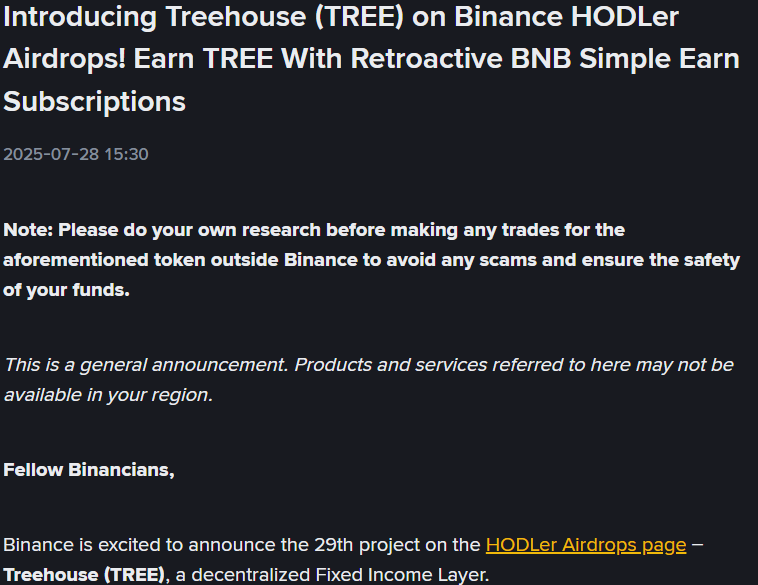
Notably, Binance added Treehouse to its HODLer Airdrops on July 28, 2025, distributing 12.5 million TREE tokens to users. TREE is now live for trading on several pairs including USDT and BNB.
Final Thoughts
Treehouse is quietly shaping the next frontier of DeFi—bringing predictability and structure to an industry often ruled by volatility. With tETH, DOR, and the TESR curve, it’s giving crypto users tools to plan better, earn smarter, and unlock a broader range of financial strategies on-chain.



