
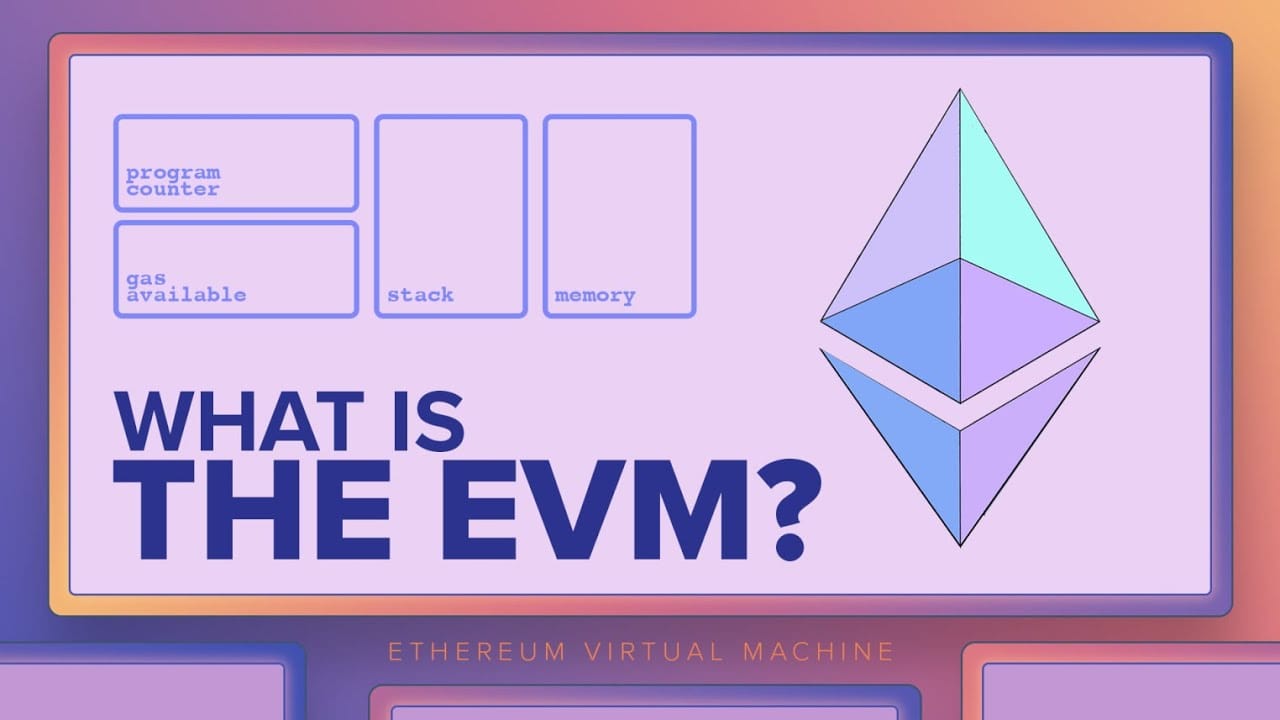
Ethereum isn’t just a cryptocurrency—it’s a global computing platform. At the heart of that system is the Ethereum Virtual Machine (EVM), the engine that powers smart contracts and decentralized applications (dApps). If Bitcoin showed the world digital money, Ethereum—through the EVM—showed what programmable money could do.
The Role of the EVM
The EVM is Ethereum’s runtime environment. Every time you send a transaction, deploy a smart contract, or interact with a dApp, the EVM is the one doing the heavy lifting. It ensures that:
- Transactions are valid and executed consistently across all Ethereum nodes.
- Smart contracts run exactly as programmed, without downtime or interference.
- Developers can build applications in a safe, isolated “sandbox.”
In short, the EVM is the reason Ethereum can function as a decentralized world computer.
Smart Contracts and dApps
The EVM is what allows developers to write smart contracts—self-executing programs that run on the blockchain. These contracts form the foundation of dApps, decentralized finance (DeFi) platforms, NFTs, and even ICOs (initial coin offerings).
Because the EVM is quasi–Turing complete, it can process almost any kind of computation—as long as the user pays enough gas fees to cover the cost. This prevents endless loops or runaway code from overwhelming the network.
Why the Sandbox Matters
Code inside the EVM is sandboxed, meaning it can’t directly interact with external networks, file systems, or processes. That isolation makes testing safer and ensures smart contracts don’t disrupt the underlying blockchain.
Of course, this also introduces limits. The EVM doesn’t know the date, the weather, or stock prices. To get real-world data, smart contracts rely on oracles—trusted data feeds that bridge the gap between blockchain code and off-chain information.
Gas: The Safety Valve
Every action on Ethereum consumes gas, paid in ETH. Whether you’re transferring tokens or executing a complex DeFi trade, the EVM calculates how much gas the computation will require.
If you don’t provide enough gas, the transaction fails—and the fee is still collected by miners (or validators in Ethereum’s proof-of-stake system). This mechanism keeps the network safe by discouraging spam and preventing infinite loops.
How the EVM Processes a Transaction
When you send a transaction on Ethereum, the EVM checks three things:
- Validity: Are the values correct, the signature valid, and the nonce (transaction counter) accurate?
- Fees: Has enough gas been allocated to cover execution costs?
- Execution: If everything checks out, the EVM carries out the transfer or contract call.
If there’s not enough gas, the transaction fails. If there’s an error with the recipient, the EVM refunds the sender.
Why the EVM Matters
The EVM is where Ethereum’s innovation truly comes to life. By enabling smart contracts, it turned Ethereum into more than just a blockchain—it became a platform for building decentralized systems that challenge traditional finance, gaming, supply chains, and beyond.
This is why Ethereum remains the second-largest cryptocurrency by market cap, with ETH (Ether) serving both as the network’s fuel and its native currency.
Think of the EVM as Ethereum’s engine room. It quietly powers the blockchain’s most exciting features—from DeFi protocols to NFT marketplaces—while keeping the system secure, reliable, and decentralized. Without the EVM, Ethereum would just be another ledger. With it, it’s the backbone of Web3.



