

A Simpler Way to Use Zero-Knowledge Proofs
Zero-knowledge proofs (ZKPs) let you prove something is true—without revealing the details. They’ve become essential in crypto and privacy tech, but building them traditionally takes powerful hardware and deep cryptographic knowledge.
Succinct is aiming to fix that. Instead of asking every developer to reinvent the wheel, Succinct offers a decentralized network where anyone can request ZKPs and have them generated by independent “provers” competing for rewards. It’s fast, efficient, and built directly on Ethereum.
What Succinct Is (And Why It Matters)
At its core, Succinct is a decentralized prover network. Think of it as an open ZK proof marketplace: developers and apps can submit jobs, and provers bid to complete them. This turns something once slow and complex into a plug-and-play backend for projects building rollups, bridges, AI agents, and games.
It runs as a verifiable application (vApp)—as responsive as a modern web app, but fully secured on-chain. Everything that happens can be verified using Ethereum and zero-knowledge proofs.
Meet SP1: The ZK Virtual Machine for Everyone
Succinct’s secret weapon is SP1 (Succinct Processor 1), a general-purpose zero-knowledge virtual machine (zkVM). Built by Succinct Labs, SP1 lets developers use familiar languages like Rust or C++ instead of writing custom cryptographic code.
Once a program is compiled, SP1 enables provers to run it and generate a ZKP that proves it ran correctly—without revealing the program’s data or internals. This dramatically lowers the barrier to entry for using ZKPs in real-world apps, especially in AI, simulation, and DeFi infrastructure.
How the Network Works
Off-Chain Matching with On-Chain Trust
The prover network operates like a two-sided gig economy:
- Requesters submit proof jobs
- Provers compete to win and complete them
All the matchmaking happens off-chain via an “auctioneer” system using fast Remote Procedure Calls (RPC), meaning no blockchain wait times. But when it comes to final settlement—payments, job proofs, and audits—it’s all recorded on Ethereum.
The architecture splits speed and security: users get the responsiveness of a centralized system with the trust and transparency of Ethereum.
Transparent, Verifiable Backend
To keep things accountable, the auctioneer logs every balance update, proof request, and job assignment using Merkle proofs—a cryptographic way to verify data integrity. These records are regularly posted to Ethereum, and the SP1 prover service creates ZKPs of the entire system state. It’s all public, auditable, and tamper-proof.
Real-World Use Cases
Succinct’s infrastructure unlocks powerful new applications, such as:
- Cross-chain bridges: Prove data from one blockchain is valid on another—no middlemen required
- ZK-rollups: Offload proof generation to a shared network, improving scalability
- Verifiable AI computation: Prove an AI or off-chain process ran as expected
- Light clients: Use tiny ZK proofs to validate blockchain data without needing to sync full nodes
The Role of the PROVE Token
Succinct’s native token, PROVE, is central to how the network operates:
- Payments: Developers pay provers in PROVE for generating ZKPs
- Staking: Provers must stake PROVE to take on jobs—bad behavior gets penalized
- Delegation: Token holders can delegate their PROVE to active provers and share in rewards
- Governance: The token will eventually be used to vote on protocol upgrades and network rules
PROVE Lands on Binance HODLer Airdrops
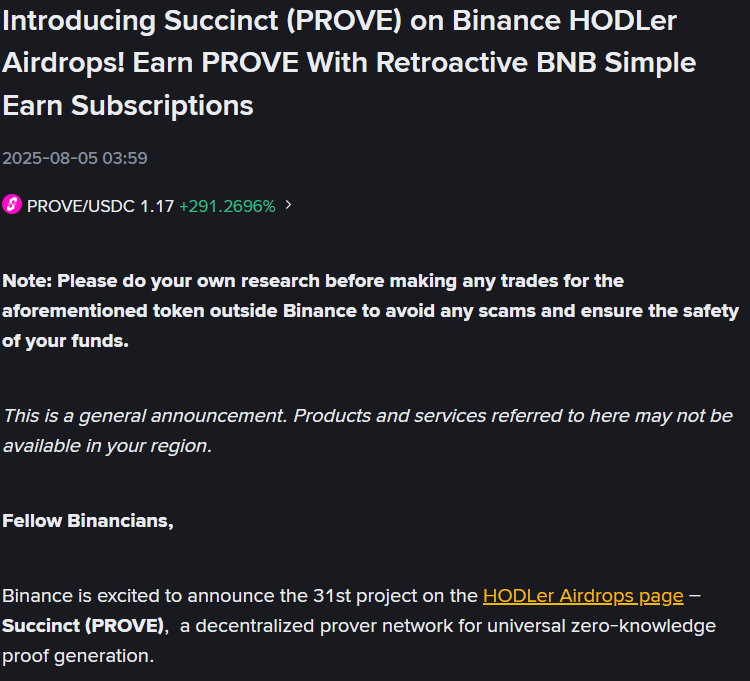
On August 5, Binance listed PROVE as its 31st HODLer Airdrop project. Users who had BNB in certain Binance products between July 9 and 12 were eligible to receive a share of 15 million PROVE tokens—1.5% of the total supply. Trading launched with pairs against USDT, USDC, BNB, FDUSD, and TRY.
Why Succinct Could Matter
Zero-knowledge proofs are becoming essential for scaling blockchain and verifying data in an increasingly complex, AI-powered world. Succinct offers a rare blend of usability, performance, and decentralization—bridging cutting-edge cryptography with real developer needs.
By abstracting away the complexity of ZKPs and letting a global network of provers handle the heavy lifting, Succinct isn’t just making cryptography more accessible—it’s making it practical.



