

Realized Extractable Value (REV) Explained: A Real-World Look at Blockchain Profit Metrics
In the ever-evolving world of crypto valuation metrics, a term gaining traction—and stirring debate—in 2025 is Realized Extractable Value, or REV. While blockchains have long been measured by metrics like Total Value Locked (TVL) or protocol revenue, REV is emerging as a data point that aims to quantify something a bit more grounded: actual profits captured through blockchain activity.
Here’s what you need to know about REV, how it’s calculated, and what it really tells us about a blockchain’s economic health.
What Is Realized Extractable Value?
REV measures how much value is actually extracted from the network via MEV (Maximal Extractable Value) strategies—after factoring in all costs like validator fees and gas. It's a reality check for MEV projections.
"bro wat is rev?"
— nairolf (@0xNairolf) May 19, 2025
An explanation of Realized Extractable Value or REV, in (very) simple terms. 🧵 pic.twitter.com/bPyTdnDmen
- MEV refers to the maximum value that validators (or miners) can extract by strategically reordering or inserting transactions in a block.
- REV goes a step further and measures how much of that value was really earned once all operational costs, such as bribes (priority fees), transaction fees, and gas costs, are deducted.
In other words, REV is MEV’s real-world twin—what MEV might look like after taxes and fees.
How Is REV Calculated?
REV considers two core revenue sources:
- Profit made by searchers or bots executing MEV strategies (like arbitrage or sandwich attacks).
- Fees paid to validators for including these transactions—often far above normal gas fees due to fierce competition among searchers.
Here’s the simplified formula:
REV = (MEV profits – associated trading/loan costs) + validator/miner fees
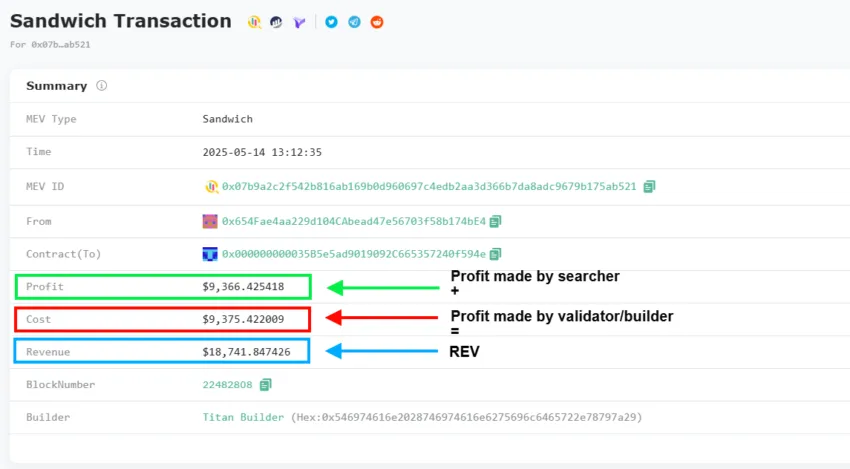
In a common MEV strategy like a sandwich attack, a bot inserts a transaction before and after a user’s trade to profit from slippage. To secure this position, the bot pays a premium (a bribe) to the validator. The validator profits from this high-priority inclusion, and the bot profits from the trade itself. The total of both parties' profits forms the REV.
Why Is REV Controversial?
While REV provides a more grounded snapshot than theoretical MEV, its growing use as a valuation tool raises concerns. Originally designed to track economic activity—not predict future value—it’s now being used by analysts and protocols to argue for higher valuations.
Critics argue:
- High REV doesn’t always mean long-term value. It may reflect speculative trading, network congestion, or poorly optimized infrastructure—hardly hallmarks of a stable ecosystem.
- REV is vulnerable to manipulation. A network could look “profitable” due to short-term MEV spikes without offering real utility or user growth.
Context Matters: REV in Perspective
REV works best when used alongside other valuation metrics—not instead of them. It complements figures like:
- Protocol Revenue (what’s actually earned by the protocol or DAO)
- TVL (value locked in smart contracts)
- User metrics (active addresses, transaction count, etc.)
In isolation, a high REV could mislead investors or developers about the health of a network. But in context, it helps surface the real economics behind network activity.
Understanding REV vs. MEV: Can Blockchain Profit Metrics Predict Long-Term Value?
In the race to define what makes a blockchain economically valuable, two metrics are leading the debate: Maximal Extractable Value (MEV) and Realized Extractable Value (REV). While both aim to capture how value flows through a blockchain, their meanings, implications, and usefulness are being hotly contested—from technical circles to investment analysts.
So, what exactly separates MEV from REV—and does REV deserve its growing role as a valuation benchmark for Layer-1 (L1) blockchains?
MEV 101: The Potential for Profit
Maximal Extractable Value (MEV) refers to the highest possible profit that a validator or searcher can extract by reordering, including, or excluding transactions in a block. This doesn’t involve breaking the protocol—it’s legal, but opportunistic.
Common MEV strategies include:
- Arbitrage: Profiting from price differences across decentralized exchanges.
- Sandwich attacks: Inserting trades around a user’s transaction to manipulate slippage.
- Liquidation sniping: Quickly repaying loans on behalf of borrowers to claim a fee.
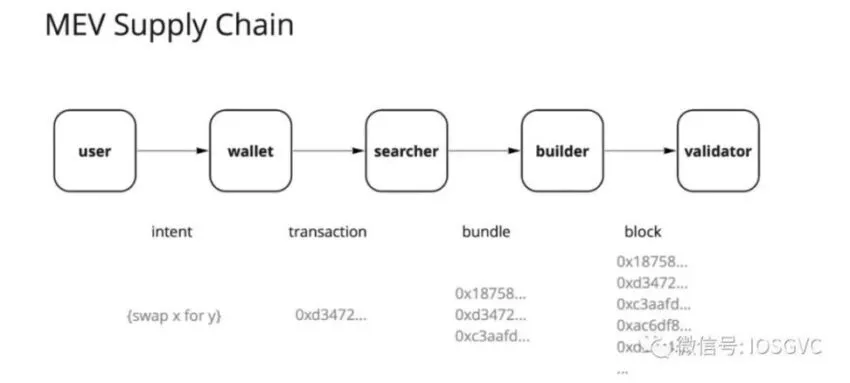
In each case, a searcher—typically a bot—identifies the opportunity, constructs a transaction, and competes to have it included in the next block.
REV: The Realized Profit
Realized Extractable Value (REV), by contrast, measures what’s actually earned after costs. These costs include:
- Gas fees and transaction costs
- Bids paid to validators for inclusion (priority fees)
- Infrastructure expenses (like flash loan fees or DEX trading fees)
Here’s a simplified formula:
REV = MEV profit – operational costs + validator payments
In practical terms, if multiple bots chase the same MEV opportunity, they bid up inclusion fees to gain priority in the block. REV tracks how much was truly captured—not just what was possible in theory.
Why REV Is Sparking Debate
The metric gained momentum after Flashbots introduced the concept in 2021. Initially seen as a technical tool to analyze chain activity, REV is now at the center of a larger philosophical and financial debate.
REV is a really bad metric for valuing L1 assets and it's now time for it to die
— sassal.eth/acc 🦇🔊 (@sassal0x) May 18, 2025
Stay tuned pic.twitter.com/B5QflgU54s
Supporters say that REV:
- Reflects true economic throughput on a blockchain
- Provides a cash-flow-like metric akin to traditional finance’s discounted cash flow (DCF)
- Offers real insight into a chain’s commercial utility beyond hype
They argue that REV could be used to measure long-term sustainability of L1 protocols, particularly those catering to high-frequency DeFi applications.
When you start losing on a basic metric, simply deny the metric
— Jon Charbonneau 🇺🇸 (@jon_charb) May 18, 2025
ETH maxis used to love bragging about billions in fees + MEV generated (circa 2021 bull market) until Solana flipped it https://t.co/Zkud5LdGTv
Critics, however, caution that:
- High REV can be misleading, especially during meme coin frenzies or speculative surges
- REV may reward inefficiencies in block space rather than actual utility
- Some blockchains, like Bitcoin, have no REV by design but remain highly valuable due to their security, scarcity, and decentralization
Excellent take by @_bfarmer:
— Haseeb >|< (@hosseeb) May 19, 2025
REV is primarily a function of:
- the wealth effect of the L1 token
- the volatility of assets issued on the chain
- the immaturity of MEV infra
Certain forms of activity—namely, gambling on high-vol assets—disproportionately generate REV. https://t.co/SbYlO1zJzF
There’s also the concern that a blockchain overly reliant on MEV or REV-based income might deter users due to front-running or high transaction fees, degrading the user experience over time.
REV Is a Mirror—Not a Map
Whether or not you believe REV is the best way to value a blockchain, one thing is clear: it reflects something real. Unlike hypothetical metrics, REV captures dollars already earned, and it forces protocols and investors alike to face the true costs of on-chain activity.
But REV isn’t predictive. It can spike during market noise and plummet when attention fades. And it doesn't reflect user loyalty, decentralization strength, or developer activity—all crucial pieces of a blockchain’s long-term health.
Is REV a Reliable Way to Value Blockchains? The Debate Explained
Valuing a blockchain is anything but straightforward. From market cap and total value locked (TVL) to network fees and user growth, every metric tells a different story. Lately, one term has gained traction in crypto circles: Realized Extractable Value (REV) — a metric that tracks actual profits made through Maximal Extractable Value (MEV) strategies. But is REV a reliable measure of a blockchain’s value, or just another misleading benchmark?
The short answer: it depends on how—and why—you use it.
REV Wasn’t Built for Valuation
To understand why this matters, it helps to revisit why REV was created in the first place. Flashbots introduced the concept in 2021 not as a tool for pricing blockchains, but as a more realistic way to measure the value actually extracted through MEV—strategies like arbitrage, sandwich attacks, and liquidation sniping.
While MEV measures the potential value that can be pulled from transaction ordering, REV reflects the profits that actually materialize, accounting for things like:
- Gas fees
- Validator payments
- Network competition
- Infrastructure costs
That nuance is critical. REV is a record of past profitability, not a forecast of future performance. Yet, some investors now use it to estimate the intrinsic value of an entire Layer-1 network—an approach that oversimplifies a complex system.
The Risks of Relying on REV Alone
Aswath Damodaran, a leading finance professor, once said:
“A good valuation is more about the story than about the numbers.”
That wisdom holds true here. REV without context is just a number—one that may mislead rather than enlighten. Here’s why:
- REV Doesn’t Capture All MEV Costs
Failed MEV strategies, preflight checks, and gas spent on unsuccessful attempts are all excluded. These losses are real for searchers, but invisible to REV. - Higher REV Might Indicate Network Inefficiency
In mature systems with optimized MEV infrastructure—like order flow auctions (OFA) or app-specific sequencing (ASS)—competition drives profit margins down. Ironically, high REV on such a network could signal inefficiency or poor MEV compression. - Application-Level MEV Can Obscure Blockchain-Level REV
When MEV is captured at the app layer (via protocols like Uniswap’s MEV protection), those profits don’t appear in blockchain-level REV, even if the chain is economically active. - Not All Value Is Extractable
Some blockchains prioritize user protection, deliberately minimizing MEV opportunities. These chains might show low REV—not because they’re unproductive, but because they’re deliberately fair.
REV Is a Tool — Not a Crystal Ball
Used carefully, REV offers a valuable lens into a network’s real-world cash flows, particularly for understanding validator income, user fee dynamics, and the competitiveness of MEV markets. But as with any metric, context is everything.
REV is best understood alongside:
- Protocol revenue
- Validator yields
- Token incentives
- On-chain user metrics
- Infrastructure maturity
No single figure captures the full value of a decentralized system, especially one as dynamic and fast-evolving as a blockchain.



