
What Is Polymarket?
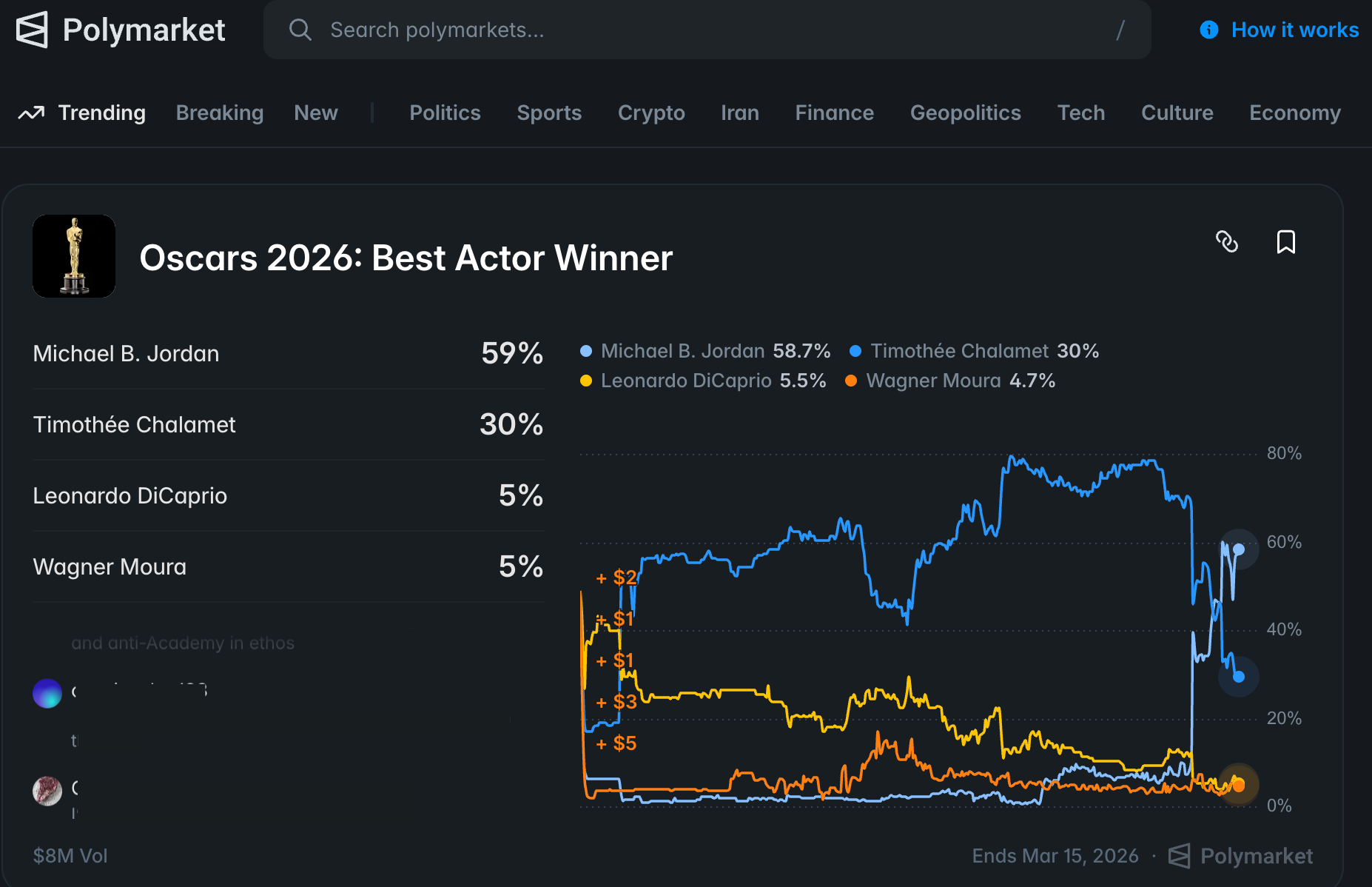
Polymarket is a crypto-based prediction market where users trade on the outcome of real-world events. Instead of betting against a bookmaker, participants trade directly with each other by buying shares tied to specific outcomes.
Most markets are structured as simple “Yes” or “No” questions. For example:
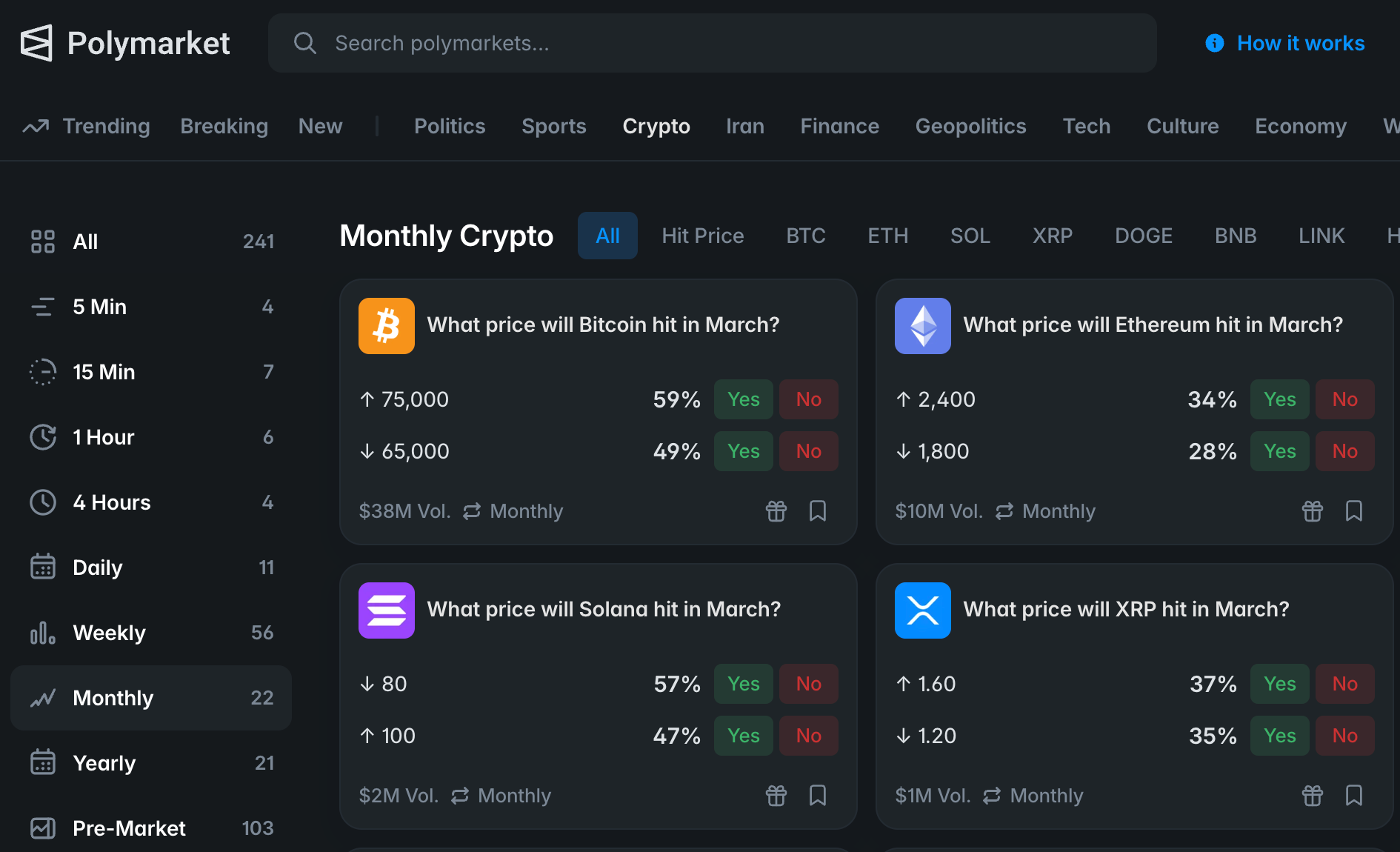
- Will Bitcoin exceed a certain price this month?
- Will a political candidate win an election?
- Will a sports team win a championship?
Users buy shares depending on what they believe will happen. If a “Yes” share costs $0.70, the market is roughly pricing a 70% chance that the event will occur.
Unlike traditional betting platforms, prices move based on supply and demand between traders. As new information arrives—polling data, breaking news, earnings reports, or game results—market participants react and prices shift accordingly.
Polymarket runs on blockchain infrastructure, which allows transactions and settlements to be publicly verified.
How Trading Works on Polymarket
Polymarket operates more like a financial exchange than a sportsbook.
The platform uses a central limit order book (CLOB)—the same trading mechanism used by many stock exchanges. Users can either place an order at their preferred price or accept an existing order from another trader.
Shares usually trade between $0.01 and $1.00.
Here’s a simple example:
- You buy a “Yes” share for $0.65
- If the outcome is Yes, the share pays $1.00
- Profit per share = $0.35
If the final result is “No,” the share becomes worthless.
Importantly, traders do not have to wait for the event to finish. If the market price moves in their favor, they can sell early and lock in a profit—or exit to limit losses.
Blockchain and Stablecoins Behind the Platform
Polymarket runs on Polygon, a scaling network connected to Ethereum. Trading is done using USD Coin (USDC), a stablecoin designed to maintain a value close to one U.S. dollar.
This structure offers a few practical advantages:
- Transparent transactions: Trades are recorded on-chain and can be verified publicly.
- Self-custody: Users control funds through their own crypto wallets rather than a central account.
- Fast settlement: Polygon allows relatively quick and inexpensive transactions.
There are trade-offs as well. Because users control their own wallets, they are also responsible for security. Losing wallet keys or signing a malicious transaction can result in permanent loss of funds.
How Polymarket Determines the Final Outcome
Every prediction market needs a reliable way to determine the correct result.
Polymarket relies on UMA Protocol’s optimistic oracle, which combines automated data sources with a dispute process.
The process typically works like this:
- After an event ends, someone proposes the result and posts a bond.
- A short challenge window allows others to dispute the outcome.
- If uncontested, the result becomes final and winning shares pay $1 each.
- If challenged, the dispute goes to UMA’s Data Verification Mechanism (DVM), where token holders vote on the correct outcome.
For objective questions—such as a sports score or market price—resolution is usually straightforward.
How Polymarket Makes Money
Historically, Polymarket gained attention for not charging direct trading commissions. However, traders still face costs.
One common cost is the bid–ask spread—the difference between the highest price buyers are offering and the lowest price sellers will accept.
For example:
- Best bid: $0.64
- Best ask: $0.66
Buying and immediately selling would cost about $0.02 per share.
Users also pay small blockchain fees when depositing, withdrawing, or settling trades.
In 2026, Polymarket began shifting toward a more traditional fee-based revenue model, signaling a focus on steady platform income as the user base grows.
Growth, Funding, and Market Interest
Prediction markets have drawn growing attention from investors and institutions.
Reports suggest Polymarket has seen major funding activity in recent years, including:
- October 2025: A reported $2 billion investment from Intercontinental Exchange (ICE), valuing the company around $9 billion
- January 2026: Secondary market valuation near $11.6 billion
- March 2026: Early discussions reportedly exploring a $20 billion valuation
Sports markets are a major driver of activity. According to reported figures, the 2026 Super Bowl generated roughly $795 million in related prediction market volume, with sports accounting for about 39% of total trading.
Is Polymarket Safe?
Polymarket has processed billions of dollars in trading volume and resolved thousands of markets since launching. Because transactions are recorded on-chain, users can independently verify that markets settle according to their rules.
That said, several risks remain:
- Smart contract vulnerabilities
- Wallet security risks
- Potential market manipulation
- Changing regulations
In 2022, the platform paid a $1.4 million fine to the U.S. Commodity Futures Trading Commission (CFTC) for operating without proper registration. In December 2025, Polymarket received approval to re-enter the U.S. through a regulated Designated Contract Market (DCM) structure.
Regulations still vary widely across countries, so users should check local laws before participating.
The Bottom Line
Polymarket combines crypto infrastructure with prediction markets to create a platform where people can trade on real-world events. By using Polygon and USDC, the system aims to keep transactions fast and transparent while allowing users to hold their own funds.
The concept is simple: markets aggregate opinions, and prices reflect what participants believe is likely to happen.
Still, prediction markets carry real financial risk. Anyone using them should understand how the mechanics work, protect their wallet security, and remain aware of the legal environment in their region.



