
What Is Kamino Finance?
Kamino Finance (KMNO) is a decentralized finance (DeFi) protocol built on the Solana network. It combines three core functions—lending, liquidity provision, and leveraged trading—into a single platform.
Instead of jumping between multiple DeFi apps, users can manage different strategies in one place. That design focuses on capital efficiency and ease of use, two areas where DeFi platforms often fall short.
Kamino first launched its Automated Liquidity Vaults in August 2022. Since then, it has added a risk engine called the Kamino Risk Assessment Framework (KRAF), which tracks liquidation risk and market conditions in real time.
How Kamino Works
Kamino’s system revolves around three connected products that feed into each other.
Automated Liquidity Vaults
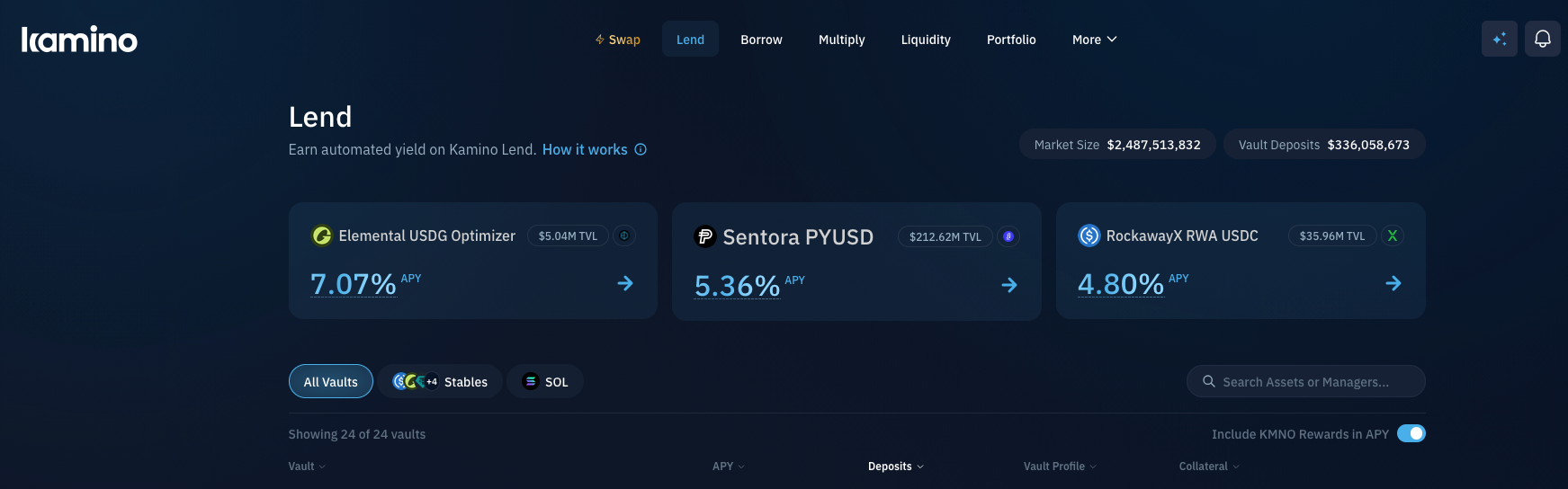
Users can deposit tokens into managed liquidity pools across Solana-based decentralized exchanges. In return, they receive “kTokens,” which represent their share in the pool and earn yield over time.
The key detail is automation. Kamino actively rebalances positions and compounds rewards, so users don’t need to adjust strategies manually.
These kTokens are also reusable. They can be posted as collateral in Kamino’s lending market, allowing users to stack multiple strategies at once.
K-Lend
K-Lend is Kamino’s lending and borrowing layer. It follows a peer-to-pool model, where lenders supply assets to earn interest, and borrowers access liquidity by posting collateral.
Interest rates aren’t fixed. They adjust dynamically based on supply and demand, which is standard across modern DeFi lending markets.
K-Lend also enables more advanced strategies. “Multiply” loops deposits and borrows to increase exposure, while “Long/Short” allows directional bets between assets.
Leverage and eMode
For experienced users, Kamino offers leverage of up to 10x through a feature called eMode. This works by increasing the loan-to-value (LTV) ratio to as high as 90% for closely correlated assets, such as SOL and liquid staking derivatives.
Higher leverage can amplify returns, but it also increases liquidation risk. Kamino’s KRAF dashboard helps users track that risk with tools like volatility metrics and stress simulations.
What Is KMNO?
KMNO is the native token of Kamino Finance. Its main role today is governance. Token holders can vote on protocol upgrades, parameter changes, and funding decisions.
The token has a maximum supply of 10 billion, with roughly 4.47 billion currently in circulation. Most of the supply—60%—is allocated to the community through incentives like liquidity mining and staking.
Future use cases may include fee discounts or staking rewards tied to protocol revenue, though these features are still under consideration.
KMNO on Binance
Binance listed KMNO in May 2025 with spot pairs against USDT and USDC. The token is also available across Binance services, including Simple Earn, Margin, and Futures.
That listing expanded access to a wider user base beyond the Solana ecosystem.
Why Kamino Stands Out
Kamino’s main differentiator is integration. Many DeFi platforms specialize in one function. Kamino combines several, allowing users to reuse capital across strategies without leaving the platform.
This approach has attracted attention as DeFi users look for more efficient ways to deploy funds. Still, risks remain. Smart contract bugs, market volatility, and liquidation events are all part of the equation.
Kamino’s next phase will likely depend on how well it scales these integrated tools while maintaining risk controls in volatile markets.



