
Why Bonding Curves Matter in Crypto
Supply and demand have guided markets for centuries. Scarcity pushes prices up, abundance pulls them down. Crypto may be digital, but it still follows those same rules. Bonding curves are one way the industry translates this old economic idea into code.
In simple terms, a bonding curve is a mathematical formula that links a token’s price directly to its supply. As more tokens enter circulation, the price changes automatically. No order books, no manual market making. Everything runs on smart contracts, which makes the process transparent and predictable.
Bonding curves have become a core building block in tokenomics, especially in decentralized finance (DeFi). Platforms like pump.fun rely on them to automate pricing, liquidity, and token distribution from day one.
What Is a Bonding Curve?
A bonding curve is an algorithmic pricing model. The price of a token is not negotiated between buyers and sellers but calculated by a predefined formula. When tokens are bought, new supply is minted and the price usually rises. When tokens are sold or removed from circulation, the price typically falls.
This mirrors how real-world resources behave when demand grows faster than supply. The key difference is automation. In crypto, smart contracts enforce the rules, removing intermediaries and reducing uncertainty around pricing mechanics.
How Bonding Curves Work in Practice
The logic behind bonding curves is straightforward. Early buyers usually pay less because supply starts low. As interest grows and more tokens are purchased, the circulating supply increases and the price moves higher along the curve.
Projects can customize this behavior by choosing different curve shapes. While the math can get complex, most curves fall into a few common categories:
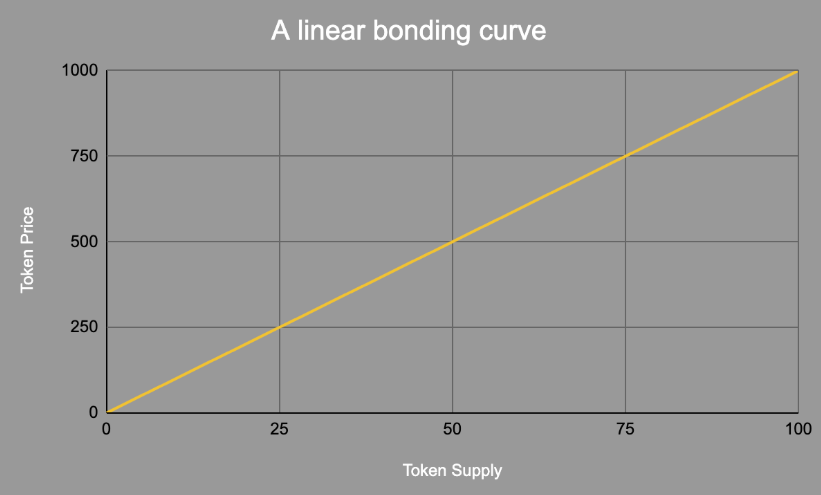
Linear bonding curves
The simplest model. The price increases by a fixed amount for every new token minted. Growth is steady and predictable, which can appeal to users who value transparency.
Exponential bonding curves
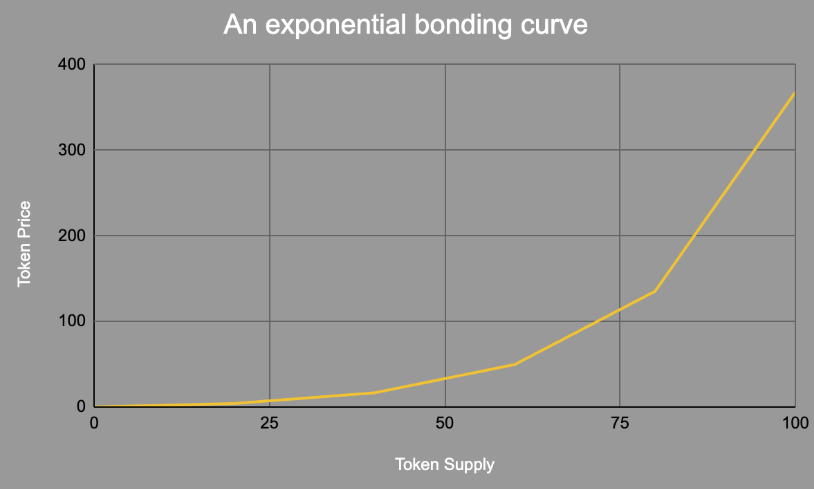
Here, prices rise faster as supply increases. If demand accelerates, prices can climb sharply. This model tends to reward early participants the most, but it also carries higher risk if momentum fades.
Logarithmic bonding curves
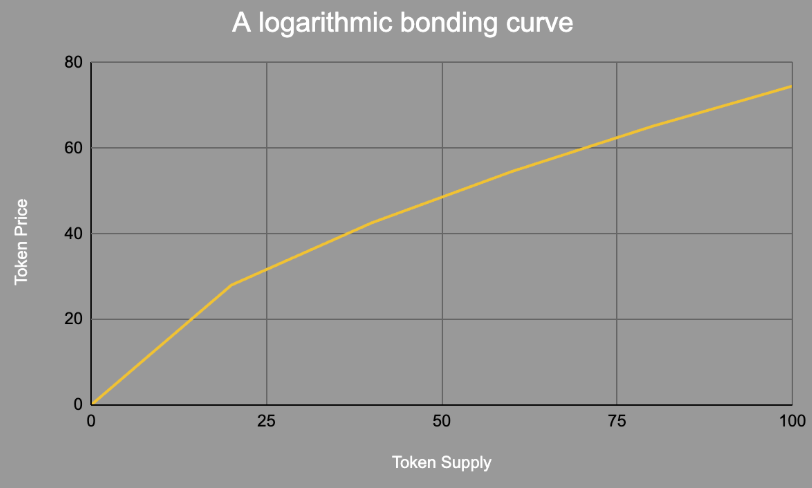
Prices jump quickly at the start, then slow down as supply grows. Early buyers benefit from the initial surge, while later participants see more stable pricing.
Some DeFi projects experiment with other models, such as step-function curves tied to milestones, S-curves designed for phased growth, or even inverse curves where prices fall as supply expands.
A Real-World Example: pump.fun
Pump.fun, built on Solana, shows how bonding curves work outside theory. The platform lets users launch tokens, often meme coins, using automated pricing and liquidity rules powered by smart contracts.
Instead of relying purely on hype-driven trading, pump.fun uses a smooth bonding curve. A token might start at 0.1 SOL, rise to 0.2 SOL after a few hundred sales, and continue increasing as demand grows. The platform visually displays progress along the curve, so users can see exactly where the token sits.
Once a token reaches a certain market cap and the curve nears completion, it transitions to Raydium for open-market trading. A portion of the SOL raised is paired with tokens to form a liquidity pool. This structure rewards early buyers with lower prices while maintaining clear rules for later participants.
Final Thoughts
Bonding curves bring structure to an industry often driven by speculation. By encoding supply and demand directly into smart contracts, they offer a transparent way to manage pricing and liquidity from the start.
As platforms like pump.fun show, bonding curves are not just theory. They are practical tools shaping how tokens are launched and traded in DeFi today. While they don’t remove risk, they do provide clarity, which is something both new and experienced crypto users can appreciate.



