
Ethereum co-founder Vitalik Buterin has shared a refreshed view of how blockchain technology could fit into a future increasingly shaped by artificial intelligence, arguing that Ethereum’s real value lies in coordination, governance, and trust rather than a race toward artificial general intelligence.
In a post published Monday on X, Buterin revisited ideas he first explored two years ago about the intersection of crypto and AI, refining them around more practical, near-term use cases. He noted that the two fields are often discussed from very different philosophical standpoints, which can lead to misplaced priorities.
Two years ago, I wrote this post on the possible areas that I see for ethereum + AI intersections: https://t.co/ds9mLnrJWm
— vitalik.eth (@VitalikButerin) February 9, 2026
This is a topic that many people are excited about, but where I always worry that we think about the two from completely separate philosophical… pic.twitter.com/pQq5kazT61
Rather than framing progress as a sprint toward AGI, Buterin cautioned against what he described as “undifferentiated acceleration.” In his view, Ethereum’s purpose is about choosing direction and values, not simply pushing technology forward as fast as possible.
A Practical Vision for Crypto and AI
Buterin’s updated framework focuses on how Ethereum can support privacy, decentralization, and human agency in an AI-heavy environment. Instead of building autonomous superintelligence, he sees Ethereum as part of a broader technical stack that helps people and systems interact with AI on their own terms.
One area he highlighted is tooling. This includes local large language models, cryptographic payment systems for AI services, and client-side verification methods that reduce dependence on centralized platforms. Together, these tools could allow users to access AI capabilities in more private and trust-minimized ways.
Ethereum as a Coordination Layer
Another pillar of the vision positions Ethereum as an economic and coordination layer for AI-related activity. Buterin described onchain mechanisms that could allow AI agents to transact with one another, post security deposits, and build reputational records. Such systems, he suggested, could support more decentralized AI architectures instead of models controlled by a single organization.
He also returned to a long-standing cypherpunk principle: reducing trust by increasing verification. According to Buterin, large language models could make this more achievable by handling complex verification tasks at a scale that would overwhelm human reviewers, such as analyzing smart contracts or protocol assumptions.
Governance, Markets, and “Defensive Acceleration”
In governance and market design, Buterin argued that AI could help revive ideas that have struggled due to human attention limits. Tools powered by AI could make prediction markets, decentralized governance, and more nuanced voting systems workable by scaling human judgment rather than replacing it.
These ideas align with what Buterin has previously called “defensive acceleration,” or d/acc, a concept focused on using technology to strengthen decentralized cooperation and social resilience while avoiding excessive concentration of power.
The post builds on his earlier breakdown of four areas where crypto and AI overlap—AI as an actor, an interface, a rule-set, or an objective—published in January 2024. It also echoes his recent calls to rethink DAO governance beyond simple token-based voting, including the use of zero-knowledge proofs and AI to reduce decision fatigue and governance capture.
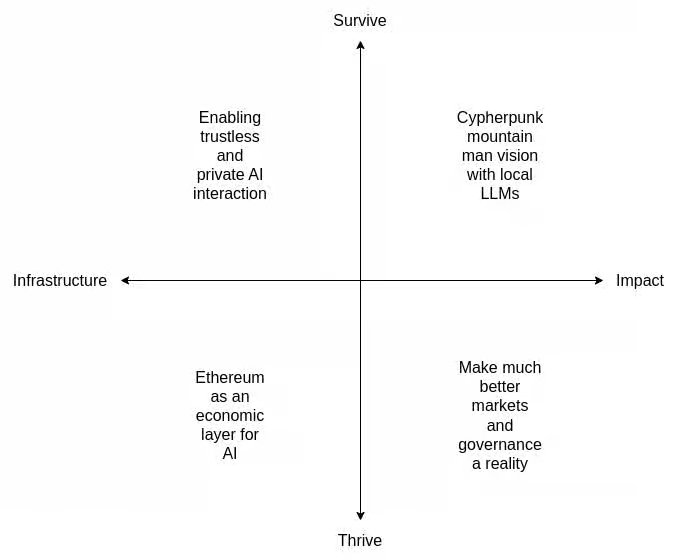
To illustrate the scope of his thinking, Buterin included a simple two-by-two chart mapping Ethereum’s AI ambitions across infrastructure versus impact and survival versus flourishing, signaling that the ideas range from defensive safeguards to more transformative possibilities.
“There’s a lot to build,” he concluded.
Looking Ahead
Buterin’s updated vision offers a grounded perspective on crypto and AI, shifting the conversation away from distant superintelligence and toward tools and systems that can be built now. As AI continues to advance, his framework positions Ethereum not as a competitor in intelligence, but as an enabler of coordination, accountability, and human-centered design.



