

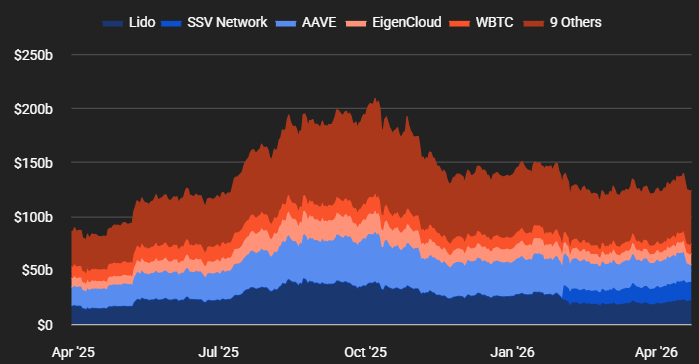
Aave’s total value locked (TVL) has fallen to about $15.3 billion following a $292 million exploit tied to KelpDAO’s rsETH. The drop highlights mounting stress in DeFi lending markets as liquidity tightens and withdrawals accelerate.
Gordon Liao, chief economist at Circle, proposed raising USD Coin (USDC) lending rates on Aave v3 Ethereum to as high as 40%–50% under stress conditions. His April Request for Comment argues the current roughly 14% rate has failed to restore liquidity, with utilization pinned near 100% for four consecutive days. The proposal also suggests lowering optimal utilization thresholds to attract fresh deposits.
 GordonLiao
Can Higher USDC Rates Restore Aave Liquidity?
The proposal reflects a broader DeFi pattern where pricing mechanisms are used to rebalance liquidity during market dislocations. Before the incident, Aave’s TVL exceeded $45 billion, indicating a sharp contraction as users pulled capital amid uncertainty. Still, reliance on rate adjustments rather than direct intervention shows how decentralized protocols prioritize market-driven responses over centralized backstops.
Liao argued that borrowers are currently insensitive to rising costs because they are attempting to exit constrained positions, leaving rates too low to clear supply-demand imbalances.
“The market is essentially pinned at full utilization,” he wrote, suggesting that significantly higher yields could attract external liquidity within hours and ease withdrawal pressure.
Critics warn that steeper rate curves may increase liquidation risk for existing borrowers. One community analysis estimated that around $70.1 million in debt could move closer to liquidation over a 30-day period under the proposed parameters, with a single large wallet accounting for most exposure. This raises concerns that stress could shift from lenders awaiting withdrawals to borrowers operating with limited collateral buffers.
用时一天半,KelpDAO 黑客的 75,700 枚 ETH ($1.75 亿) 现在已经基本上都换成 BTC 了。
— 余烬 (@EmberCN) April 23, 2026
黑客把 ETH 跨链兑换成 BTC 主要走的协议是 THORChain,黑客的使用也为 THORChain 带去了 $8 亿的交易量以及 $91 万的平台手续费收入。
----------------------------------------------------#Bitget VIP… https://t.co/YHNjV4jTGy pic.twitter.com/QMsFhsjWFx
The situation remains fluid as fallout from the KelpDAO exploit continues. Onchain data shows the attacker has converted roughly 75,700 ETH into bitcoin via THORChain, generating about $800 million in volume and $910,000 in fees. The next catalyst will be Aave governance feedback on the proposal and whether rate adjustments can stabilize liquidity without triggering broader liquidations.



