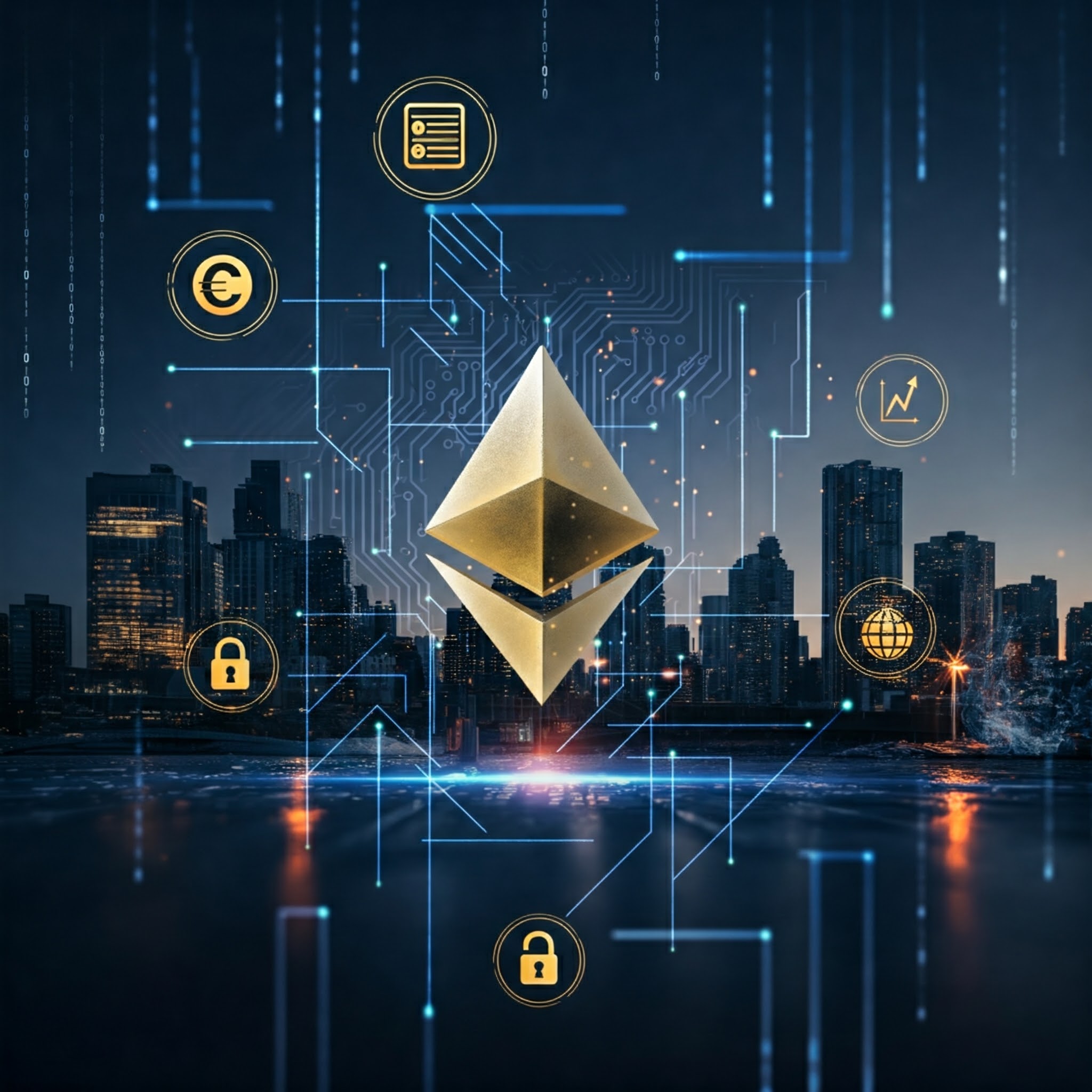
Ethereum's dominance in Decentralized Finance (DeFi) is being challenged by high fees and slow transaction speeds. Enter ZK-Rollups, a cutting-edge Layer-2 scaling solution that leverages advanced cryptography to boost Ethereum's capabilities, promising to unlock the next wave of DeFi innovation and potentially reshape the landscape for investors.
Table of Contents
- Ethereum's DeFi Dominance and its Scalability Bottleneck
- The Rise of Layer-2 Solutions: A Scalability Lifeline
- What are ZK-Rollups?
- How ZK-Rollups Work: A Simplified Explanation
- Advantages of ZK-Rollups for DeFi
- Types of ZK-Rollups: ZK-SNARKs vs. ZK-STARKs
- Leading ZK-Rollup Projects
- ZK-Rollups and the Future of DeFi
- Investment Opportunities and Considerations
- Risks and Challenges
- Conclusion
Ethereum's DeFi Dominance and its Scalability Bottleneck
Ethereum has established itself as the leading platform for Decentralized Finance (DeFi), hosting a vast ecosystem of applications that offer lending, borrowing, trading, and other financial services without traditional intermediaries. However, its success has led to a major bottleneck: scalability. As more users and applications flock to Ethereum, the network has become congested, resulting in high transaction fees (gas fees) and slow confirmation times. Imagine a popular restaurant with a limited number of tables—as demand increases, waiting times and prices go up. This is what's happening on Ethereum.
The Rise of Layer-2 Solutions: A Scalability Lifeline
To address Ethereum's scalability issues, developers have turned to Layer-2 (L2) solutions. These protocols process transactions off the main Ethereum blockchain (Layer-1), while still leveraging its security. Think of Layer-2s as efficient side streets that connect to a main highway, allowing for faster and cheaper travel. Among the various L2 approaches, ZK-Rollups have emerged as a particularly promising technology.
What are ZK-Rollups?
ZK-Rollups are a type of Layer-2 scaling solution that uses zero-knowledge proofs, a powerful cryptographic technique, to enhance Ethereum's performance. They bundle hundreds of transactions off-chain and generate a cryptographic proof, called a SNARK (Succinct Non-Interactive Argument of Knowledge) or a STARK (Scalable Transparent Argument of Knowledge), which is then submitted to the Ethereum mainnet.
- Zero-Knowledge Proofs (ZKPs): At their core, ZKPs allow one party (the prover) to prove to another party (the verifier) that a statement is true without revealing any information beyond the validity of the statement itself. Imagine proving you know the solution to a puzzle without actually showing the solution. This is the magic of ZKPs. They enable privacy and efficiency by minimizing the data that needs to be shared.
How ZK-Rollups Work: A Simplified Explanation
- Transaction Bundling: ZK-Rollups bundle multiple transactions together off-chain.
- Validity Proof Generation: A cryptographic proof (SNARK or STARK) is generated to demonstrate that all the bundled transactions are valid. This proof is much smaller in size than the individual transactions.
- Submission to Layer-1: The bundle of transactions and the validity proof are submitted to the Ethereum mainnet.
- Verification on Layer-1: The Ethereum blockchain verifies the proof, ensuring the validity of the off-chain transactions.
- State Update: Once the proof is verified, the state of the Ethereum blockchain is updated to reflect the changes from the bundled transactions.
Advantages of ZK-Rollups for DeFi
- Scalability: ZK-Rollups can significantly increase Ethereum's transaction throughput, potentially processing thousands of transactions per second.
- Lower Gas Fees: By bundling transactions and submitting only a proof to Layer-1, ZK-Rollups drastically reduce gas costs for users.
- Security: They inherit the security of the Ethereum mainnet, as the validity proofs ensure that only valid transactions are processed.
- Fast Finality: Compared to other Layer-2 solutions like Optimistic Rollups, ZK-Rollups offer faster transaction finality, as the validity proofs are verified quickly on Layer-1. There is no need for a challenge period.
- Privacy: Certain ZK-Rollup implementations (using ZK-SNARKs) can offer enhanced privacy by not revealing the details of the transactions on Layer-1.
Types of ZK-Rollups: ZK-SNARKs vs. ZK-STARKs
ZK-SNARKs (Succinct Non-Interactive Argument of Knowledge):
- Advantages: Smaller proof sizes, leading to lower gas costs on Layer-1.
- Disadvantages: Require a trusted setup, which can be a potential security concern if not done properly. They are also potentially vulnerable to future quantum computing attacks.
- Examples: zkSync Era, zkSync Lite, Polygon zkEVM, Scroll.
ZK-STARKs (Scalable Transparent Argument of Knowledge):
- Advantages: Don't require a trusted setup, and are considered quantum-resistant.
- Disadvantages: Larger proof sizes compared to SNARKs, resulting in potentially higher gas costs.
- Examples: StarkNet, Immutable X.
Leading ZK-Rollup Projects
- zkSync: Developed by Matter Labs, zkSync is one of the leading ZK-Rollup projects. It offers a developer-friendly platform and supports a wide range of DeFi applications.
- StarkNet: Developed by StarkWare, StarkNet uses ZK-STARKs to provide scalability and privacy. It has gained traction with projects like dYdX, a decentralized derivatives exchange, moving its operations to StarkNet.
- Polygon zkEVM: A ZK-Rollup solution that is fully compatible with the Ethereum Virtual Machine (EVM). This allows existing Ethereum developers to easily migrate their dApps to Polygon zkEVM and benefit from the scalability and low fees of ZK-Rollup technology, without having to learn a new programming language or change their existing tools.
- Scroll: Scroll is a newer ZK-Rollup project that aims to achieve full EVM equivalence. This means that any smart contract that can run on Ethereum can also run on Scroll, without any modifications. It uses a combination of ZK-Rollups and other scaling techniques to achieve high throughput and low latency.
ZK-Rollups and the Future of DeFi
ZK-Rollups are poised to play a pivotal role in the future of DeFi by:
- Enabling Mainstream Adoption: Lower fees and faster transactions make DeFi more accessible to a wider audience.
- Unlocking New Use Cases: Scalability opens the door for more complex and demanding DeFi applications, such as high-frequency trading and on-chain gaming.
- Enhancing Privacy: ZK-Rollups can enable privacy-preserving DeFi applications, allowing users to transact without revealing sensitive information.
- Driving Innovation: The competition among different ZK-Rollup projects is fostering rapid innovation in the Layer-2 space.
Investment Opportunities and Considerations
The rise of ZK-Rollups presents several investment opportunities:
- ZK-Rollup Tokens: Investing in the native tokens of ZK-Rollup projects like zkSync, StarkNet, Polygon zkEVM and Scroll.
- DeFi Protocols on ZK-Rollups: Investing in DeFi projects that are building on or migrating to ZK-Rollups.
- Infrastructure and Tooling: Investing in companies developing infrastructure and tools for ZK-Rollups, such as wallets, developer platforms, and security solutions.
Risks and Challenges
- Early Stage Technology: ZK-Rollup technology is still relatively new and under development. There may be unforeseen technical challenges or security vulnerabilities.
- Complexity: ZK-Rollups are complex systems that can be difficult to understand, even for experienced developers.
- Competition: The Layer-2 space is highly competitive, and it's not yet clear which projects will emerge as the dominant players.
- Regulatory Uncertainty: The regulatory landscape for cryptocurrencies and Layer-2 solutions is still evolving.
Conclusion
ZK-Rollups represent a major leap forward in Ethereum scaling, offering a powerful combination of speed, security, and low fees. By unlocking Ethereum's potential, ZK-Rollups are poised to revolutionize DeFi, enabling a new wave of innovation and making decentralized finance more accessible to the masses. For investors, the ZK-Rollup ecosystem presents a wealth of opportunities, but it's crucial to approach this emerging market with a thorough understanding of the technology, the risks, and the competitive landscape. As ZK-Rollup technology continues to mature and the DeFi ecosystem expands, the projects that can successfully harness the power of zero-knowledge proofs are likely to play a pivotal role in shaping the future of finance.



