

Uniswap is rolling out a new mechanism designed to bring more clarity and fairness to early token markets. On Thursday, the decentralized exchange unveiled Continuous Clearing Auctions (CCA), a permissionless auction framework built for Uniswap v4 that aims to reshape how projects launch tokens and establish liquidity onchain.
CCA conducts auctions on a block-by-block basis and automatically seeds a liquidity pool at the auction’s final clearing price. According to Uniswap, this approach improves transparency, reduces hidden deal-making, and encourages more accurate price discovery during the earliest and often most chaotic phase of a token’s life.


The model was developed in collaboration with Aztec, which will be the first project to run an auction through the new system. An optional ZK Passport feature adds another layer to the experience, allowing participants to verify eligibility while keeping personal data private—a blend of confidentiality and trustless onchain validation.
Addressing opaque launch processes
In announcing the model, Uniswap argued that today’s token launches often unfold in a fragmented environment dominated by private negotiations, preferential access, and limited liquidity. CCA aims to counter these issues with an open, fully onchain process where pricing, bidding, and settlement occur transparently and without gatekeepers.
By settling each block at a single market-clearing price, the system distributes tokens gradually and allows bidders to set maximum bid levels while only receiving fills when the price drops below their limit. This structure discourages last-second sniping and encourages more steady, early participation—conditions Uniswap says help the market find a fairer price.
How CCA operates
Projects launching through CCA can configure auction parameters such as token quantity, starting price, and duration. They can also layer on features like tranche-based distribution or ZK Passport-based verification. Bidders place orders throughout the auction, and if too many buyers want tokens within a block, fills are distributed proportionally.
When the auction ends, the collected proceeds automatically create a liquidity pool on Uniswap v4 at the final clearing price. This ensures that trading can begin immediately with an established pool, reducing volatility and friction for early participants. The CCA smart contract is already live, with more modules expected in the coming months as part of Uniswap’s broader push to support token launches, scaling, and long-term liquidity.
Part of a broader liquidity-focused push
The launch of CCA comes as Uniswap sharpens its efforts around sustainable liquidity and protocol economics. Earlier this week, Uniswap Labs and the Uniswap Foundation put forward a proposal to activate a fee switch, a topic that has resurfaced across the DeFi community.
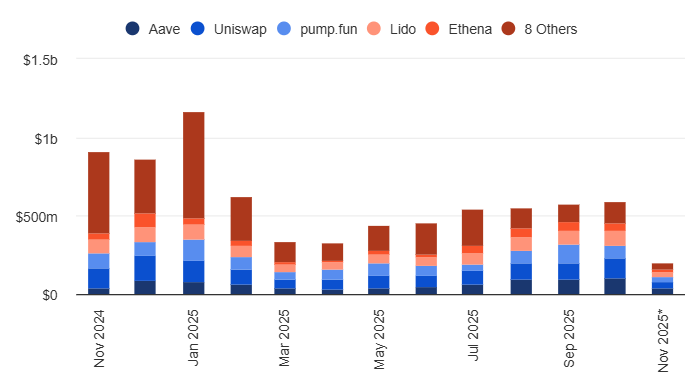
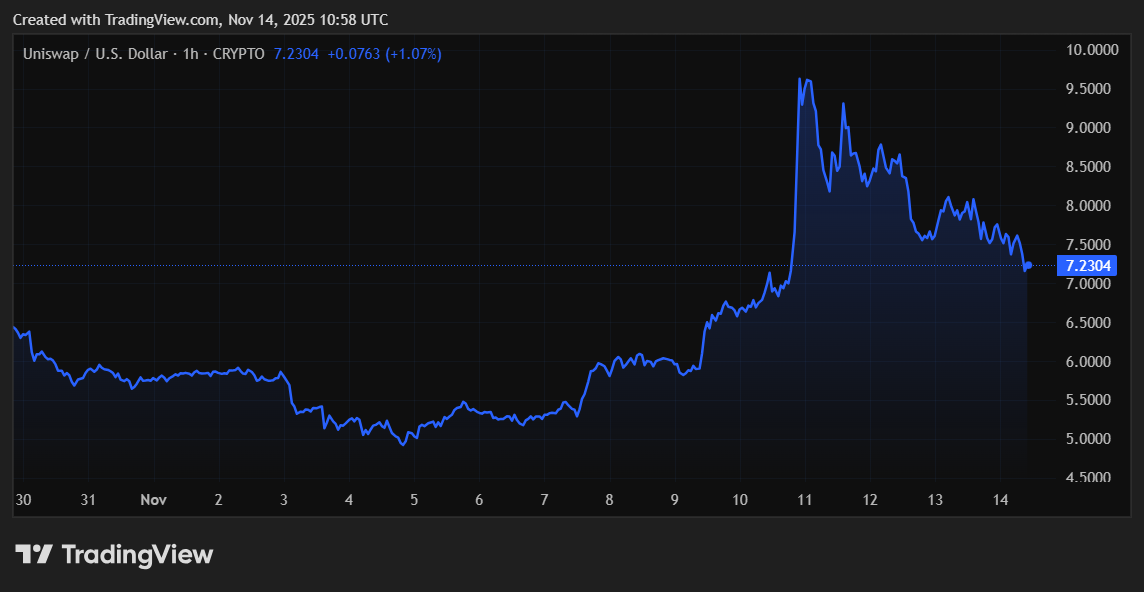
Meanwhile, major DeFi platforms are showing signs of renewed activity. Uniswap and Aave led a recovery in protocol fees—reaching roughly $600 million in September—driven by higher onchain engagement and evolving token models centered on buybacks and long-term sustainability. At the time of writing, UNI trades in the mid-$7 range, still below its peak earlier this year.



