
Uniswap is heading toward one of the most consequential governance votes in its history, with token holders asked to weigh in on the long-awaited UNIfication proposal before the holiday season ends.
UNI founder Hayden Adams formally submitted the proposal for a final vote this week, setting a voting window from December 19 through December 25. In a lighthearted post on X, Adams encouraged delegates not to delay, joking that anyone who misses the deadline risks landing on Santa’s “naughty list.”
Just submitted the Unification proposal for final governance vote
— Hayden Adams 🦄 (@haydenzadams) December 18, 2025
Voting starts on 12/19 at 10.30pm EST and ends on 12/25
If it passes, after a 2 day timelock period:
🔥 100m UNI will be burned
🦄 v2 + v3 fee switches will flip on mainnet and begin burning UNI, along with…
Behind the humor, however, is a serious decision that could reshape how value flows through one of decentralized finance’s largest protocols.
A long-debated fee switch returns
At the heart of the proposal is the activation of protocol fees, often referred to as the “fee switch.” For years, UNI holders have debated redirecting a portion of trading fees away from liquidity providers and toward the protocol itself. Previous efforts stalled amid regulatory uncertainty in the United States and ongoing legal challenges, particularly during the tenure of former SEC Chair Gary Gensler.
The proposal’s authors argue those conditions have since evolved, opening the door for a governance-backed change.
If approved, the plan would take effect after a two-day timelock and trigger a series of onchain actions. These include a retroactive burn of 100 million UNI from the treasury, intended to mirror what might have been removed from circulation had protocol fees existed since the token’s launch.
v4 and will be a separate governance proposal!
— Hayden Adams 🦄 (@haydenzadams) December 18, 2025
How the fee rollout would work
Protocol fees would be introduced gradually to limit disruption. The initial phase would focus on Uniswap v2 pools and a selected group of v3 pools on Ethereum mainnet that account for the vast majority of liquidity provider fees.
On Uniswap v2, liquidity provider fees would drop from 0.3% to 0.25%, with the remaining 0.05% routed to the protocol. For Uniswap v3, protocol fees would be set as fractions of existing liquidity provider fees, starting at one-quarter for lower-fee pools and one-sixth for higher-fee pools. Governance would retain the ability to adjust these parameters over time.
The proposal also brings Unichain into the picture. Sequencer fees from the Layer 2 network would be directed into the same UNI burn mechanism, after covering Layer 1 data costs and a 15% allocation to Optimism. Unichain, launched roughly nine months ago, is currently handling about $100 billion in annualized decentralized exchange volume and generating around $7.5 million in annualized sequencer fees, according to the team.
Future expansions could extend protocol fees to other Layer 2s, additional Layer 1 networks, Uniswap v4, UniswapX, and other components designed to capture and redirect certain types of MEV to the protocol.
A broader restructuring of the ecosystem
UNIfication goes beyond fees. The proposal outlines a structural reorganization intended to more closely align Uniswap Labs with protocol governance. Under the plan, Uniswap Labs would enter into a legally binding services agreement under Wyoming’s Decentralized Unincorporated Nonprofit Association framework, with indemnification protections for members of the independent committee involved in negotiations.
Operational responsibilities currently handled by the Uniswap Foundation would shift to Uniswap Labs, while Labs would eliminate interface, wallet, and API fees. The proposal also introduces an annual growth budget of 20 million UNI starting in 2026, funded from the treasury, to support long-term development.
Supporters frame the changes as a move toward a clearer division of roles: protocol usage would drive UNI burns, while Uniswap Labs would focus on building and expanding the ecosystem.
Market reaction and what comes next
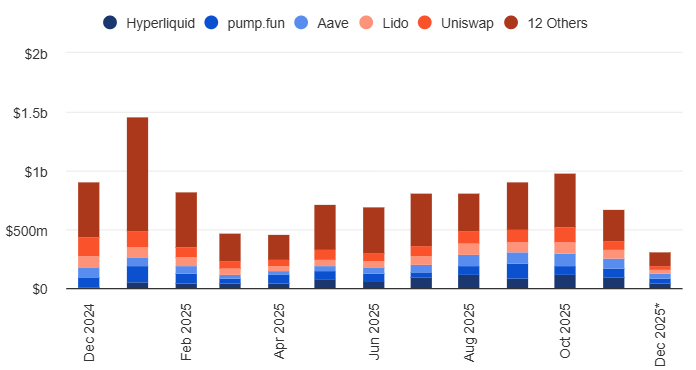
Uniswap has been one of DeFi’s strongest performers in 2025, generating nearly $100 million in average monthly fees and more than $1 billion year to date, according to industry data. Following the submission of the proposal for a final vote, UNI rose about 7.5%, reflecting heightened investor attention.
With the voting deadline falling on Christmas Day, delegates now face a short but pivotal window to decide the future direction of the protocol. Whether UNIfication passes or not, the outcome is likely to set a precedent for how mature DeFi platforms balance governance, growth, and value capture.



