
Uniswap’s community has approved a sweeping governance proposal that reshapes the protocol’s economic model and introduces a long-anticipated token burn mechanism. Known as “UNIfication,” the initiative passed with overwhelming support and marks a shift toward a more deflationary future for the UNI token.
Voting concluded on Thursday, with Uniswap founder Hayden Adams confirming that more than 99.9% of participating votes favored the proposal. Over 125 million UNI tokens were cast in support, compared with just 742 tokens voting against, underscoring broad alignment among token holders.
Voting has concluded on Unification 🦄
— Hayden Adams 🦄 (@haydenzadams) December 25, 2025
125,342,017 YES
742 NO
Unified, true to the name
After a ~2day vote timelock, 100m UNI will be burned, fee switches will be flipped, labs will turn off frontend fees and focus on the protocol, and more
Merry Christmas everyone 🎄 https://t.co/wpsEC8udlW pic.twitter.com/P0rJmLN9Cc
The proposal, jointly introduced by Uniswap Labs and the Uniswap Foundation in November, activates the protocol’s long-discussed “fee switch.” Under this change, a portion of trading fees that previously went entirely to liquidity providers will now be directed to the protocol itself. Those funds will be used to regularly burn UNI tokens, permanently removing them from circulation. In addition, net sequencer fees from Unichain will be funneled into the same burn mechanism.
Together, these changes are designed to create a feedback loop in which increased use of the Uniswap protocol leads to a shrinking supply of UNI. Supporters argue this aligns the token more closely with the platform’s growth and long-term sustainability.
Beyond the fee switch, the UNIfication proposal also streamlines Uniswap’s internal structure. Responsibilities currently handled by the Uniswap Foundation will transition to Uniswap Labs, consolidating operations under a single umbrella. The plan also removes fees from Uniswap Labs’ interface, wallet, and API services, lowering friction for users and developers. To support continued development, an annual growth budget funded by UNI tokens will be established to invest in the protocol and its broader ecosystem.
With the vote now complete, the proposal enters a standard two-day timelock. Once that period ends, Uniswap is expected to burn 100 million UNI tokens. This one-time burn represents an estimate of how many tokens might have been destroyed if the fee switch had been active from the protocol’s earliest days.
The governance decision follows a period of heightened regulatory scrutiny for the decentralized finance sector, including legal challenges involving Uniswap during the tenure of former U.S. Securities and Exchange Commission Chair Gary Gensler. In the proposal, Uniswap argued that the regulatory environment has evolved and that DeFi has reached a turning point toward broader adoption.
“I believe Uniswap protocol can be the primary place tokens are traded,” Adams wrote in a post discussing the vote outcome. “This proposal sets the stage for the next decade of its growth.”
Today, I’m incredibly excited to make my first proposal to Uniswap governance on behalf of @Uniswap alongside @devinawalsh and @nkennethk
— Hayden Adams 🦄 (@haydenzadams) November 10, 2025
This proposal turns on protocol fees and aligns incentives across the Uniswap ecosystem
Uniswap has been my passion and singular focus for… pic.twitter.com/Ee9bKDric5
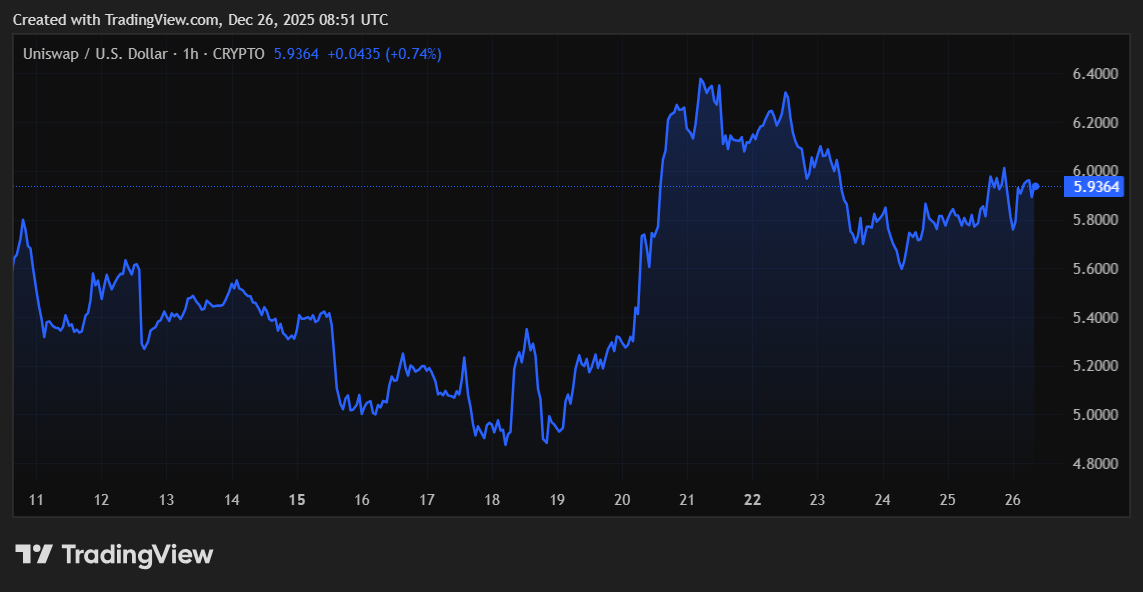
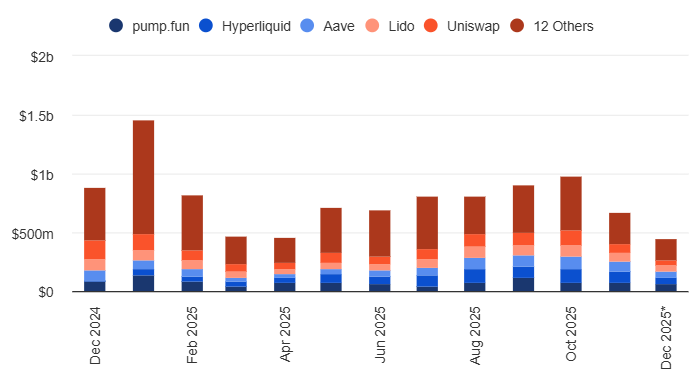
Market reaction has been positive so far. UNI was trading at $5.92 as of late Thursday, up nearly 19% over the past week, according to data. The protocol has also continued to generate substantial activity, with more than $1.05 billion in fees recorded so far this year.



