
What Is WebSocket?
WebSocket is a communication protocol that lets users exchange data instantly between a client (like your browser) and a server—without constant refreshes or repeated requests. Unlike the traditional HTTP model, where the client must ask for updates repeatedly, WebSocket keeps the connection open so both sides can send and receive data in real time.
Think of it as a two-way street: once the connection is established, messages can flow freely in both directions until one side decides to close it. This makes WebSocket ideal for applications that demand live updates—like crypto trading dashboards, multiplayer games, or messaging platforms.
On platforms like Binance, a WebSocket connection can deliver multiple “streams” of data through one link. For example, you can receive live Bitcoin price updates and trade data simultaneously, without opening separate connections.
How WebSocket Works
A WebSocket session begins with what’s known as a handshake. This is an initial HTTP request where the client asks the server to upgrade the connection from HTTP to WebSocket. Once the server agrees, the connection is “upgraded,” and communication continues seamlessly over a persistent TCP channel.
During this session, several core events keep the system running smoothly:
- onopen: triggered when the connection is successfully established.
- onmessage: fired when the server sends a message.
- onclose: occurs when either party closes the connection.
- onerror: signals a network or protocol problem.
These events ensure stability and allow apps to respond gracefully—for example, by attempting a reconnection after an unexpected drop.
WebSocket API vs. WebSocket Streams
Binance offers two types of WebSocket connections:
- WebSocket API – A feature-rich option that supports both market and user data. It comes with request limits but offers broader functionality.
- WebSocket Streams – Simpler, no rate limits, but restricted to market data only.
Each type has a different endpoint and naming convention. For instance, WebSocket Streams use an @ symbol in their stream names, while APIs do not.
The right choice depends on your needs: Streams are quick and easy for market updates, while APIs are better suited for complex trading operations that require multiple data types.
Multiplexing vs. Multi-Connections
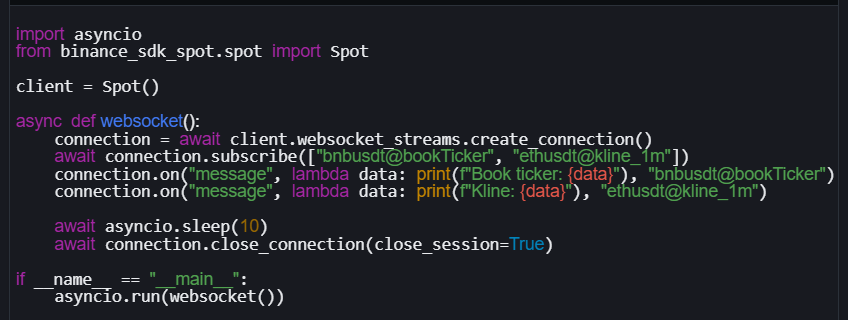
If you need access to multiple data streams at once, you can either multiplex them (combine several streams into one connection) or open multiple connections.
- Multiplexing is more efficient—it conserves bandwidth and CPU resources by running up to 1,024 streams over a single link.
- Multi-connections offer more flexibility and resilience but consume more system resources. Binance, for instance, limits users to 300 connections per five minutes per IP address to prevent abuse.
Why WebSocket Beats HTTP for Real-Time Apps
HTTP is inherently one-way: the client must keep asking the server for updates. WebSocket eliminates that back-and-forth. Once connected, both sides can communicate instantly—no polling required.
That’s why WebSocket powers today’s real-time web—from financial platforms streaming live order books to chat apps pushing instant messages. It’s faster, lighter, and far more responsive than traditional HTTP.
Final Thoughts
WebSocket isn’t just another API—it’s the technology that makes real-time digital experiences possible. Whether you’re building a trading platform, live dashboard, or online game, it provides a fast, reliable way to keep data flowing in both directions.
As more applications demand immediate updates and seamless interactivity, understanding how WebSocket works can help developers and users alike tap into the true potential of real-time web communication.



