
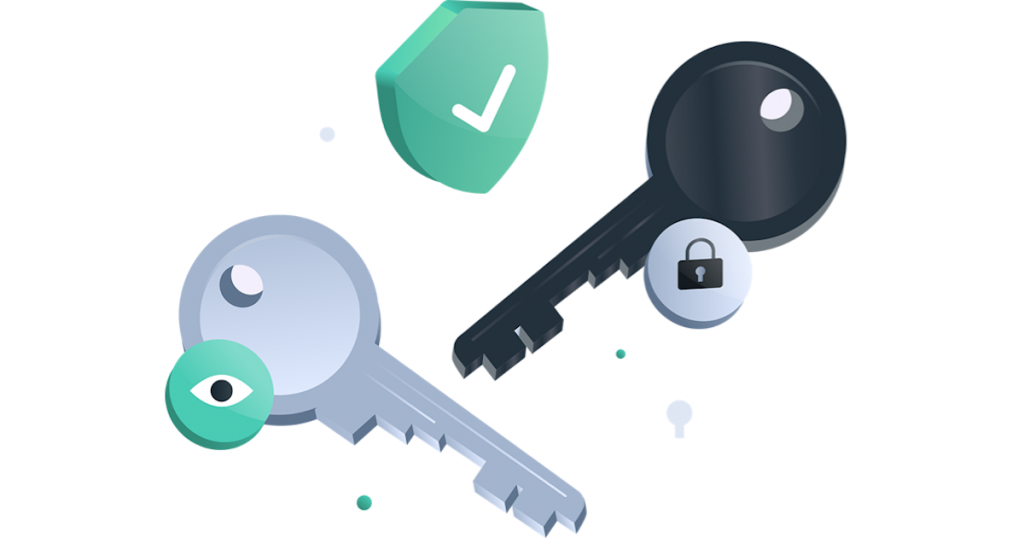
If you've ever owned Bitcoin or Ethereum, you've used public and private keys—even if you didn't realize it. These two mathematically linked codes are the core of all cryptocurrency and the reason digital assets are possible without a bank or central authority. They are the digital keys to your kingdom.
Cryptocurrency isn't just called "crypto" for fun; the entire system fundamentally relies on public-key cryptography, a military-grade technology now available to everyone.
Let's break down these two essential pieces of code and how they work together to manage your money.
The Two Halves of Your Digital Identity
Public-key cryptography is described as asymmetric because it uses a pair of keys—a public one and a private one—instead of a single universal key (symmetric cryptography).
Think of your crypto wallet as a digital bank vault.
1. The Public Key (Your Account Number)
The public key is exactly what it sounds like: it's visible to everyone on the network.
- Role: The public key is used to encrypt data and is the base for generating your blockchain address (the string of characters you share with someone when you want to receive funds).
- Analogy: This is your email address or your bank account number. Anyone can see it, and anyone can send money to it, but seeing it doesn't allow them to access your funds.
2. The Private Key (Your Password)
The private key is the secret, confidential string of characters known only to you.
- Role: This key is used to decrypt data and, most importantly, to create a digital signature that signs (authorizes) every transaction you send.
- Analogy: This is your bank PIN or the password to your vault. If someone else gets your private key, they effectively gain complete control over your funds.
How Transactions Are Secured and Verified
The magic happens when these two keys—mathematically linked but functionally opposite—interact. This process ensures authentication (proving the transaction is yours) and integrity (ensuring the transaction details haven't been changed).
- Signing (The Private Key Action): When you want to send Bitcoin from your address to someone else's, your wallet uses your private key to encrypt (or "sign") the transaction details. This digital signature is proof that the transaction originated from the legitimate owner of that address.
- Verifying (The Public Key Action): The rest of the network—the miners and nodes—can instantly use your publicly known public key to decrypt and verify the signature. If the public key successfully decrypts the signature, it proves the private key (which only you possess) was used. The transaction is then validated and added to the public ledger.
This ingenious system ensures that even though all transactions are recorded on a public ledger, only the owner of the private key can authorize a transfer, maintaining complete confidentiality and control.
The Golden Rule: Losing Your Key Means Losing Your Money
The entire security model hinges on one factor: the secrecy of your private key.
In a centralized system, if you lose your password, you call the bank, and they reset it. In a decentralized, asymmetric system, there is no bank to call.
- If your private key leaks: Only the address it corresponds to is compromised, but the attacker gains control and can drain your funds immediately.
- If you lose your private key: You permanently lose access to your funds, as you can no longer create the digital signature required to prove ownership and authorize transactions.
This is why securely storing your private key (often represented by a seed phrase or mnemonic phrase) is the most critical responsibility of any crypto holder. Always back it up securely, preferably offline using a dedicated hardware wallet.



