

A U.S. appeals court has upheld a lower court ruling that digital asset bank Custodia is not automatically entitled to a Federal Reserve master account, marking another setback in the company’s multi-year effort to gain direct access to the Fed’s payment system.
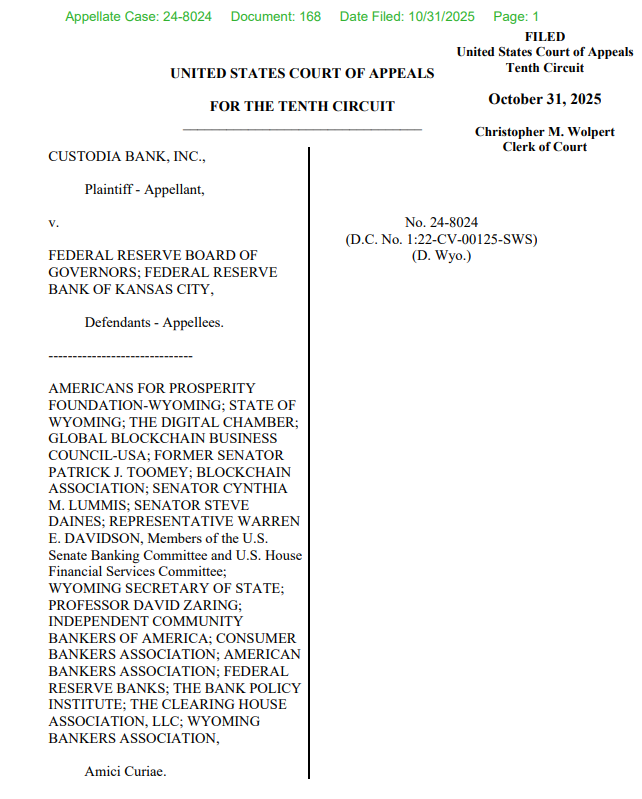
In a decision released Friday, the U.S. Court of Appeals for the Tenth Circuit affirmed a previous judgment from the U.S. District Court for the District of Wyoming, which found that the Federal Reserve retains full discretion over which institutions receive access.
“Accordingly, Custodia is not automatically entitled to a master account,” the judges wrote. “We affirm the judgment of the district court in favor of Defendants on all claims.”
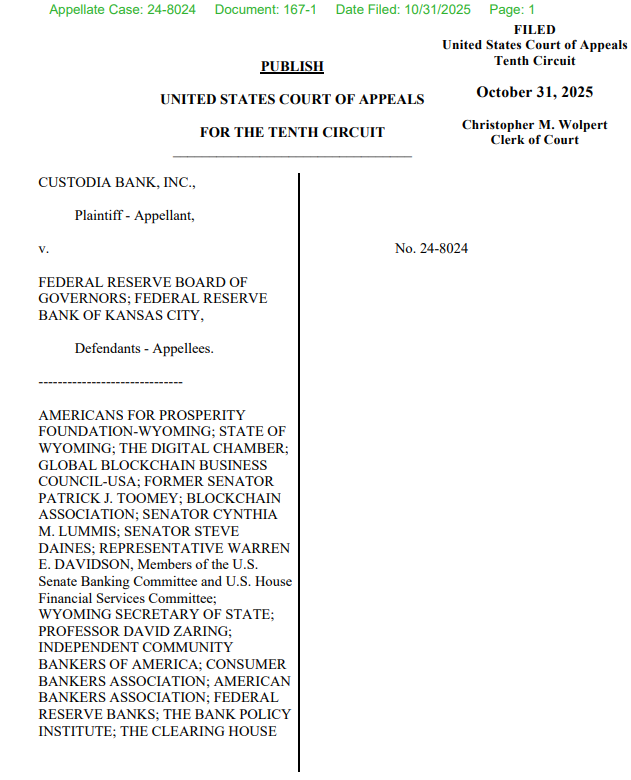
The decision reinforces an earlier 2023 ruling by Judge Scott Skavdahl, who determined that the central bank is under no obligation to grant Custodia — or any institution — a master account. Such accounts allow banks to interact directly with the Federal Reserve’s payment network, giving them the most direct access possible to the U.S. money supply. Institutions without one must rely on partner banks to process payments and hold reserves, adding cost and complexity.
A Long Road for Custodia
Founded by former Wall Street executive Caitlin Long, Custodia — previously known as Avanti Bank — first applied for a Fed master account in 2020 through the Federal Reserve Bank of Kansas City. The following year, the Federal Reserve Board of Governors took control of the decision-making process, prompting Custodia to file a lawsuit in 2022 accusing the Fed of delaying action on its application.
Custodia operates under Wyoming’s Special Purpose Depository Institution (SPDI) framework, a state-level banking model designed to bridge traditional finance with digital assets. SPDIs can accept deposits and custody digital assets but must maintain 100% reserves rather than lending out customer deposits, distinguishing them from conventional banks that operate on fractional reserves.
Federal Reserve’s Broader Outlook
The ruling comes amid broader discussions at the Federal Reserve about modernizing the banking system’s approach to digital assets. Earlier this month, Federal Reserve Governor Christopher Waller said the central bank is exploring new frameworks for innovation, including a potential “skinny master account” structure for nontraditional financial entities focused on payment innovation.
Custodia has not yet issued a public statement regarding the appeals court’s decision.



