The U.S. financial landscape is entering uncertain territory as inflation ticks upward and political pressure mounts on the Federal Reserve. Former President Donald Trump is once again at odds with Fed Chair Jerome Powell, raising the prospect of a significant reshuffle that could ripple through global markets.
Inflation Creeps Up as Spending Stalls
According to the latest data, the Fed’s preferred inflation metric—the Personal Consumption Expenditures (PCE) Price Index—rose modestly in May. Core PCE, which excludes food and energy, increased by 0.2% month-over-month and 2.7% year-over-year, slightly above expectations. Headline PCE, which includes all components, climbed 0.1% on the month and 2.3% annually.
*US MAY PCE PRICE INDEX RISES 0.1% M/M; EST. +0.1%
— *Walter Bloomberg (@DeItaone) June 27, 2025
*US MAY CORE PCE PRICE INDEX RISES 0.2% M/M; EST. +0.1%
*US MAY PCE PRICE INDEX RISES 2.3% Y/Y; EST. +2.3%
*US MAY CORE PCE PRICE INDEX RISES 2.7% Y/Y; EST. +2.6%
This marks the first uptick in PCE inflation since February, signaling that price pressures may not have fully subsided. Yet, while inflation edges higher, economic momentum appears to be cooling. Personal income fell by 0.4%, and inflation-adjusted spending dipped 0.3%—both figures missing economists’ forecasts.
*US MAY PERSONAL INCOME FALLS 0.4% M/M; EST. +0.3%
— *Walter Bloomberg (@DeItaone) June 27, 2025
*US MAY PERSONAL SPENDING FALLS 0.1% M/M; EST. +0.1%
*US MAY REAL PERSONAL SPENDING FALLS 0.3% M/M; EST. +0.0%
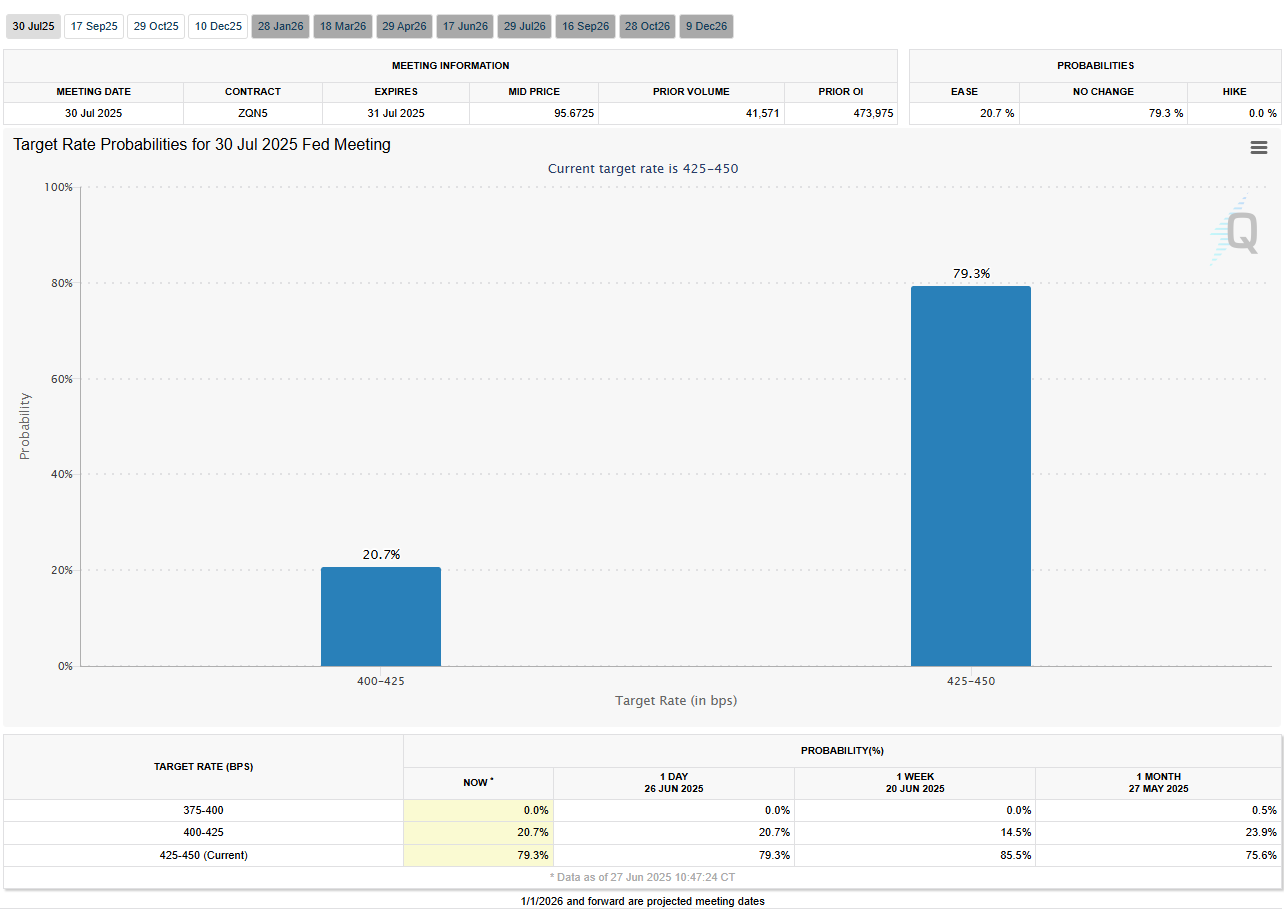
The data reinforces expectations that the Federal Reserve will hold interest rates steady at its upcoming July 30 meeting, with the CME FedWatch Tool currently assigning a 79.3% probability to no change.
Trump’s Fed Frustration Escalates
While economic indicators have been driving policy decisions so far, political winds are starting to blow more forcefully. Former President Trump has publicly criticized Powell, expressing growing frustration over the Fed’s resistance to cutting interest rates.
There is deep momentum in Washington building for Jerome Powell’s resignation.
— Pulte (@pulte) June 26, 2025
In recent appearances, Trump has labeled Powell “the WORST” and a “dummy,” blaming him for slowing the economy and “costing America billions.” Sources familiar with the matter report that Trump is actively considering replacing Powell with a more politically aligned figure, potentially as early as this summer—even though Powell’s term officially ends in 2026.
Such a move would mark a sharp deviation from the longstanding tradition of central bank independence, injecting heightened political uncertainty into U.S. monetary policy.
Currency Markets React
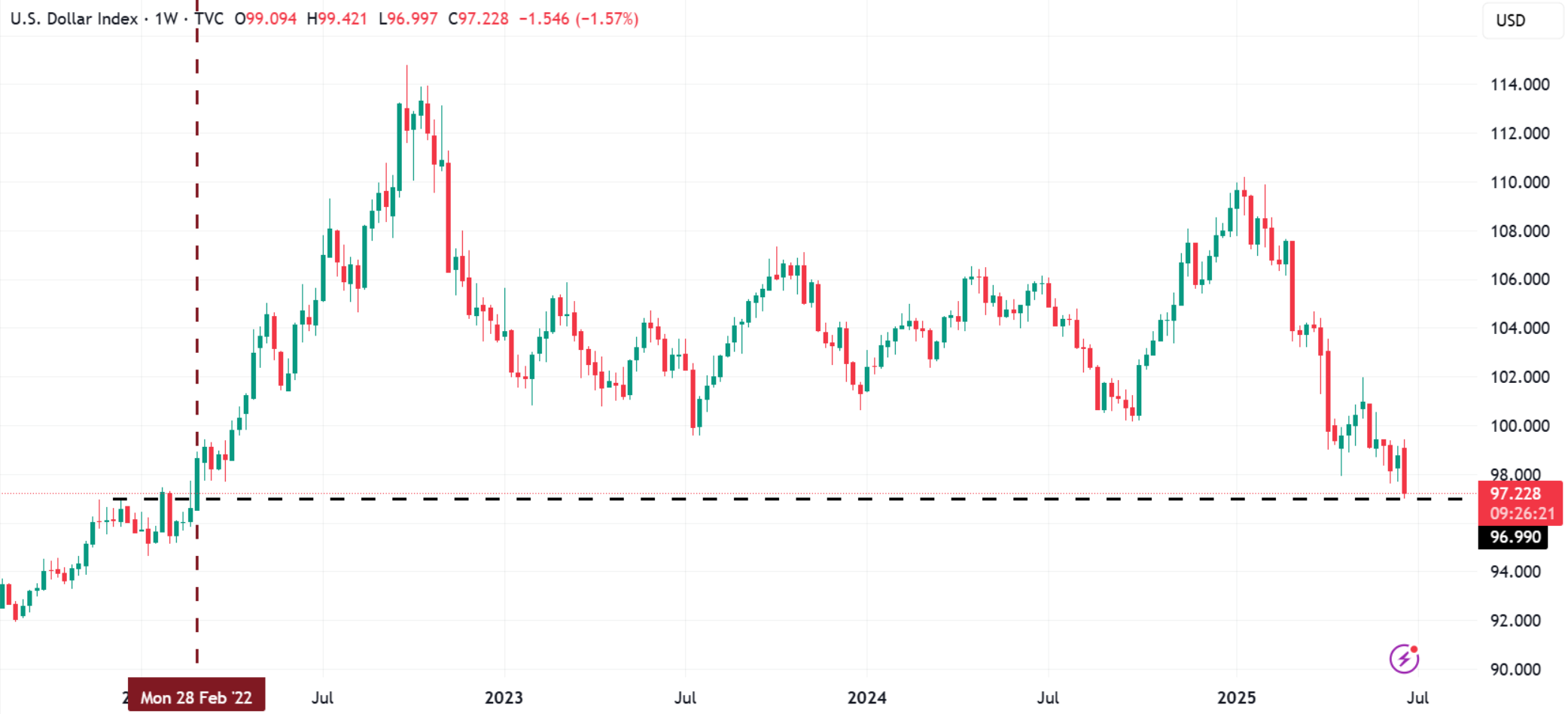
The possibility of a Trump-led Fed shakeup has not gone unnoticed by financial markets. The U.S. Dollar Index (DXY), a measure of the greenback’s strength against a basket of major currencies, has dropped to levels last seen in 2022. Market participants are increasingly wary of a scenario in which interest rate decisions could be driven more by political agendas than economic fundamentals.
Powell, in testimony before the Senate Banking Committee, acknowledged that recent tariffs imposed by the Trump campaign could contribute to inflation in the months ahead. His remarks underscore a broader concern that monetary policy could be complicated by trade tensions and political interference.
Chart of the Day