

Agentic AI is quickly reshaping how organisations use data, pushing analytics beyond dashboards and static reports toward real-time, decision-driven systems. For data and analytics leaders, the pace of change is clear. What is often less clear is how to respond in practical terms. ThoughtSpot believes it has part of that answer, with a growing suite of AI-powered agents designed to make analytics more active, accessible, and trustworthy.
 Ketan Karkhanis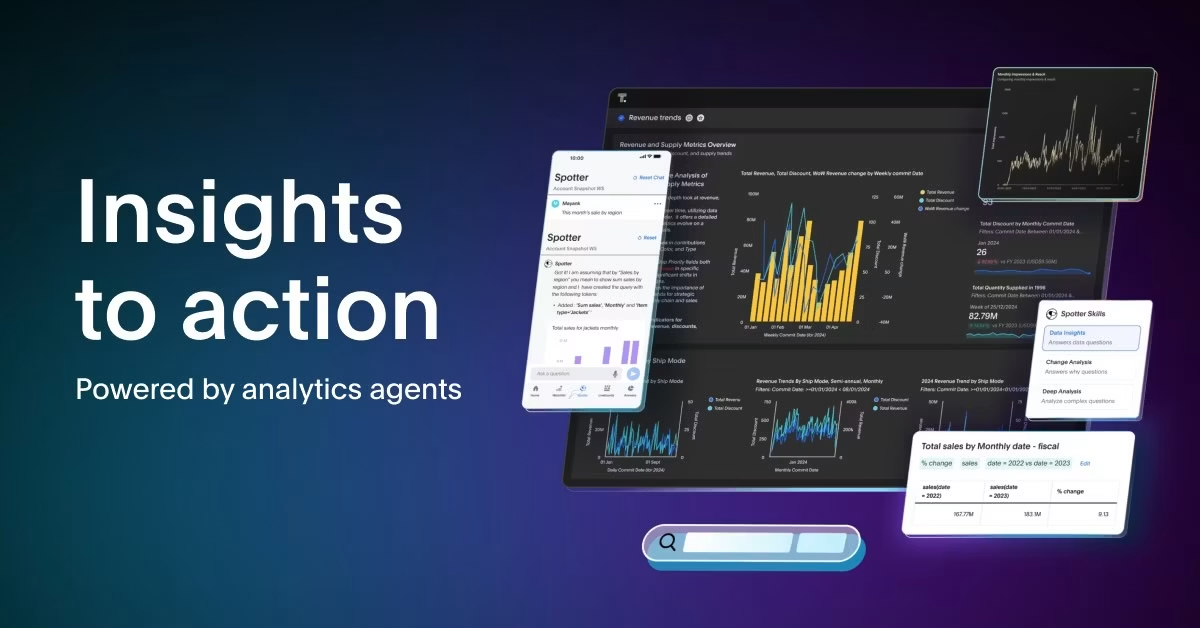
The company says it is “reimagining analytics and BI from the ground up,” a shift reflected in how its tools are evolving from insight delivery to decision support. According to Jane Smith, field chief data and AI officer at ThoughtSpot, agentic systems mark a fundamental break from traditional business intelligence.
“Agentic systems are shifting us away from passive reporting to much more active decision making,” Smith explains. “Traditional BI waits for you to find an insight. These systems are proactively monitoring data from multiple sources around the clock, diagnosing why changes happened, and triggering next actions automatically.”
That move toward action-oriented analytics is only one part of the transformation Smith sees underway. Another is the push for true data democratisation. Agentic AI lowers the barrier for business users to engage directly with data, reducing reliance on specialist teams and allowing insights to surface where work already happens.
At the same time, Smith points to a renewed focus on the semantic layer as essential to making this work safely and effectively.
“You cannot have an agent taking action when it doesn’t strictly understand business context,” she says. “A strong semantic layer is really the only way to make sense of the chaos of AI.”
ThoughtSpot’s approach centres on what it calls a “fleet of agents,” designed to operate together rather than in isolation. In December, the company introduced four new BI agents intended to work as a coordinated system delivering modern analytics across the organisation.
The most advanced of these is Spotter 3, the latest version of an agent first introduced in late 2024. Spotter 3 integrates with tools such as Slack and Salesforce, allowing users to ask questions in natural language within familiar applications. Beyond answering queries, it evaluates the quality of its own responses and continues refining them until it reaches a reliable result.
“It leverages the Model Context protocol, so you can ask questions of your organisation’s structured data, like tables and columns, while also incorporating unstructured data,” Smith explains. “That means you get much richer, more contextual answers, either through our agent or through your own large language model if you prefer.”
As analytics systems become more autonomous, governance and trust move to the centre of the conversation. ThoughtSpot’s recent eBook on data and AI trends for 2026 highlights the responsibility facing senior leaders to ensure that decisions, whether made by humans or machines, can be explained, reviewed, and improved over time.
This thinking underpins ThoughtSpot’s concept of “decision intelligence,” or DI. Rather than treating insights as one-off outputs, DI focuses on how decisions are made, tracked, and refined. Smith describes this as the emergence of “decision supply chains.”
“Instead of a single insight, decisions will flow through repeatable stages,” she says. “Data analysis, simulation, action, and feedback. These are interactions between humans and machines, all logged within what becomes a decision system of record.”
In practice, this could have significant implications for highly regulated industries. Smith points to clinical trials in the pharmaceutical sector as one example. A decision intelligence system could record every step involved in selecting a patient, from analysing health records and simulating eligibility against trial protocols to documenting how a final recommendation was made by a clinician.
“These processes can be audited and improved for future trials,” she explains. “By logging each step in the decision flow, organisations gain transparency and a clear path to learning from past outcomes.”
ThoughtSpot will be discussing these developments at the AI & Big Data Expo Global in London on February 4–5, where Smith is scheduled to speak. The event offers an opportunity to explore how agentic AI and decision intelligence are moving from concept to real-world deployment.
As analytics continues to evolve, ThoughtSpot’s message is that the future lies not just in faster insights, but in systems that understand context, support accountability, and help organisations act with confidence. For data leaders navigating rapid change, that shift may prove just as important as the technology itself.



