
Tether’s USDT, the world’s largest stablecoin, continued to expand at a steady pace in the final quarter of 2025, even as the broader cryptocurrency market faced one of its sharpest downturns in recent years.
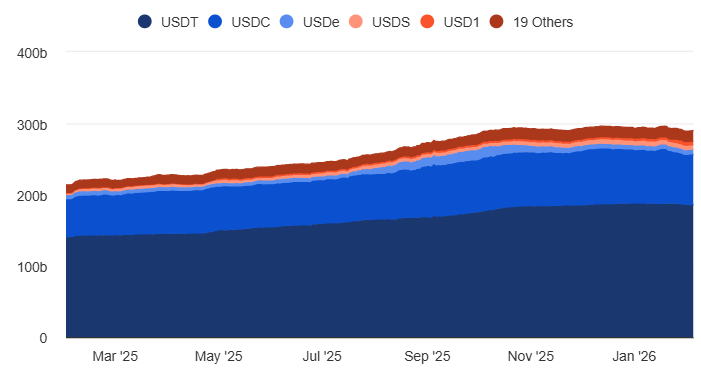
According to Tether’s latest quarterly market report released Wednesday, USDT’s market capitalization climbed to a new all-time high of $187.3 billion. That marks an increase of $12.4 billion over the quarter, a notable achievement given the heavy market sell-off that began in October.


User adoption was a key driver of this growth. Tether estimated that USDT added 35.2 million new users during the fourth quarter, bringing its total global user base to approximately 534.5 million. This was the eighth consecutive quarter in which the stablecoin attracted more than 30 million new users, underscoring its sustained appeal across market cycles.
On-chain activity also continued to rise. The number of on-chain USDT holders grew by 14.7 million to reach 139.1 million, with USDT wallets representing 70.7% of all stablecoin wallets in circulation. Tether estimates that more than 100 million users hold USDT through centralized platforms, while average monthly active on-chain users reached a record 24.8 million during the quarter.
Behind the scenes, Tether’s reserves expanded alongside usage. Total reserves increased by $11.7 billion to $192.9 billion by the end of the quarter. These holdings include 96,184 bitcoin, 127.5 metric tons of gold, and $141.6 billion in U.S. Treasury assets, reflecting a diversified reserve strategy.
The growth came despite a challenging market backdrop. A major crypto liquidation event on 10 October 2025 triggered heightened volatility that persisted through the end of the year. Since then, overall crypto prices have declined sharply, with bitcoin recently trading near $71,200, its lowest level since October 2024.
Tether acknowledged that the broader stablecoin sector has slowed since the market shock. However, USDT has continued to gain ground relative to its peers. Between 10 October 2025 and 1 February 2026, the total crypto market capitalization fell by more than one-third. Over the same period, USDT grew by 3.5%, while the second- and third-largest stablecoins declined by 2.6% and 57%, respectively.
In its report, Tether attributed USDT’s resilience to demand beyond trading alone. The company noted that users increasingly rely on USDT both as a store of value and as a practical tool for everyday transactions, particularly in regions where access to stable currencies is limited.
Separately, reports earlier on Wednesday indicated that Tether has adjusted its fundraising ambitions. Advisers are now discussing a potential $5 billion raise, down significantly from earlier considerations of up to $20 billion.
As markets remain volatile, USDT’s performance in the fourth quarter suggests that stablecoins with broad adoption and diversified use cases may continue to play a central role in the global digital economy, even during periods of uncertainty.



