
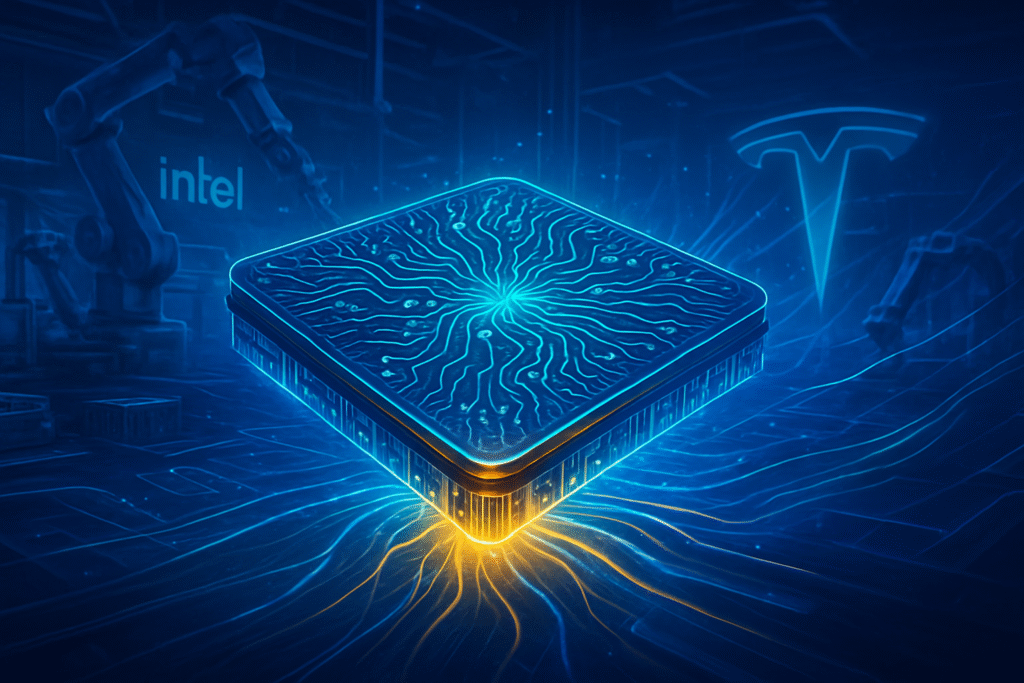
Tesla Eyes Intel for Next-Gen AI Chip Manufacturing
Tesla is reportedly exploring a partnership with Intel to produce its fifth-generation AI chip, a move that could dramatically reduce the cost of advanced AI hardware — potentially to just 10% of Nvidia’s production costs.
Speaking at Tesla’s annual shareholder meeting on November 6, 2025, CEO Elon Musk revealed that discussions with Intel were underway, though no formal deal has been signed.
“Maybe we’ll do something with Intel,” Musk said, according to Reuters. “We haven’t signed any deal, but it’s probably worth having discussions.”
The comment immediately sparked market interest, sending Intel shares up 4% in after-hours trading — a sign of how significant investors view the potential collaboration.
Strategic Timing for Both Companies
The potential tie-up comes at a critical moment for both Tesla and Intel. Tesla, now developing its AI5 chip to power its next-generation autonomous driving systems, has run into supply bottlenecks with existing partners such as TSMC and Samsung.
“Even when we extrapolate the best-case scenario for chip production from our suppliers, it’s still not enough,” Musk told shareholders, adding that Tesla may need to build its own massive fabrication facility — dubbed a ‘terafab’ — capable of producing 100,000 wafer starts per month.
For Intel, the opportunity could be transformative. The U.S. chipmaker has struggled to catch up with Nvidia in the AI space and is eager to attract major external customers for its new manufacturing nodes. The U.S. government’s recent 10% equity stake in Intel underscores Washington’s commitment to strengthening domestic semiconductor production.
Cost and Performance Could Reshape AI Economics
Musk claimed Tesla’s AI5 chip could deliver comparable performance while using one-third the power of Nvidia’s flagship Blackwell processors — and at a tenth of the cost to manufacture.
“I’m super hardcore on chips right now,” Musk said. “I have chips on the brain.”
If Tesla’s cost and efficiency targets prove accurate, the development could upend enterprise AI economics, lowering the barrier to entry for companies deploying large-scale AI systems.
The AI5 chip, optimized for Tesla’s proprietary software stack, could also serve as a proof of concept for cost-efficient, vertically integrated AI infrastructure — something that might pressure other manufacturers to follow suit.
Production Timeline and the ‘Terafab’ Vision
Tesla’s roadmap outlines limited AI5 production in 2026, with full-scale manufacturing expected by 2027. Musk added that Tesla’s AI6 chip, already in early design, will target double the performance and use the same fabrication process, with mass production planned for mid-2028.
The company’s proposed ‘terafab’ facility would represent a new phase in domestic chip production, aimed at easing global supply chain vulnerabilities that have hampered tech manufacturing since the pandemic.
“It’s like a giga but way bigger,” Musk said. “I can’t see any other way to get to the volume of chips that we’re looking for.”
Implications for Enterprise and Policy Leaders
If realized, the Tesla–Intel partnership could have ripple effects across the global AI and semiconductor sectors:
- Supply Chain Resilience: Shifting more production to U.S. facilities could reduce dependence on Asian manufacturing hubs.
- Cost Structure Disruption: Tesla’s 90% cost reduction target could reshape the pricing power of incumbents like Nvidia.
- Technology Sovereignty: The U.S. government’s backing of Intel signals an effort to safeguard domestic chip capabilities amid rising geopolitical tensions.
- Innovation Acceleration: Tesla’s rapid hardware cycles — AI5 in 2027 and AI6 by 2028 — may pressure enterprises to shorten their own technology refresh timelines.
A Turning Point for AI Hardware
The potential partnership unfolds as export restrictions continue to constrain Nvidia’s business in China, leaving room for new players to capture market share. While Intel declined to comment on Musk’s remarks, the combination of public statements and market reaction suggests that serious negotiations may be underway.
The global AI chip race is entering a new phase — one where cost efficiency, energy use, and domestic production could matter as much as raw performance. For enterprise leaders planning long-term AI investments, Tesla’s next move might redefine the economics of computation itself.



