
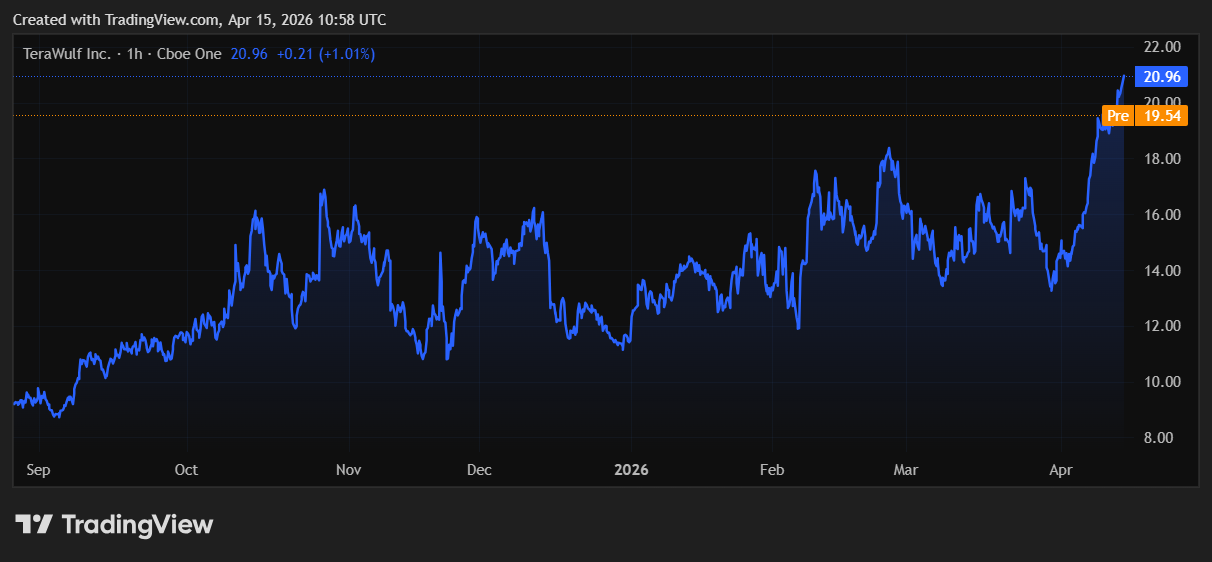
TeraWulf shares fell roughly 6% in pre-market trading after the company priced an upsized $900 million equity offering. The decline reflects investor sensitivity to dilution as the firm pivots capital toward artificial intelligence infrastructure.
The Maryland-based bitcoin miner priced 47.4 million shares at $19 each, above its initial $800 million target. The offering includes a 30-day option for underwriters to purchase an additional 7.11 million shares. TeraWulf said proceeds will fund construction of a data center campus in Kentucky and repay outstanding bridge financing.


Is AI Infrastructure Reshaping Bitcoin Miner Economics?
The capital raise coincides with a strategic shift toward high-performance computing (HPC) hosting. TeraWulf reported that more than 50% of its first-quarter revenue came from HPC operations, signaling diversification away from pure bitcoin mining. By comparison, most listed miners still derive the majority of revenue from block rewards and transaction fees.
Preliminary results for the quarter ending March 31 show revenue between $30 million and $35 million, with adjusted EBITDA of up to $3 million. The near-breakeven profitability highlights the capital-intensive nature of scaling both mining and AI infrastructure simultaneously. The company reported $3.1 billion in cash and equivalents against $5.8 billion in total debt.
“Preliminary results reflect a transition toward long-term, credit-enhanced revenues,” said Chief Financial Officer Patrick Fleury.
He added that additional HPC capacity is expected to come online خلال the year, supporting more stable income streams relative to bitcoin price volatility.
The move aligns with a broader trend among miners repurposing energy-intensive infrastructure for AI workloads. Firms are increasingly targeting enterprise clients seeking compute capacity for machine learning and data processing. This shift introduces new revenue models but also exposes operators to different competitive dynamics and capital requirements.
TeraWulf’s offering is expected to close on April 16, with Morgan Stanley acting as lead bookrunner. The next catalyst will be whether the Kentucky facility delivers contracted HPC revenues at scale, validating the economics of hybrid mining and AI data center strategies.



