
As the European Union advances toward implementing its AI General-Purpose Code of Practice, major tech companies are split on whether to align with the voluntary guidelines. Microsoft and OpenAI are leaning in, while Meta is pushing back—highlighting a deepening divide in how industry leaders approach global AI regulation.


The code, published by the European Commission on July 10, is designed to provide a compliance roadmap ahead of the EU’s binding AI Act, which begins enforcement in August 2025. Developed with input from over 1,000 stakeholders—ranging from AI developers to academics and civil society—the framework outlines key requirements around transparency, copyright compliance, and risk management for general-purpose AI (GPAI) models.
Microsoft and OpenAI Support, Meta Rejects
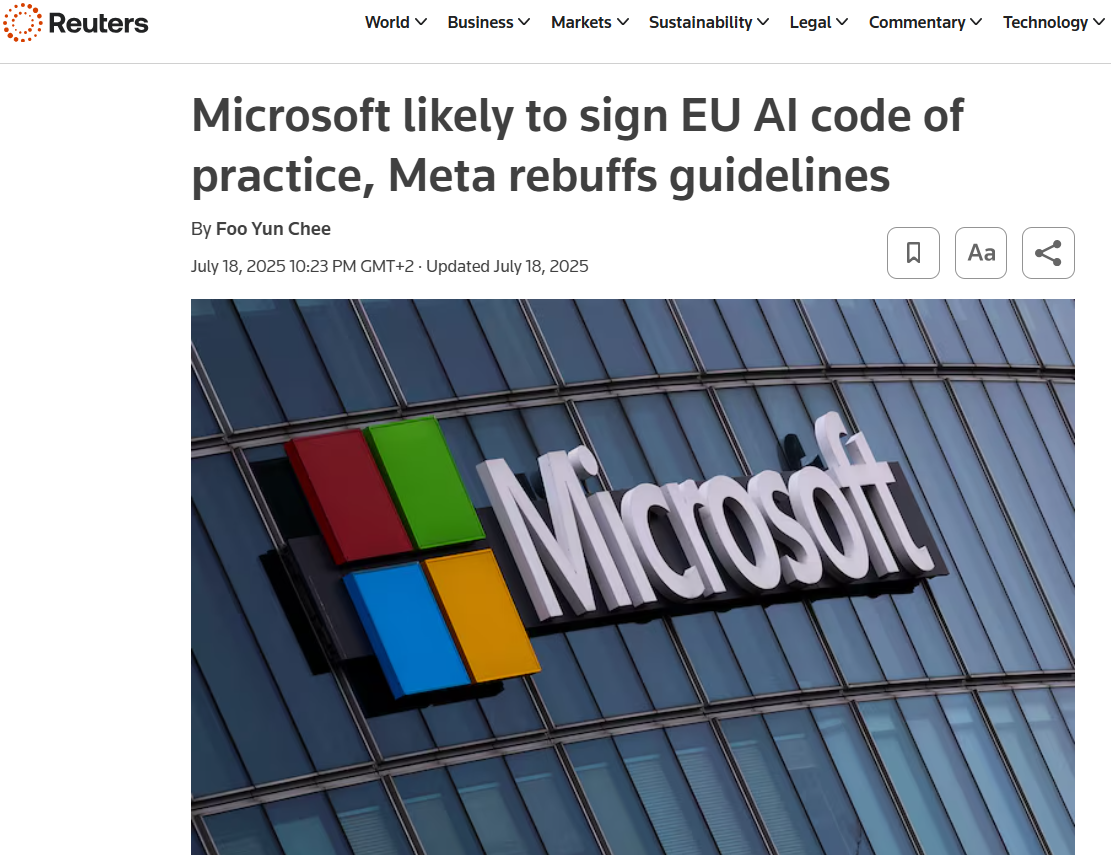
Microsoft appears ready to sign on. President Brad Smith said the company is reviewing the code and aims to be constructive:
“Our goal is to find a way to be supportive,” he told Reuters, emphasizing Microsoft's desire for ongoing collaboration with EU regulators.
Meta, however, is taking a starkly different stance. Joel Kaplan, Meta’s Chief Global Affairs Officer, announced that the company would not sign the code, arguing that it imposes "legal uncertainties" and "extends well beyond the scope of the AI Act." In a LinkedIn post, Kaplan warned that Europe’s approach risks stifling AI innovation and weakening competitiveness across the continent.
bettya
OpenAI and Mistral have already signed, framing the move as a commitment to building secure and trustworthy AI for European users.
“Signing the Code reflects our commitment to providing capable, accessible, and secure AI models,” OpenAI said in a statement.
What the Code Requires
The voluntary code targets developers of powerful general-purpose AI models—systems with wide application potential across sectors. It introduces three main obligations:
- Transparency: Companies must document training datasets and technical model details.
- Copyright Compliance: Developers are expected to outline internal policies that comply with EU copyright laws.
- Systemic Risk Controls: For high-impact models—like OpenAI’s o3, Google’s Gemini 2.5 Pro, and Anthropic’s Claude 4 Opus—the code requires detailed risk assessments and governance frameworks.
Signatories must also publish summaries of training data sources and commit to long-term safety monitoring, particularly if their models fall under the “GPAI with Systemic Risk” (GPAISR) category.
Compliance, Enforcement, and Penalties
Although voluntary for now, the Code of Practice is closely tied to the forthcoming AI Act. Starting August 2, 2025, enforcement begins in earnest. Companies found non-compliant could face steep penalties—up to €35 million or 7% of global revenue, depending on the violation.
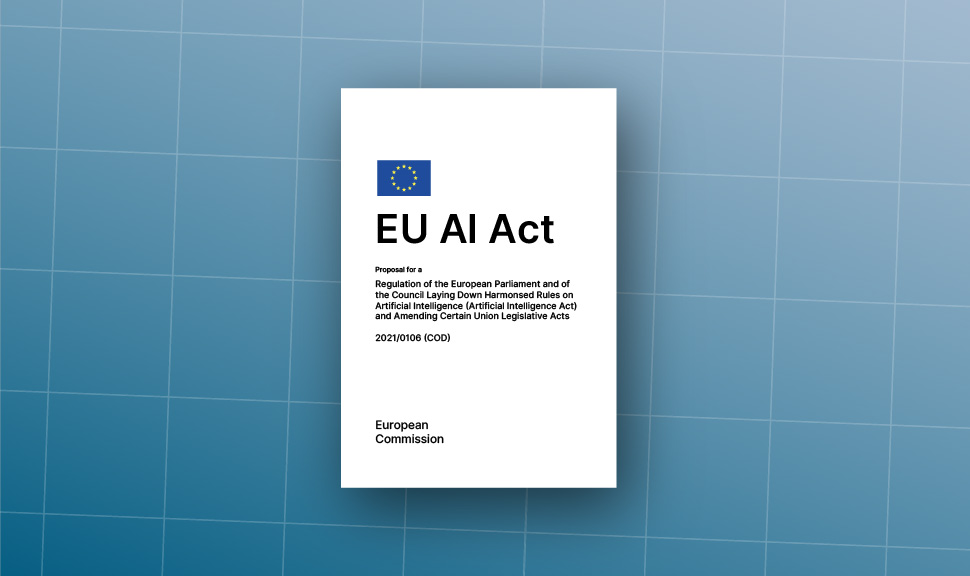
Importantly, signing the Code can streamline the compliance process. Regulators have indicated that adherence will be treated as a “simplified compliance path,” reducing the need for individual audits and offering regulatory clarity ahead of the formal deadline.
Growing Industry Pressure and Political Pushback
Still, not everyone is on board. More than 40 of Europe’s largest businesses, including Airbus and ASML Holding, recently urged the European Commission to delay the AI Act by two years. Their concerns center on implementation speed and potential burdens for companies developing or relying on AI technologies.
Despite mounting pressure, the EU remains firm. Internal Market Commissioner Thierry Breton stated that the AI Act is essential to building public trust and ensuring safe innovation:
“We are not postponing. The timeline stands,” he affirmed.
Global Implications
The split between companies like Microsoft and Meta may signal broader challenges ahead for multinational tech firms navigating inconsistent regulatory landscapes. The EU’s Code, while regional, is likely to shape international norms. Its alignment with initiatives like the G7 Hiroshima AI Process suggests European principles could influence global AI governance strategies.



