

Strategy executives sought to reassure investors this week that the company’s financial position remains stable despite Bitcoin’s recent price decline and broader volatility across crypto markets.
Speaking during Strategy’s fourth-quarter earnings webinar on Thursday, CEO Phong Le said Bitcoin would need to experience an extreme and prolonged collapse before the company’s balance sheet faced serious pressure. According to Le, Bitcoin would have to drop to roughly $8,000 and stay at that level for five to six years before Strategy would struggle to service its convertible debt.
“In the extreme downside, if we were to have a 90% decline in Bitcoin’s price and it remained around $8,000, that’s the point where our Bitcoin reserves would equal our net debt,” Le told investors. “Only then would we need to consider restructuring or raising capital through equity or additional debt.”
The comments came as executives addressed concerns following Bitcoin’s recent sell-off, which pushed prices lower across the market. At the time of the call, Bitcoin was trading near $64,800, down about 9% over the previous 24 hours.
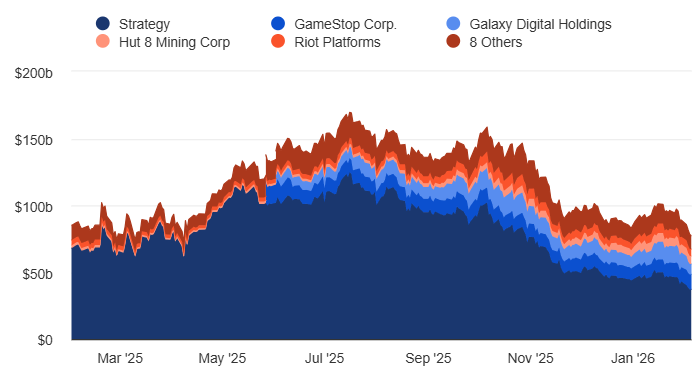
Strategy, widely known as the largest corporate holder of Bitcoin, reported a net loss of $12.6 billion for the quarter. The loss was primarily driven by unrealized mark-to-market losses on its Bitcoin holdings after prices dipped below the company’s average purchase cost.
Chief Financial Officer Andrew Kang emphasized that the reported loss reflected accounting treatment rather than operational weakness.
“These results were obviously driven by the quarter-end decline in Bitcoin’s fair value,” Kang said, adding that the company continues to execute its strategy despite market swings.
Executive Chairman Michael Saylor echoed that message, stressing that Strategy’s approach is designed to endure volatility.
“Quarter-to-quarter moves can be sharp and unsettling,” Saylor said. “But our strategy is built for the long term and for conditions exactly like these.”
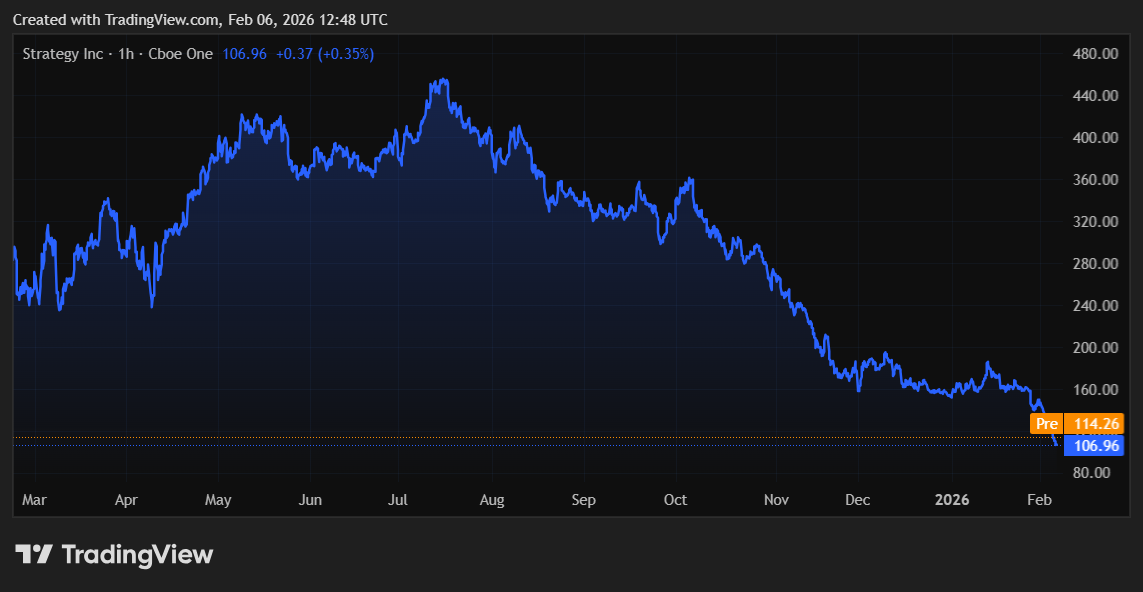
Investor sentiment around Strategy has been under pressure alongside the broader crypto downturn. Shares of Strategy (MSTR) fell 17.12% on Thursday to $106.90, erasing much of their earlier gains. The stock is now down roughly 72% over the past six months. Saylor urged investors to focus on longer-term fundamentals, including what he described as improving regulatory signals in the United States.
During the earnings call, Saylor also addressed concerns around quantum computing and its potential impact on Bitcoin’s security. He dismissed fears of an imminent threat, calling them part of a recurring cycle of negative speculation.
“We think it’s probably a decade or more away before quantum computing presents a real risk,” Saylor said. “The technology is promising, but it’s still in its early stages.”
He noted that quantum computing would pose challenges not just for Bitcoin, but for global financial systems, defense infrastructure, and any industry reliant on existing cryptographic standards. Saylor added that work on quantum-resistant protocols is already underway and that Bitcoin’s open-source nature allows it to adapt through global consensus.
“Bitcoin is upgradable,” he said. “It can be strengthened over time, just like the internet itself.”
To support that effort, Saylor announced the launch of a new Bitcoin Security program at Strategy. The initiative aims to collaborate with cybersecurity experts, cryptographers, and the broader Bitcoin community to help prepare for future threats and coordinate potential upgrades.
Closing the call, Saylor emphasized that Strategy is structured to withstand extended periods of market stress.
“The company is well managed, well collateralized, and responsibly structured,” he said. “We’re prepared to navigate difficult months, difficult quarters, and even multi-year cycles.”



