

State Street is accelerating its push into tokenization as major banks look to modernize core financial infrastructure by bringing traditional assets onto blockchain networks, according to a Bloomberg report published Thursday.
The custody bank is developing tokenized versions of familiar financial products, including money-market funds, exchange-traded funds, and cash instruments such as tokenized deposits and stablecoins. The initiative reflects a broader shift across the banking sector, where blockchain technology is increasingly viewed as an upgrade to existing systems rather than a departure into crypto-native finance.
Building on an established digital foundation
State Street’s latest move builds on its growing presence in digital markets. The bank already provides fund administration and accounting services for crypto exchange-traded funds and has previously announced plans to expand into digital-asset custody by 2026.
Instead of launching new products designed solely for the crypto ecosystem, State Street is framing tokenization as a way to enhance well-known investment structures. By converting traditional assets into blockchain-based representations, the bank aims to improve efficiency, transparency, and settlement speed without altering the regulatory or risk profile of the underlying products.
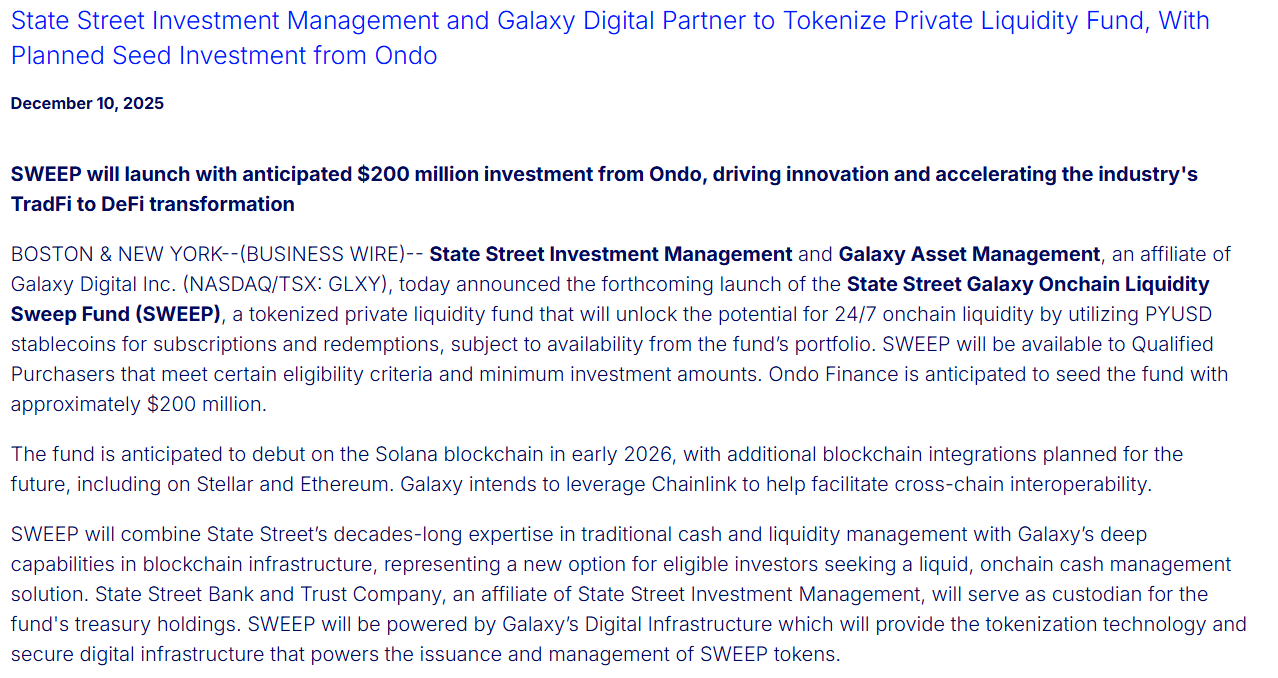
The effort will involve close collaboration with institutional money managers and existing clients. State Street’s asset-management arm has already taken steps in this direction, partnering with Galaxy Digital last month on a tokenized private liquidity fund.
Cash goes digital, but stays familiar
Tokenization efforts are not limited to investment funds. Custodial banks are also moving quickly to digitize cash itself, a development that could reshape payments, collateral management, and margin processes.
Earlier this month, BNY Mellon activated a tokenized deposit service designed for institutional use cases such as payments and collateral transfers. Unlike stablecoins, these tokenized deposits remain direct liabilities of the issuing bank, offering a blockchain-based alternative that stays firmly within the traditional banking framework.
State Street’s work on tokenized cash instruments fits squarely within this trend, as banks explore how blockchain rails can support real-time movement of money while maintaining established safeguards.
Asset managers follow suit
Large asset managers are also advancing tokenization initiatives. This week, Franklin Templeton updated two institutional money-market funds to support blockchain-based settlement and ownership records. The change allows the funds to integrate with tokenized and regulated stablecoin environments without modifying how they are managed or regulated.
These developments suggest a coordinated industry effort to adapt existing financial products to new infrastructure, rather than reinventing them. For institutional investors, this approach offers a familiar entry point into blockchain-based finance.
Institutional demand drives momentum
State Street has previously highlighted rising institutional interest in digital assets and tokenization. In an October 2025 research report, the bank found that nearly 60% of institutional investors planned to increase their exposure to digital assets. Many respondents expected a meaningful share of their portfolios to become tokenized over time.
For banks like State Street, that demand is translating into concrete product development. By focusing on tokenized versions of established funds and cash products, the bank is positioning itself as a bridge between traditional finance and emerging blockchain infrastructure.
A gradual but significant shift
While tokenization is still in its early stages, recent moves by State Street, BNY Mellon, and Franklin Templeton point to a gradual but significant transformation of financial plumbing. Rather than disruptive overhauls, the changes are incremental, designed to slot into existing regulatory and operational frameworks.



