
Stablecoin velocity has doubled to roughly six monthly turns, exceeding prior assumptions from Standard Chartered. The shift complicates projections that rely on steady usage rates to drive supply expansion.
Geoffrey Kendrick, global head of digital assets research at Standard Chartered, said recent data shows tokens moving faster across networks after years of relative stability. The bank’s forecast of $2 trillion in stablecoin supply by 2028 depends partly on how frequently these assets circulate. Higher velocity reduces the need for new issuance even as transaction activity rises.
Does Rising Stablecoin Velocity Reduce Supply Demand?
The increase appears concentrated in specific segments rather than across the entire market. Standard Chartered linked the trend largely to USD Coin (USDC), which has seen accelerating activity across multiple blockchains. By contrast, lower-velocity use cases such as savings in emerging markets, where Tether (USDT) dominates, have remained relatively unchanged.
But the underlying driver is a shift in how stablecoins are used. Beyond trading and capital preservation, these assets are increasingly acting as payment rails and settlement layers, including early-stage artificial intelligence-driven transactions. This evolution introduces a different demand profile, where speed of circulation becomes as critical as total supply.
“Velocity has increased recently, contrary to our assumption that it would remain stable,” Kendrick wrote, noting that the change warrants closer monitoring.
He added that if velocity continues to rise, transaction growth alone may not translate into proportional supply expansion.
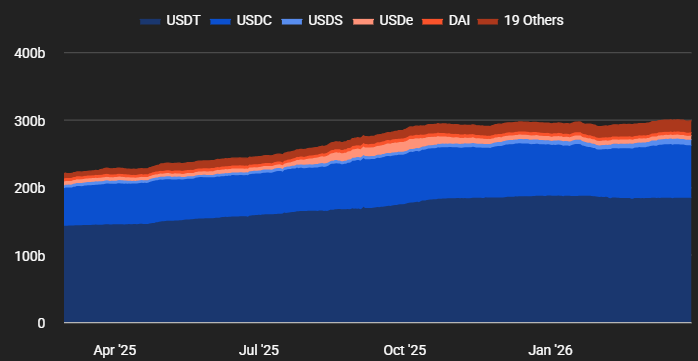
Still, the bank is maintaining its headline projections. It continues to expect stablecoin supply to reach $2 trillion by 2028, generating roughly $1 trillion in incremental demand for U.S. Treasury bills. Can faster turnover offset the need for large-scale issuance as adoption broadens?
The next catalyst will center on whether high-velocity use cases, particularly in payments and machine-driven transactions, sustain momentum and begin to influence aggregate demand across the broader stablecoin market.



