
Bitget Wallet launched a payments network connecting stablecoins to over 150 million merchants across 50 markets. The scale signals a shift from pilot programs to live consumer-facing infrastructure in crypto payments.
The company introduced its Onchain Payments Matrix, integrating with providers including Ripple, Mastercard, Visa, Tether, Circle, and MoonPay. The system enables users to send, spend, and store digital assets through a self-custodial wallet serving more than 90 million users globally. It also supports QR-based payments at 2.5 million merchants across Asia and Latin America.
Can Stablecoins Bridge Global Payment Fragmentation?
The infrastructure is designed to unify fragmented financial rails across banks, card networks, and blockchain systems. Bitget Wallet positions the platform at the user and merchant interface, rather than institutional settlement layers where many competing initiatives remain focused. This approach targets real-time usability rather than backend experimentation.
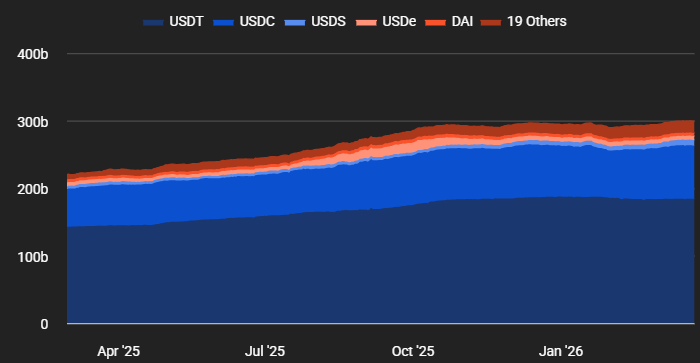
Stablecoin adoption continues to accelerate across payments and financial services. Industry data shows annual transaction volume has surpassed $33 trillion, while crypto-linked card spending has grown 525% year-on-year. Total stablecoin supply now stands near $298.9 billion, with Tether (USDT) accounting for $184 billion and USD Coin (USDC) representing about $80 billion.
The company said the system connects issuers, liquidity providers, and merchants into a single execution layer for payments. This structure supports cross-border transfers and emerging automated financial applications, sometimes referred to as agent-driven transactions. The design reflects growing demand for programmable payment systems.
Still, competition is intensifying as both crypto-native firms and traditional networks expand stablecoin strategies. Integration depth and regulatory alignment will likely determine adoption across regions. The next catalyst will be whether transaction volumes on these networks translate into sustained merchant usage and repeat consumer activity.



