

A group of 12 Senate Democrats has introduced a sweeping framework to regulate U.S. cryptocurrency markets, marking the party’s most comprehensive proposal yet and signaling readiness for bipartisan negotiations.
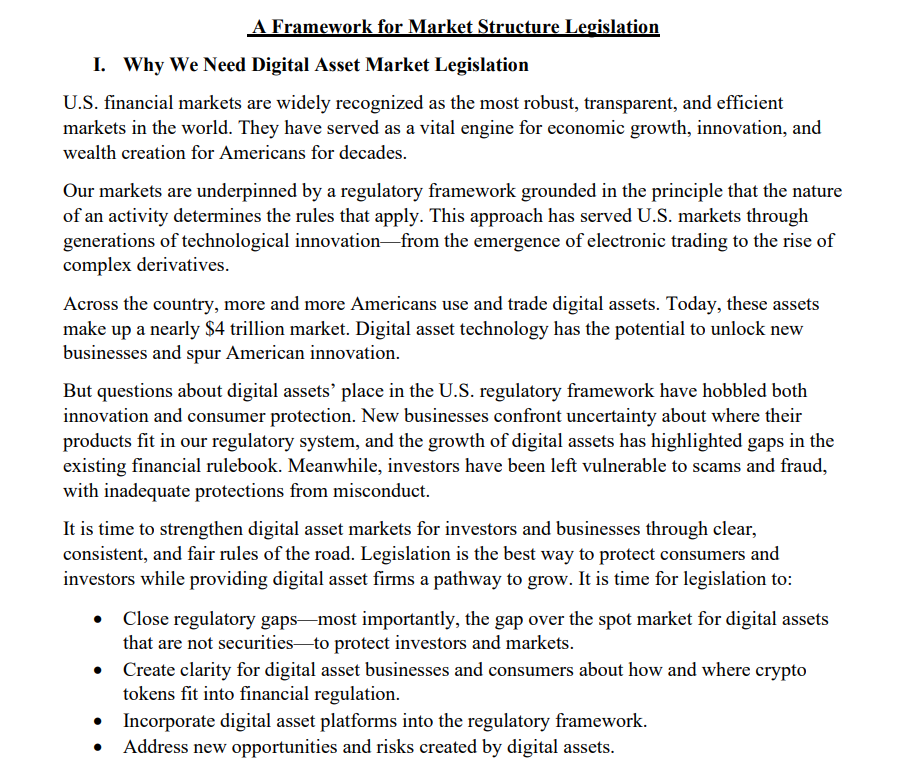
The plan, unveiled Tuesday by Senators Ruben Gallego, Mark Warner, Kirsten Gillibrand, Cory Booker, and others, outlines seven key pillars for oversight of the nearly $4 trillion global crypto industry. At its core, the proposal seeks to strengthen investor protections, close regulatory gaps, and impose stricter ethical standards on public officials involved in digital asset ventures.
“Digital asset technology has the potential to unlock new businesses and spur American innovation,” the senators wrote, adding that regulatory uncertainty has slowed both innovation and consumer protection efforts.
Key Provisions of the Framework
The Democratic blueprint would grant the Commodity Futures Trading Commission (CFTC) new authority over spot markets for non-security tokens, while creating a clear process to determine whether a digital asset should instead fall under the Securities and Exchange Commission (SEC).
Other major elements include:
- Disclosure rules for token issuers.
- Crypto-specific regulations for exchanges and custody providers.
- Stronger consumer protections, including anti-fraud and anti-manipulation standards.
- Registration requirements with the Financial Crimes Enforcement Network (FinCEN) for platforms serving U.S. customers, ensuring compliance with the Bank Secrecy Act, anti-money laundering rules, and sanctions enforcement.
The framework also highlights decentralized finance (DeFi) as a potential risk for illicit finance, calling for new tools to monitor its use. However, it stops short of clarifying whether software developers behind decentralized protocols would face registration mandates, a key difference from Republican proposals that explicitly shield DeFi developers.
Stablecoin issuers face additional restrictions under the Democratic plan, including a ban on paying interest or yield directly or indirectly—a move that contrasts with reward-style programs still permitted under the recently signed GENIUS Act.
Ethics and Political Accountability
One of the proposal’s most controversial sections introduces ethics rules designed to separate politics from crypto profits. It would bar elected officials and their families from launching or profiting from digital asset projects while in office and require them to disclose any crypto holdings.
The senators argue that without such rules, conflicts of interest could erode trust in the industry. They pointed specifically to former President Trump’s involvement in crypto ventures, accusing him of using digital assets for personal enrichment while in office.
The plan also calls for increased funding for financial regulators and bipartisan representation in their rulemaking to prevent partisan dominance of oversight agencies.
Bipartisan Dynamics Ahead
The Democratic framework comes just days after Senate Republicans updated their own legislative vehicle, the Clarity Act, which already passed the House in July with a 294–134 vote. The Clarity Act focuses on clarifying token definitions and regulatory authority, with a more lenient stance on DeFi and without the Democrats’ ethics restrictions.
While both parties share a goal of establishing clearer rules for the crypto market, differences remain over ethics provisions, DeFi oversight, and legislative timing. Republicans have pressed for swift passage, while Democrats stress that a bipartisan outcome cannot be rushed.
With detailed frameworks now circulating on both sides of the aisle, negotiations in the Senate Banking Committee are expected to intensify in the coming weeks. The outcome will determine whether Congress can finally deliver long-awaited comprehensive rules for the U.S. crypto market after years of gridlock.



