

S&P Dow Jones Indices has licensed its benchmark for the first officially sanctioned S&P 500 perpetual futures contract on a decentralized exchange. The product marks a direct bridge between traditional financial benchmarks and crypto-native derivatives markets.
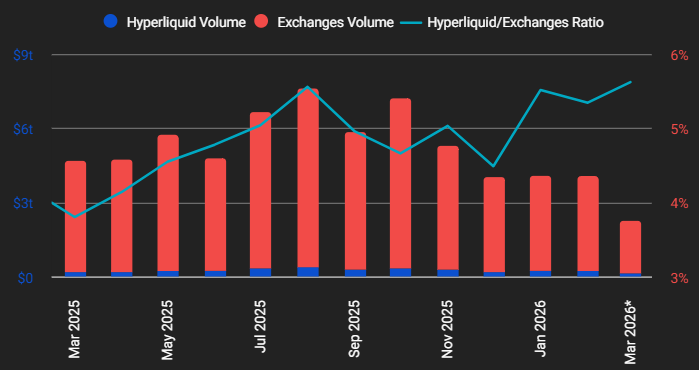
The license was granted to Trade.xyz, a perps provider operating on Hyperliquid, which currently holds over 36% of the decentralized perpetuals market share, according to data. The contract enables eligible non-U.S. investors to gain leveraged exposure to the S&P 500 through a 24/7 trading instrument without expiration.
Will Licensed Perps Redefine TradFi Access Onchain?
Perpetual contracts, or perps, allow traders to take long or short positions without a fixed settlement date, making them a core instrument in crypto markets. While centralized exchanges like Binance still dominate volumes, decentralized venues are gaining traction as new asset classes emerge. On Trade.xyz, nearly 90% of open interest in builder-deployed markets comes from tokenized or synthetic representations of traditional assets, including commodities and equities.
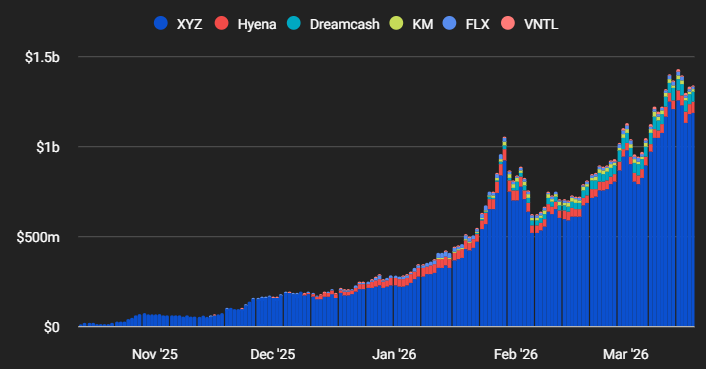
But, unofficial versions of equity-linked perps already exist across decentralized platforms. Providers such as Dreamcash have launched synthetic S&P 500 products without formal licensing, highlighting a gap between market demand and regulated access. The introduction of an officially licensed contract could narrow that gap while raising the bar for compliance and legitimacy.
“This collaboration represents the first time eligible, non-US investors can gain leveraged exposure to the S&P 500 through an officially licensed, digitally native product designed for 24/7 trading on a decentralized platform,” the announcement stated.
The move comes as decentralized protocols experiment with tokenizing traditional financial instruments at scale.
Still, regulatory boundaries remain fluid. The Securities and Exchange Commission (SEC) and Commodity Futures Trading Commission (CFTC) recently clarified that many digital assets are not securities, while outlining conditions under which classification could change. How regulators interpret licensed index-based derivatives on decentralized infrastructure may determine whether similar products expand or face constraints in the next phase of market development.



