

Robinhood shares pulled back this week after the trading platform reported a sharp year-over-year decline in fourth-quarter cryptocurrency revenue. Yet analysts at Bernstein say the selloff may be overdone, calling the weakness “temporary crypto jitters” and reiterating a bullish $160 price target.
The stock fell about 9% in after-hours trading following the earnings release before recovering some ground. Robinhood (NASDAQ: HOOD) closed Tuesday at $85.60, up from an intraday low of $78.80 but still down 24% since the start of the year.
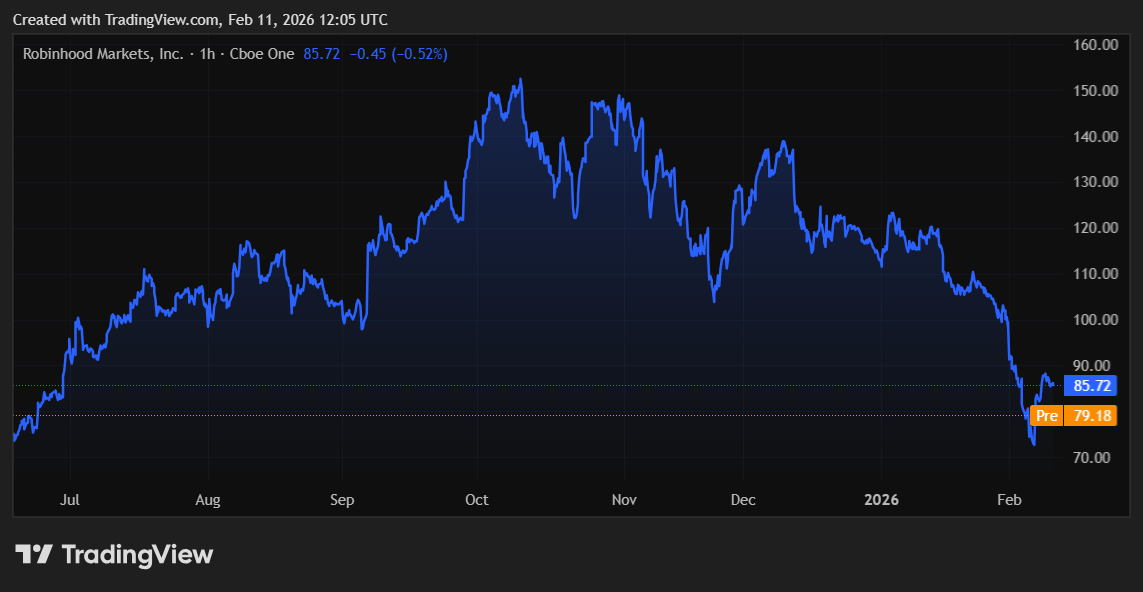
Crypto Revenue Falls as Overall Business Hits Record High
The market reaction came despite Robinhood posting record total net revenue of $1.28 billion for the fourth quarter, a 27% increase from a year earlier. Growth in options and equities trading helped offset a 38% drop in cryptocurrency transaction revenue, which declined to $221 million.
The slowdown in crypto activity reflected a 52% year-over-year drop in trading volumes on the core Robinhood app. The shift signals a broader evolution in the company’s business model. Rather than relying heavily on retail-driven crypto trading spikes, Robinhood has been expanding subscription services, interest-based income, and diversified product offerings.
While crypto remains a visible part of the platform, it is no longer the sole engine of growth.
Bernstein: Crypto Weakness Is “Expected”
In a note to clients, Bernstein analysts led by Gautam Chhugani described the softer crypto performance as anticipated. They argued that now is not the time to turn negative on the stock, especially given the company’s broader momentum.
Several key metrics reached new highs in the fourth quarter. Funded accounts, Robinhood Gold subscribers, and Gold cardholders all increased. Retirement assets climbed to $26.5 billion, roughly double the level from a year earlier.
Robinhood Banking, launched in late 2025, has also gained traction, attracting more than 25,000 funded customers and over $400 million in balances.
For Bernstein, these figures suggest that Robinhood’s platform engagement remains solid even as crypto trading cools.
Prediction Markets Emerge as Growth Driver
One of the standout developments has been the rapid expansion of Robinhood’s prediction markets. In the fourth quarter, prediction markets accounted for about 14% of transaction-based revenue and 8% of total revenue.
The platform processed 8.5 billion contracts during the quarter, exceeding expectations. Early 2026 volumes have already reached $4 billion, compared with a full-year forecast of $27 billion.
Looking ahead, the scheduled mid-2026 launch of Rothera, a joint venture with Susquehanna, could further strengthen Robinhood’s position in this space. Bernstein views the initiative as a key step in transforming the company into a broader information and capital markets ecosystem.
Expanding Into Tokenization and Private Markets
Robinhood is also investing in new areas beyond traditional brokerage services. The company plans to prioritize family investing, private markets, and tokenization.
This week, Robinhood launched the public testnet for Robinhood Chain, an Ethereum Layer 2 blockchain built on Arbitrum. The initiative aims to support experimentation with tokenized assets ahead of a planned mainnet launch later this year.
These moves reflect a long-term strategy to broaden the company’s revenue streams and deepen its role in digital finance.
Price Target Signals Strong Upside
Bernstein maintained its outperform rating and $160 price target for Robinhood shares, implying roughly 87% upside from Tuesday’s closing price. The firm identified a $60 to $75 range as a potential accumulation zone, reflecting more conservative, downside scenarios outlined in prior research.
For investors, the debate now centers on whether the crypto slowdown is a short-term cycle or a structural shift. For now, analysts at Bernstein are betting that Robinhood’s expanding ecosystem, from prediction markets to tokenized assets, will outweigh near-term volatility.
As the company continues to diversify beyond crypto trading, the coming quarters may reveal whether this broader strategy can deliver sustained growth and renewed investor confidence.



