

Robinhood posted $1.067 billion in Q1 revenue, missing estimates by 7%, yet Bernstein maintained a $130 price target. The call implies 58% upside, signaling confidence that recent weakness is already reflected in the stock.
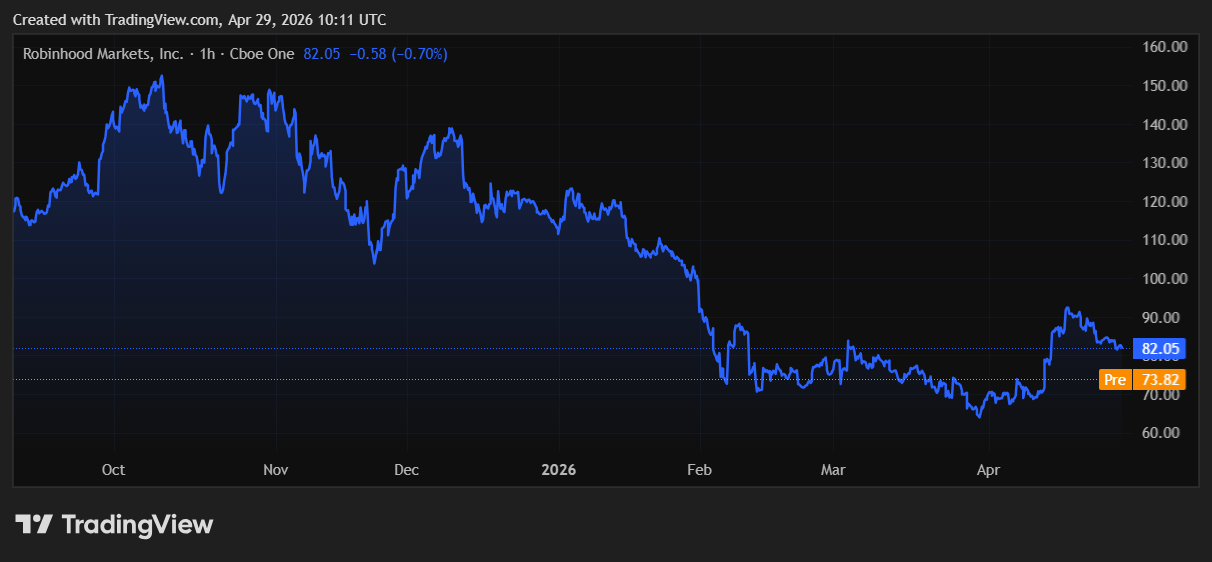
Adjusted earnings per share came in at $0.39, while adjusted EBITDA reached $534 million, both below expectations by 8% and 9%, respectively, according to Bernstein. Shares fell more than 6% in after-hours trading before partially recovering, closing at $82.07 on Tuesday, based on data.
Are Prediction Markets Driving Robinhood Growth?
Despite softer headline results, several internal metrics expanded. Robinhood’s margin book hit a record $17.0 billion, up 93% year-over-year, while Robinhood Gold subscriptions rose 36% to 4.34 million, representing 16% of funded accounts. Crypto revenue declined to $134 million, or 13% of total revenue, down from 17% in Q4 2025, though analysts noted stabilization in April activity.
Bernstein analysts led by Gautam Chhugani argued the market had already discounted the earnings miss. The firm highlighted prediction markets as a key driver, with event contracts reaching 8.8 billion units traded in Q1 and contributing $415 million in annualized revenue, or 17% of transaction-based income.
The company is preparing to launch Rothera, a joint venture exchange with Susquehanna, aimed at internalizing event contract trading and reducing reliance on third-party venues like Kalshi. In parallel, Robinhood was named the sole initial trustee for “Trump Accounts,” a program with 5.5 million enrolled users from a pool of 60 million eligible participants.
Robinhood plans to invest $100 million into this initiative, raising its 2026 operating expense guidance to between $2.7 billion and $2.825 billion. Investors are now watching whether sustained growth in prediction markets and a rebound in crypto trading volumes can validate Bernstein’s upside thesis.



