

The community behind blockchain project Qubic has voted to make Dogecoin its next target, just days after the group announced a successful 51% attack on Monero. Founder Sergey Ivancheglo revealed the decision on August 17, following confirmation that Qubic’s mining pool had gained majority control over Monero’s network.
Looks like Qubic is targetting Zcash now. https://t.co/6IW2zdXBZb
— Son of a Tech (@SonOfATech) August 17, 2025
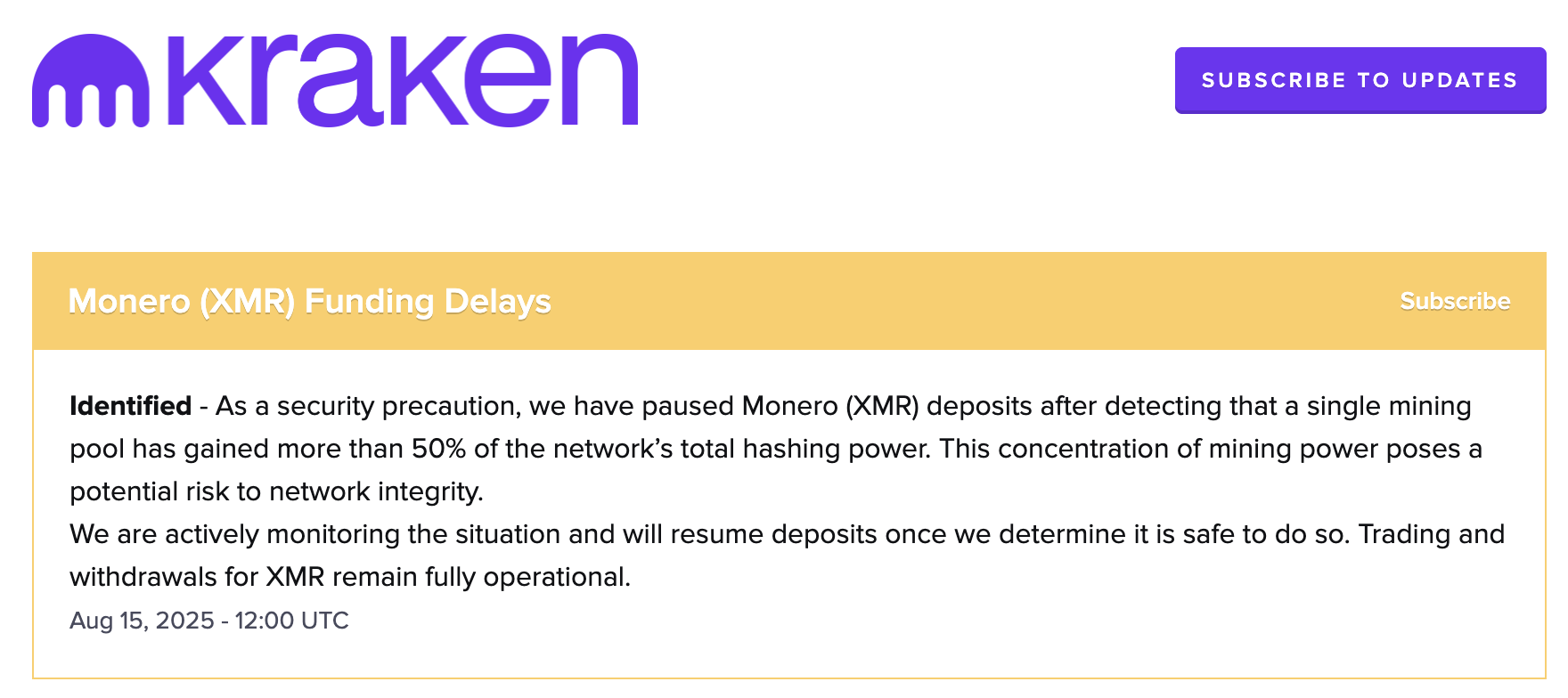
Last week, Qubic stated that its pool had reorganized six Monero blocks, demonstrating the ability to rewrite transaction history—an event that triggered the Kraken exchange to temporarily pause Monero deposits. While the network continued operating, the incident sparked wider concerns about vulnerabilities in proof-of-work blockchains.
Dogecoin Wins Vote Over Zcash and Kaspa
After the Monero attack, Ivancheglo asked the Qubic community to vote on which ASIC-enabled network to test next. Dogecoin won by a wide margin, receiving more than 300 votes—more than Zcash and Kaspa combined. With a market capitalization of over $35 billion, Dogecoin now faces the possibility of a similar stress test.
What a 51% Attack Could Mean for Dogecoin
A 51% attack occurs when a single group controls the majority of a blockchain’s mining power, giving it the ability to reorganize blocks, censor transactions, or attempt double-spending. Qubic currently operates a pool with roughly 2.3 GH/s of Monero hashrate, a level that allowed it to dominate Monero’s network. If comparable resources were directed toward Dogecoin, the risks could be significant.
Qubic maintains that its actions are not intended to destroy networks but to test its own mining model, called useful proof-of-work. The group says all mining profits are used to purchase and burn QUBIC tokens. Still, the attacks have raised new concerns about the security of proof-of-work systems, especially when mining power is concentrated in just a few pools.
No Timeline Yet, but Pressure on Developers
While Qubic has not provided a timeline for its move against Dogecoin, the announcement has already drawn attention to the coin’s security framework. Developers and exchanges may be forced to assess potential risks and prepare safeguards in case Qubic follows through.
For now, the crypto community is watching closely as the world’s largest meme coin faces a new kind of test—one that could have implications for the security of proof-of-work cryptocurrencies more broadly.



