

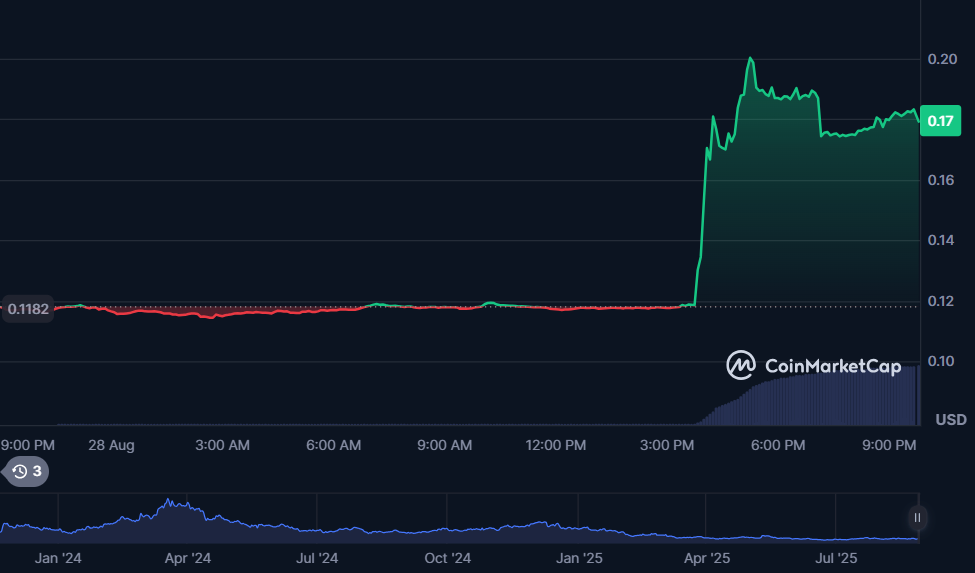
The Pyth Network’s native token (PYTH) surged more than 70% on Thursday after the U.S. Department of Commerce confirmed it would use Pyth and Chainlink to publish official economic data across multiple blockchains. The move marks a significant step in bringing government statistics onchain and highlights the growing role of blockchain oracles in data verification.
According to CoinMarketCap, PYTH briefly peaked above $0.20, its highest level since February, before settling near $0.19, still up roughly 62% on the day. The rally pushed the project’s market capitalization past $1 billion, with trading volumes soaring more than 2,700% in 24 hours.
Blockchain Enters Government Data Systems
The Commerce Department confirmed that key economic indicators, including quarterly GDP figures, will now be distributed across nine blockchains such as Bitcoin, Ethereum, Solana, Tron, Stellar, and Avalanche. Both Pyth and Chainlink were tapped to serve as oracle providers, ensuring the accuracy and secure distribution of this data.
Oracles like Pyth and Chainlink act as bridges, bringing real-world information — such as stock prices, exchange rates, and commodities data — directly onto blockchains. This infrastructure is critical for decentralized finance (DeFi) applications that rely on trusted, real-time data feeds.
The U.S. Department of Commerce has selected Pyth Network to verify & distribute economic data onchain 🏛️
— Pyth Network 🔮 (@PythNetwork) August 28, 2025
Today’s announcement by @howardlutnick & @realDonaldTrump marks a landmark step for the adoption of decentralization & validates Pyth’s role as a trusted data source 🧵 ⬇️ pic.twitter.com/cOvw8lDNhP
A Political Push for Blockchain Adoption
The decision also reflects the Trump administration’s broader embrace of blockchain and digital assets. U.S. President Donald Trump has recently prioritized pro-crypto policies, following controversy over revisions to Bureau of Labor Statistics (BLS) data. Earlier this month, after a major employment data revision, Trump dismissed BLS Commissioner Erika McEntarfer, claiming the figures were politically manipulated.
Last weeks Job’s Report was RIGGED, just like the numbers prior to the Presidential Election were Rigged. That’s why, in both cases, there was massive, record setting revisions, in favor of the Radical Left Democrats. Those big adjustments were made to cover up, and level out,…
— Trump Truth Social Posts On X (@TrumpTruthOnX) August 4, 2025
In response, the administration has accelerated blockchain-based initiatives aimed at enhancing transparency and public trust in government reporting. The move follows the passage of the GENIUS Stablecoin Act, as well as House approval of both a comprehensive market structure bill and an anti-CBDC bill, now awaiting Senate review.
Market Context and Industry Impact
Beyond politics, the use of blockchain for official data underscores the technology’s growing legitimacy. By embedding government statistics directly onchain, authorities aim to reduce doubts about data accuracy while demonstrating blockchain’s utility beyond crypto trading.
Meanwhile, the U.S. Securities and Exchange Commission (SEC) has taken a more crypto-friendly stance under Trump, greenlighting several cryptocurrency ETFs and clarifying that certain liquid staking activities fall outside its jurisdiction.



