
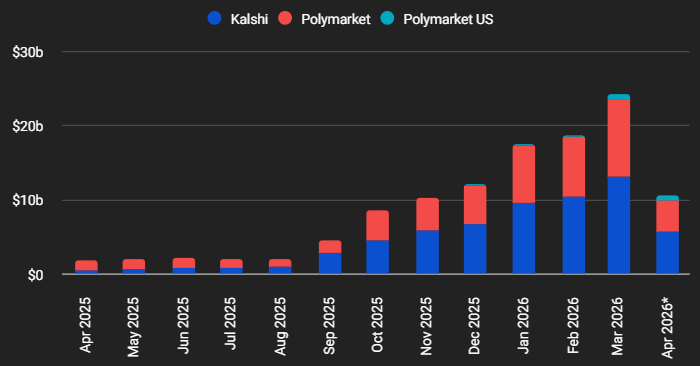
Prediction markets could reach $1 trillion in annual trading volume by 2030, according to Bernstein estimates. The projection signals a shift from niche betting activity toward institutional-grade financial instruments with broader market relevance.
Analysts led by Gautam Chhugani reported that the sector generated $51 billion in volume in 2025, tripling year over year. Growth followed capital rotation from the 2024 U.S. election cycle into sports, crypto, macroeconomic, and political contracts. Platforms including Kalshi and Polymarket have already processed a combined $60 billion in volume this year.
Can Prediction Markets Scale Beyond Sports Dominance?
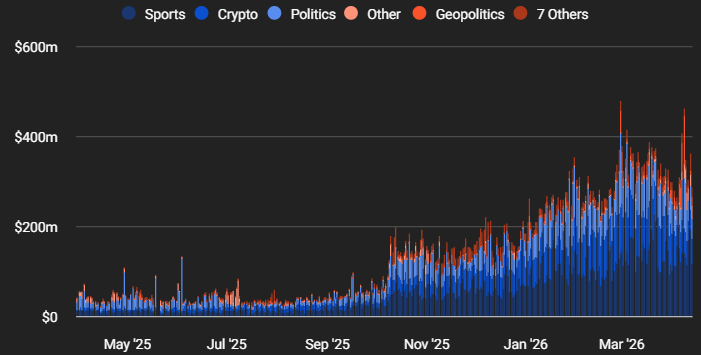
Sports contracts currently account for 62% of total prediction market volume, reflecting strong demand driven by fragmented state-level betting frameworks. But Bernstein expects that share to decline to 31% by 2030 as non-sports categories expand. The shift mirrors broader financialization trends, where event-based exposure competes with traditional derivatives markets.
"Increasing regulatory clarity at the federal level... is expanding the addressable market," the analysts wrote, pointing to the role of the CFTC (US) asserting jurisdiction.
They added that blockchain-based tokenization enables global liquidity, long-tail event creation, and institutional participation across markets.
The report highlights emerging demand from institutional investors seeking exposure to discrete economic and political outcomes. Corporates and insurers are also expected to use these markets for hedging event-specific risks. Could prediction markets evolve into a parallel system for pricing real-world uncertainty?
Revenue growth is tracking volume expansion. Industry annual recurring revenue (ARR) is projected to rise from $400 million in 2025 to $2.5 billion in 2026, with a longer-term outlook of $10.8 billion by 2030. Polymarket alone has reached a $420 million ARR after introducing fees, while Robinhood’s Kalshi-powered hub generated roughly $350 million ARR within its first year.
Distribution remains a key catalyst. Bernstein identifies platforms like Robinhood and Coinbase as critical access layers that can onboard retail and institutional users at scale. The next inflection point may come in 2026, with event-driven demand tied to the FIFA World Cup and U.S. midterm elections.



