

Six crypto wallets earned $989,191 betting on a U.S. strike on Iran before the attack occurred. The trades, recorded on the prediction platform Polymarket, are now driving a legislative push in Washington to restrict wagers tied to government actions.
U.S. Senator Chris Murphy said Wednesday he is drafting legislation that would prohibit prediction market trading on events such as military strikes or political speeches. The proposal follows blockchain analysis from Bubblemaps showing six newly funded wallets placing large bets on a Polymarket contract titled “US strikes Iran by Feb. 28, 2026?” hours before the Feb. 28 operation.
Last Friday, a handful of people made big, unusual $100,000+ bets on Polymarket - that the U.S. would strike Iran the next day.
— Chris Murphy 🟧 (@ChrisMurphyCT) March 4, 2026
The Iran War is fueling a new kind of corruption: White House officials secretly profiting off war.
It's disgusting. We need to ban it. pic.twitter.com/qs0aEzqemD
The largest wallet converted a $60,816 position into $494,375 in profit after buying 560,680 “yes” shares priced at 10.8 cents. Another trader, using the handle “Planktonbets,” reportedly earned $173,907 across seven predictions, while “Dicedicedice” recorded a $119,964 gain from a single bet priced at 20 cents.
Could Insider Knowledge Be Driving Prediction Market Bets?
Prediction markets tied to geopolitics have expanded rapidly as crypto-native platforms gain traction. Data shows February trading volume reached $7.9 billion on Polymarket, while rival platform Kalshi processed $10.4 billion, bringing combined monthly activity to roughly $18.3 billion.
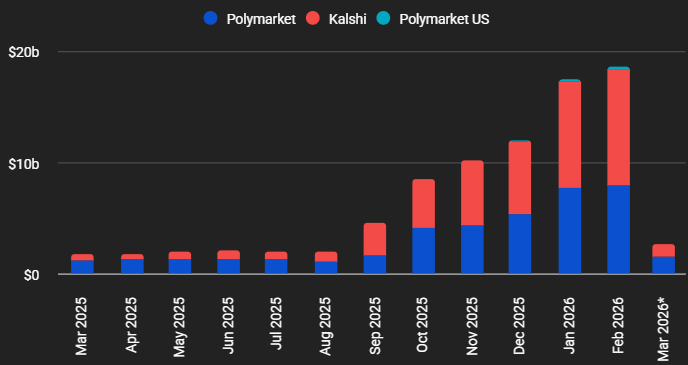
Yet the rapid growth has drawn scrutiny from lawmakers and regulators. Murphy alleged in a video posted to his official account on X that individuals with advance knowledge of the strike may have placed the wagers.
“It is very likely, probable even, that the people that placed those bets were people with inside information,” Murphy said.
The senator warned that allowing bets on military action could create financial incentives around national security decisions.
“If we continue to allow people to bet on war, on military strikes, then you're going to have people inside the situation room making decisions not based on national security,” he said.
Similar concerns have surfaced globally. Israeli prosecutors recently charged an Israel Defense Forces reservist and a civilian with using classified intelligence to bet on the timing of Israel’s 2025 strike on Iran, generating more than $150,000 in profits, according to court filings.
Murphy said the bill will be introduced later this month, with Representative Mike Levin preparing a companion measure in the House. The next catalyst will be whether lawmakers attempt to regulate prediction markets directly or extend existing insider trading frameworks to crypto-based platforms.



