

The British pound is bracing for a turbulent week as traders shift their focus to a series of high-stakes U.S. economic reports, capped by Friday’s Nonfarm Payrolls (NFP) release.
After regaining some ground against the U.S. dollar last week, the GBP/USD pair remains stuck in a consolidation range, trading just above the 1.35 level. The short-term outlook now hinges on how U.S. labor market data will shape expectations for the Federal Reserve’s next policy move.
Fed Dovish Signals Support Pound
The dollar’s recent weakness has been driven by growing expectations of a September interest rate cut from the Federal Reserve. Fed Chair Jerome Powell and several policymakers signaled a dovish tilt, with Governor Christopher Waller openly backing a cut next month and suggesting further reductions could follow within six months to shield the labor market.
New York Fed President John Williams also emphasized that future moves will depend on incoming economic data, reinforcing the market’s reliance on this week’s labor reports.
According to the CME FedWatch Tool, traders now assign an 85–90% probability to a September rate cut.
Political Tensions Add to Dollar Pressure
Beyond economic indicators, politics injected fresh uncertainty into U.S. markets. President Donald Trump’s announcement of plans to fire Fed Governor Lisa Cook sparked legal disputes and revived concerns over the Fed’s independence. Cook, who filed a lawsuit challenging the move, insisted the president has no authority to remove her.
Adding fuel to the debate, Vice President JD Vance told USA Today that the era of a fully independent Fed is effectively over, rattling investor sentiment.
UK Headlines Have Limited Impact
In the UK, Chancellor Rachel Reeves floated the idea of a windfall tax on commercial banks to capture profits linked to Bank of England deposit holdings, according to Bloomberg. However, the news failed to sway the pound, leaving GBP/USD movements largely dictated by U.S. dollar dynamics.
The latest U.S. PCE Price Index—the Fed’s preferred inflation gauge—showed core inflation rising 2.9% in July, in line with expectations. But with no surprises in the data, markets remain firmly focused on jobs numbers.
Data Calendar: A Packed Week
This week’s U.S. data releases are set to dominate trading sentiment:
- Tuesday: ISM Manufacturing PMI
- Wednesday: JOLTS Job Openings
- Thursday: ADP Employment Report, weekly Jobless Claims, ISM Services PMI
- Friday: UK Retail Sales, followed by the U.S. Nonfarm Payrolls, Unemployment Rate, and Average Hourly Earnings
Geopolitical headlines and fresh Fed commentary may add further volatility.
GBP/USD Technical Outlook
From a technical perspective, GBP/USD faces a critical test:
- Resistance: The 50-day SMA at 1.3496 is the next key hurdle, with further topside targets at 1.3590 (double-top high), 1.3681 (July 4 high), and 1.3788 (July 1 high).
- Support: A break below the confluence of the 21-day and 100-day SMAs near 1.3450 could open the door to deeper losses, targeting 1.3300 and potentially the August 4 low at 1.3254.
- The 14-day RSI sits near the midpoint, signaling a cautious stance for buyers.
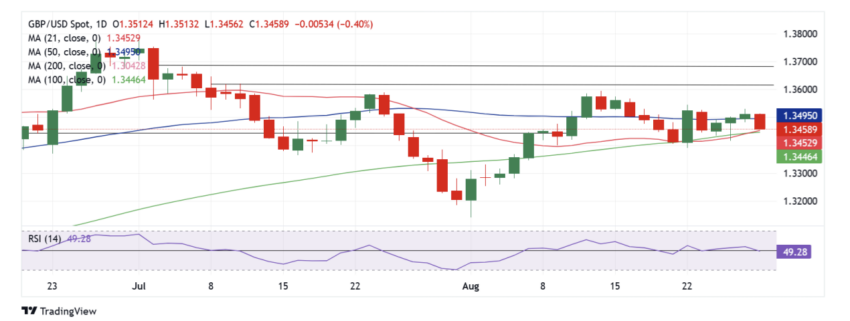
With few domestic catalysts, the pound’s fate this week will be determined in Washington, not London. If U.S. jobs data confirm a cooling labor market, expectations of aggressive Fed cuts could weaken the dollar further—potentially giving GBP/USD the push it needs to break higher. Conversely, stronger-than-expected data may hand control back to dollar bulls.



