
Polymarket is strengthening its position at the center of the prediction market industry, even as overall interest in the sector shows signs of cooling. New Google search data indicates that searches for “Polymarket” have reached an all-time high, while broader searches for “prediction markets” have dropped sharply, highlighting a growing divide between brand recognition and category awareness.
According to Google Trends, search interest for “Polymarket” currently stands at 100, the highest level ever recorded for the platform. This milestone surpasses its previous peak of 99 during the November 2024 U.S. election period, when Polymarket processed roughly $3.7 billion in election-related trading volume. What makes the latest surge notable is that it comes without a similarly high-profile, global political event driving attention.
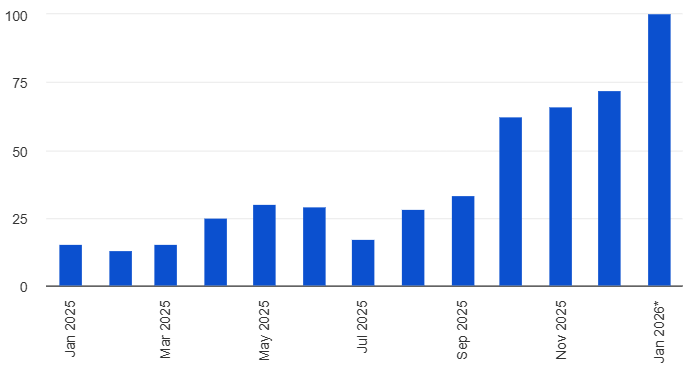
Instead, the data suggests Polymarket has retained user interest well beyond the election cycle. Analysts point to this post-election engagement as evidence that the platform is evolving from a niche election-focused product into broader infrastructure for real-time information and forecasting markets. Users are increasingly turning to Polymarket for insights on topics ranging from politics and economics to sports and technology.
At the same time, interest in the prediction market category as a whole appears to be declining. Searches for the generic term “prediction markets” fell to an index value of 40 in January, down 60 percent from December’s peak of 100. That figure is also well below the category’s historical high, signaling that fewer users are exploring the space in general terms.
This contrast between rising brand searches and falling category searches is drawing comparisons to the early days of Google. In the early 2000s, consumers gradually stopped searching for “search engines” and began searching directly for Google, eventually turning the company’s name into a verb. A similar pattern may be emerging in prediction markets, where Polymarket is increasingly becoming the default reference point.
Competitors are seeing more mixed results. Kalshi, one of Polymarket’s closest rivals, recorded a January search volume of 77. While that remains elevated compared with pre-election levels, it represents a 23 percent decline from December. The data suggests that while interest in prediction markets has not disappeared, a growing share of attention is concentrating around Polymarket specifically.
Industry observers say this shift has meaningful implications. When users search for a brand rather than a category, it can reinforce network effects. New users arrive where liquidity is already deepest, forecasts are most active, and outcomes are most visible. Over time, this dynamic can make it harder for competitors to attract attention or persuade users to switch platforms.
Market activity supports the idea that prediction markets are still expanding, even if search interest is narrowing. On Sunday, total trading volume across prediction markets exceeded $800 million, marking an all-time daily high. That pace puts the sector on track to set a new monthly volume record, suggesting that engagement among active participants remains strong.
For Polymarket, the combination of record search interest and sustained trading activity points to a platform that has moved beyond a single use case. While elections remain a major driver of volume, the data indicates that many users now see Polymarket as a general-purpose tool for gauging collective expectations in real time.
As prediction markets continue to mature, the gap between brand leaders and the broader category may widen further. Whether this trend continues will depend on how platforms innovate, expand access, and navigate regulatory environments across different regions.
For now, the latest figures make one thing clear: even as general curiosity about prediction markets fluctuates, Polymarket’s name recognition and mindshare are reaching new heights.



