

OpenAI’s latest partnership with AMD sent shockwaves through both the AI and semiconductor markets this week — and it may be about more than just hardware. The AI giant’s decision to pour billions into the U.S. chipmaker appears designed not only to accelerate its computing power but also to keep competition alive in an industry increasingly dominated by Nvidia.
OpenAI’s $100 Billion Chip Strategy
Earlier today, OpenAI announced a major deal with AMD to deploy around 6 gigawatts of GPUs — a massive order that sent AMD’s market capitalization soaring by roughly $100 billion. CEO Sam Altman described the deal as “a major step toward realizing AI’s full potential.”
Just weeks earlier, OpenAI revealed plans to invest $100 billion in Nvidia hardware as well, further cementing the chipmaker’s central role in the AI ecosystem. Together, the two partnerships highlight OpenAI’s strategic balancing act: supporting both key suppliers to avoid overreliance on a single dominant player.
This is insane:
— The Kobeissi Letter (@KobeissiLetter) October 6, 2025
AMD stock, $AMD, extends gains to +35% on the day after its deal with OpenAI.
AMD is on track for its biggest single-day market cap gain in history. pic.twitter.com/K4ee8untqe
Some market observers believe the AMD announcement even contributed to trading platform outages on Robinhood, as the company’s stock surged on record volume.
Nvidia’s Dominance — and AMD’s Catch-Up Moment
Nvidia’s rise has been nothing short of extraordinary. The company is now one of the “Magnificent 7” tech stocks — alongside Apple, Amazon, Microsoft, and others — and has become the default supplier for AI chips. Its GPUs power nearly every major AI model, including those from OpenAI, Anthropic, and Google DeepMind.
So basically OpenAI wants AMD to stick around so it doesn’t become dependent on NVIDIA? When they did their NVIDIA deal, NVIDIA bought OpenAI shares, now this time OpenAI is getting AMD warrants
— Matthew Zeitlin (@MattZeitlin) October 6, 2025
By contrast, AMD’s growth has been steadier but slower. Despite impressive products like its MI300 series GPUs, the company’s share price had stagnated over the past month. That changed overnight. OpenAI’s partnership sparked renewed investor optimism, giving AMD a rare boost in its long-standing rivalry with Nvidia.
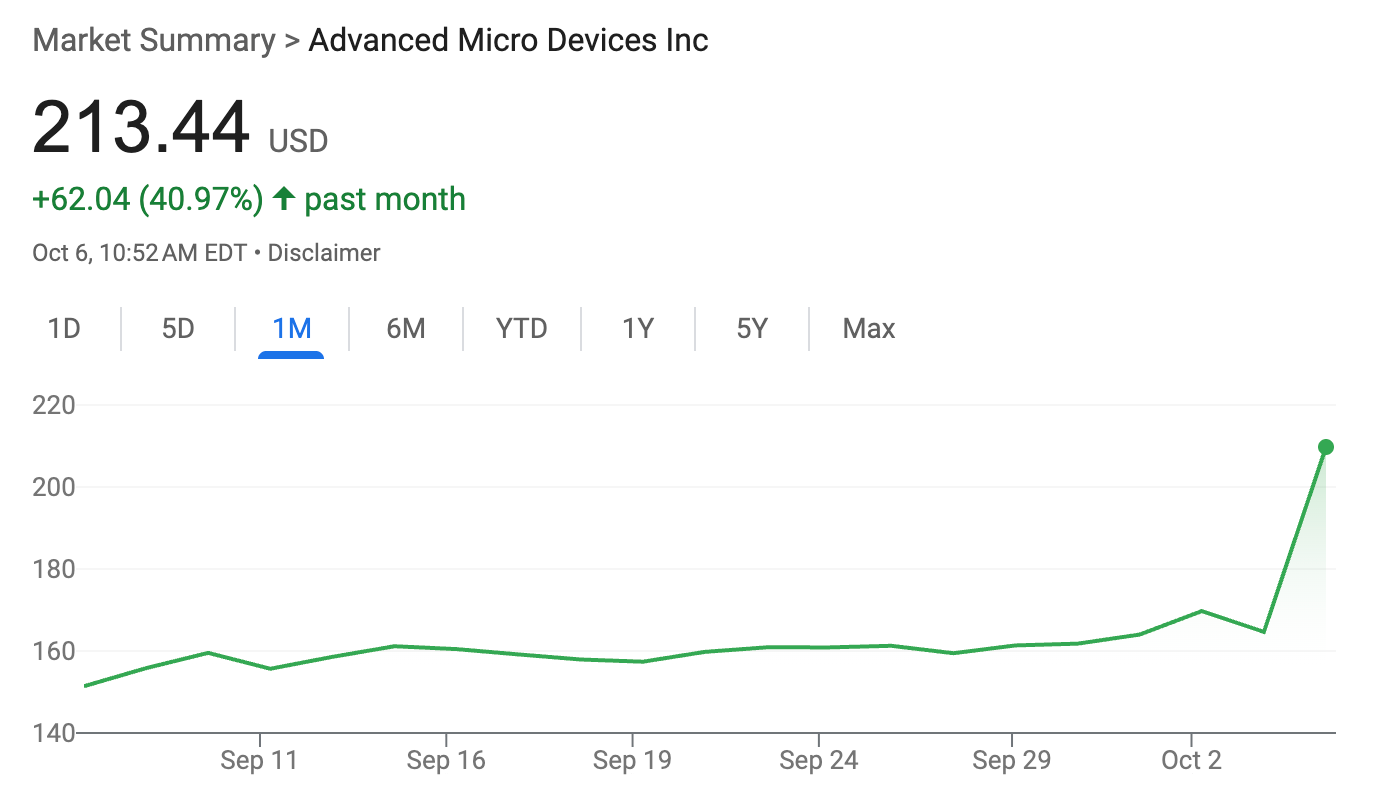
As of Monday, AMD’s valuation jumped sharply, helping it re-enter discussions about viable alternatives in the AI chip race.
A Hedge Against an AI Hardware Monopoly
OpenAI’s dual-chip strategy could be as much about risk management as performance. By spreading its investments between Nvidia and AMD, the company ensures redundancy and flexibility in its hardware supply chain — a critical safeguard at a time when AI demand is exploding.
There’s also a broader policy dimension. With Chinese manufacturers developing competitive chips and U.S. export restrictions tightening, keeping multiple American chip firms strong could be vital for national competitiveness.
If Nvidia were to become the sole dominant supplier, analysts warn it could stifle innovation, drive up costs, and slow the pace of AI progress. By contrast, OpenAI’s AMD partnership injects new life into domestic competition — effectively preventing a near-monopoly in one of the most crucial technology sectors of the decade.
The Bigger Picture
The timing of this deal couldn’t be more important. The AI industry is facing mounting concerns about an overheated market, with investors pouring billions into data centers, chips, and startups chasing generative AI’s promise.
But while some call this the makings of a bubble, OpenAI’s latest move suggests a more measured and strategic approach — one that strengthens the AI ecosystem rather than concentrating power in a single company’s hands.
If successful, OpenAI’s bet on AMD could not only reshape chip economics but also safeguard the competitive spirit that drives technological innovation.
Key Takeaways
- OpenAI announced a multi-billion-dollar deal with AMD, boosting its market cap by roughly $100 billion.
- The AI firm also plans to invest heavily in Nvidia, balancing its chip supply chain between the two U.S. giants.
- The move could prevent monopoly conditions in the U.S. semiconductor market and maintain competition in AI hardware.
- Analysts see this as a strategic hedge against overdependence on Nvidia amid rapid AI industry growth.
OpenAI’s new AMD deal isn’t just a procurement decision — it’s a strategic play to keep the U.S. AI hardware market competitive. In an era when chips are the new oil, OpenAI may be quietly ensuring no single company controls the pipeline.



