
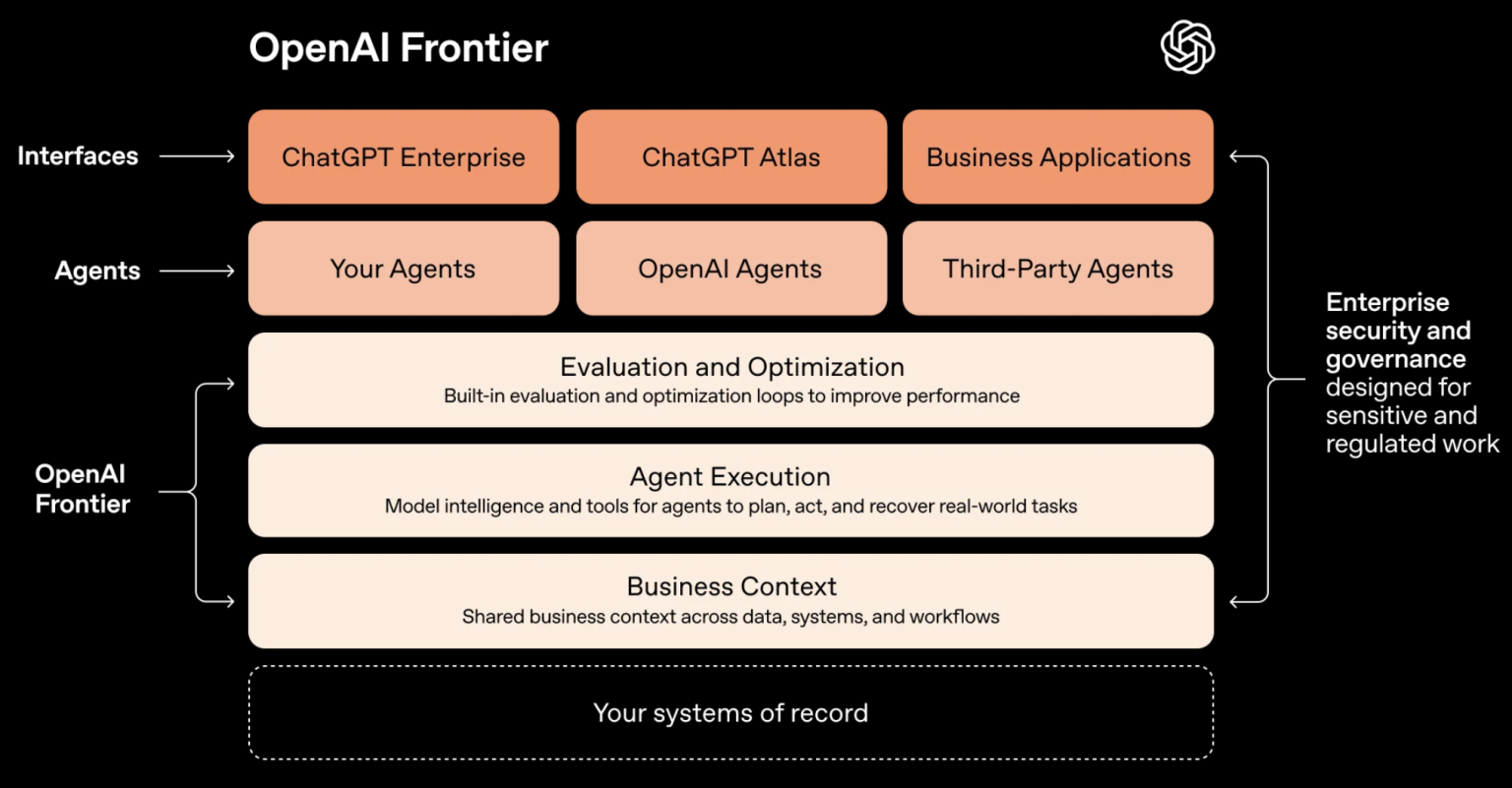
OpenAI’s Frontier platform is targeting the core economics of enterprise software. The system connects internal tools, data platforms, and business applications so artificial intelligence agents can operate with the same context as human employees.
OpenAI introduced Frontier in February as a platform for deploying enterprise AI agents across company systems. Early users include Uber, State Farm, Intuit, and Thermo Fisher Scientific, signaling early adoption among large organizations.
The company describes the agents as “AI coworkers” that can be onboarded with identities, permissions, and measurable performance. According to OpenAI chief financial officer Sarah Friar, enterprise clients already generate roughly 40% of company revenue, with a goal of increasing that share to around 50% by the end of the year.
Will AI Agents Disrupt The SaaS Seat License Model?
Frontier is designed to act as a shared semantic layer connecting tools such as data warehouses, CRM systems, ticketing platforms, and internal applications. Instead of each AI agent building its own data connections, the system provides centralized context so multiple agents can work across the same operational framework.
The architecture attempts to address a common problem in enterprise AI deployments. Many companies experiment with individual agents, but each requires separate integrations and governance controls, creating new layers of complexity rather than reducing them.
Early deployments suggest measurable operational gains. OpenAI cited one global investment firm where Frontier agents automated sales workflows, freeing more than 90% of salesperson time previously spent on administrative tasks. Another technology company reportedly saved 1,500 hours per month in product development cycles.
Fidji Simo, OpenAI’s CEO of Applications, described the integration challenge during the launch briefing.
“We spent months integrating each of the ones that we selected,” she said, referencing her experience leading Instacart’s technology operations. “Each tool was good for one use case, but they weren’t integrated or talking to one another.”
The platform’s broader significance lies in how it could reshape the software industry’s pricing model. Traditional software-as-a-service (SaaS) products rely heavily on per-user seat licenses, where revenue scales with the number of employees accessing a system.
 Jeremy Kahn
If AI agents begin handling workflows previously performed by human users, that model could face pressure. Concerns about agent-driven disruption have already weighed on some enterprise software stocks, including Salesforce, which has seen its share price decline more than 27% this year despite continued revenue growth.
SaaS providers are adapting quickly. Salesforce has introduced a fixed-price enterprise licensing model for its Agentforce platform, while ServiceNow and Microsoft have begun experimenting with consumption-based pricing tied to AI usage.
The emerging competition reflects a deeper strategic question. Should AI agents operate inside existing software systems or above them as an orchestration layer?
Frontier currently sits in the second category, acting as an overlay connecting multiple enterprise tools. Broader availability is expected in the coming months, and enterprises evaluating the platform will watch closely whether it becomes a coordination layer across existing software—or a system capable of replacing parts of it.



