

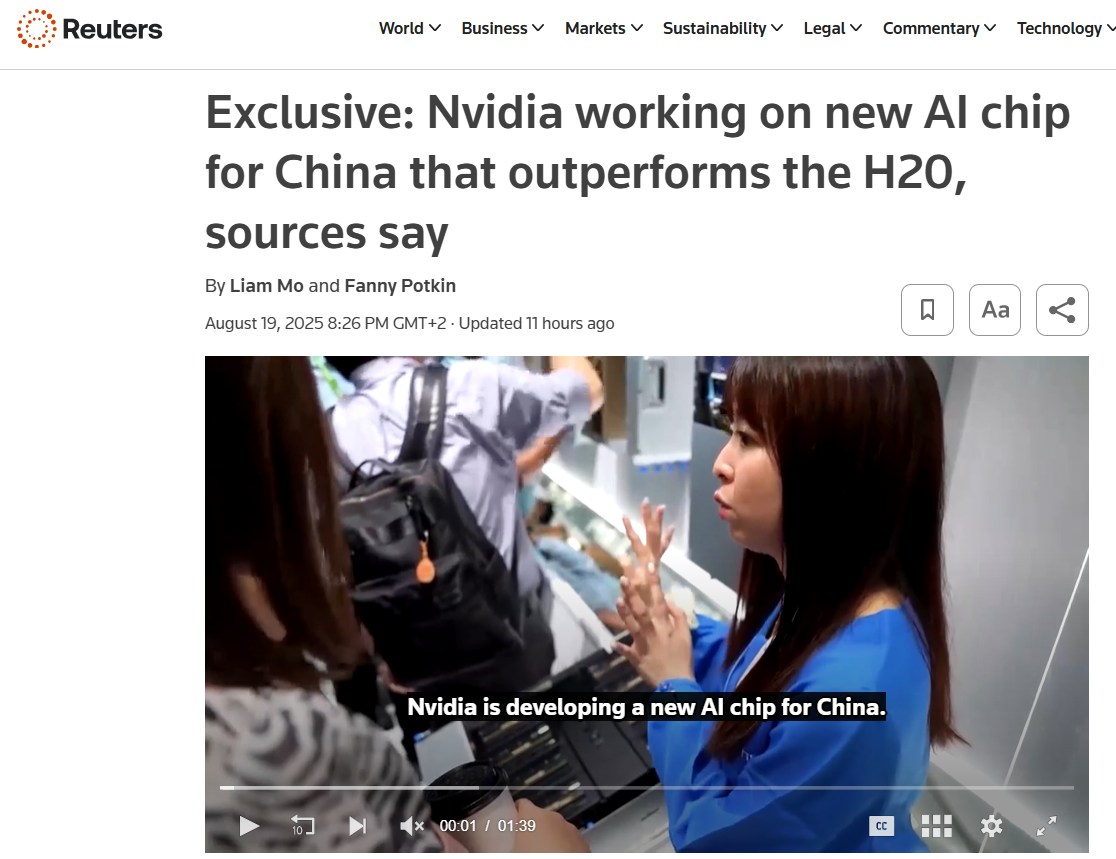
Nvidia is reportedly preparing a new AI chip for the Chinese market that could outperform its current H20 model, according to sources familiar with the plans cited by Reuters. The move underscores the company’s delicate balancing act as it tries to maintain a presence in China while navigating U.S. export restrictions on advanced semiconductors.
A China-Specific Blackwell Chip
The new chip, internally referred to as the B30A, will be built on Nvidia’s Blackwell architecture, the company’s latest generation of AI processors. Unlike Nvidia’s flagship B300, which uses a dual-die design, the B30A will feature a single-die structure. People with knowledge of the project said this would likely give the B30A about half the performance of the B300 but still stronger capabilities than the H20 currently available in China.
Like the H20, the B30A is expected to include high-bandwidth memory and Nvidia’s NVLink technology, which enables fast data transfer between processors. Final specifications are not yet confirmed, but Nvidia hopes to send test samples to Chinese clients as early as next month.
In a statement, Nvidia said: “We evaluate a variety of products for our roadmap, so that we can be prepared to compete to the extent that governments allow. Everything we offer is with the full approval of the applicable authorities and designed solely for beneficial commercial use.”
U.S. Scrutiny and Trade Tensions
The development comes as U.S.–China trade tensions over advanced chips intensify. Washington remains cautious about granting Beijing access to cutting-edge AI hardware, citing concerns over national security and technological advantage.
U.S. President Donald Trump recently hinted that more advanced Nvidia chips could eventually be sold in China, though approval remains uncertain.
Commerce Secretary Howard Lutnick confirmed that Nvidia CEO Jensen Huang has lobbied directly for authorization, noting: “Of course he would like to sell a new chip to China. The president listens to our great technology companies, and he’ll decide how he wants to play it.”
China accounted for 13% of Nvidia’s revenue last year, making it a critical market despite regulatory hurdles. Nvidia only resumed sales of the H20 in July after U.S. regulators paused shipments earlier this year. The H20 itself was developed in 2023 specifically to comply with export rules.
Rivalry and Risk
While Nvidia and rival AMD have agreed to share a portion of their China sales revenue with the U.S. government under new arrangements, lawmakers in Washington remain divided. Some argue that even scaled-down chips could bolster China’s AI capabilities, while chipmakers warn that restricting sales entirely would push Chinese buyers toward domestic alternatives such as Huawei.
Huawei’s latest AI chips are said to rival Nvidia’s in processing power, though analysts note they still lag in memory speed and software integration. Meanwhile, Chinese state media has warned local companies about potential security risks in Nvidia’s hardware, criticism the U.S. chipmaker has rejected.
Another China-Focused Chip in the Pipeline
Alongside the B30A, Nvidia is also preparing the RTX6000D, another Blackwell-based product aimed at AI inference tasks. The RTX6000D will be cheaper and less powerful than the H20, using standard GDDR memory and running just below new U.S. export thresholds.
Small shipments of the RTX6000D are expected to begin reaching Chinese customers in September.



