

Stablecoins pegged to currencies other than the U.S. dollar are carving out a growing niche in 2025, rebounding after a brief slowdown earlier this year. While dollar-backed tokens like USDT and USDC still dominate global markets, non-USD stablecoins are driving real-world crypto adoption in regions where local currency use makes more sense than defaulting to the dollar.
Latin America Leads the Charge
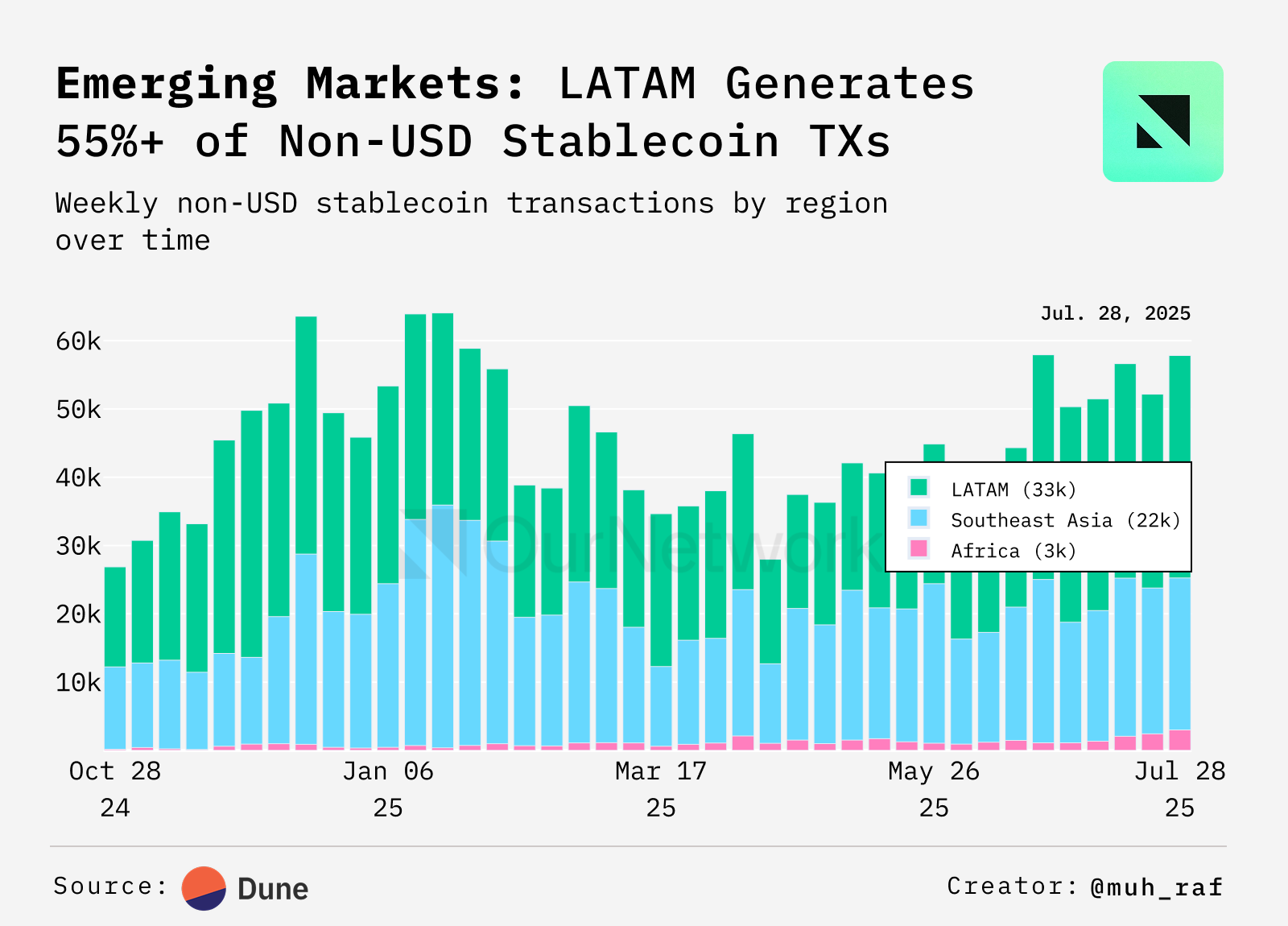
Latin America has emerged as the clear leader in this trend, with Brazil accounting for more than half (55%) of global non-USD stablecoin volume, according to on-chain data from the first half of 2025. Activity in the region now surpasses Southeast Asia and Africa combined, highlighting the growing appetite for stable, digital alternatives to volatile national currencies.
Non-USD stablecoins aren’t just a side story anymore.
— Shann³ (@shannholmberg) August 25, 2025
From Q4 2024 to August 2025, 23 different non-USD stablecoins across Southeast Asia, LATAM, and Africa pushed 20k+ weekly transactions, with peaks above 60k in early 2025.
> The biggest drivers: SGD- and BRL-pegged… pic.twitter.com/cxMgHmP8u1
These tokens aren’t just being traded—they’re being used. With more than 23 non-USD stablecoins seeing over 20,000 weekly transactions, their role in everyday payments, remittances, and local commerce is becoming harder to ignore.
Polygon Dominates the Infrastructure
The rise of non-USD stablecoins has also put a spotlight on the blockchains supporting them. Polygon currently hosts around 70% of this activity, far outpacing competitors such as Ethereum, BNB Chain, and Base. On average, Polygon has seen over 4,000 active addresses tied to these assets every week for the past year, giving it a strong first-mover advantage.
If adoption keeps climbing, Polygon could become the backbone for this corner of the market—strengthening its case as more than just a scaling solution for Ethereum.
Why Non-USD Stablecoins Matter
For years, crypto advocates have touted cross-border payments and financial inclusion as killer use cases. Yet Bitcoin and Ethereum, once pitched as currencies, have largely evolved into store-of-value assets instead of everyday payment tools.
Non-USD stablecoins may succeed where others stalled. Unlike Bitcoin, they don’t carry speculative price swings, and unlike USD-pegged tokens, they allow users to transact directly in their local currency. That makes them particularly useful in places where residents would rather spend in reals, pesos, or euros than constantly convert to dollars.
There’s also a decentralization angle. While dominant platforms like Tether and Circle are massive but highly centralized, smaller non-USD stablecoins are exploring more open, decentralized models that could reshape how stable digital money works.
Still a Small Slice of the Market
Despite the momentum, the numbers remain modest compared to the giants of the stablecoin world. Tether alone processes billions of dollars daily, while non-USD stablecoins are only scratching the surface with tens of thousands of weekly transactions.
But what they lack in size, they make up for in practical adoption. In regions where crypto is still searching for everyday relevance, non-USD stablecoins may prove to be the most useful—and sustainable—on-ramp.
Bottom Line
Non-USD stablecoins are unlikely to dethrone dollar-backed tokens anytime soon. But in Latin America, Europe, and parts of Asia, they’re showing that crypto adoption doesn’t have to revolve around the dollar. If this growth continues, they could quietly become one of the most important building blocks for real-world blockchain utility.



